Software development for the manufacturing sector — NextAge

Technology for the manufacturing sector

Custom software and specialized teams to connect the shop floor, data, and management in one integrated digital operation.

Manufacturing brands that
grew with us
Growth icon

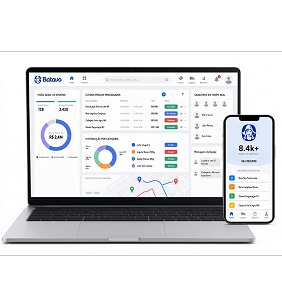
Batavo case
Batavo logo

One of the largest dairy brands in Brazil, a benchmark for quality and innovation in the food sector.

We developed a custom platform for event management, unifying registration, logistics, and real-time tracking in a single digital environment.

Services:
Software projects
Batavo
Batavo WEG Scania Munters Pado Agraria Coop Bom Jesus Vapza Positivo Sanepar Rumo Amfresh Banco Bari

Modernize your industrial ecosystem with NextAge

Tailor-made systems to bring control and efficiency to your operation.

Production planning and scheduling

a system to plan and sequence production, optimizing the use of resources, machines, and shifts with real-time visibility.

Quality control and inspection

software for quality control, automating checklists, recording non-conformities and traceability at every production stage.

Supply chain management

a platform designed to connect suppliers, inventory, and logistics in a digital flow with end-to-end visibility.

ERP and CRM integration

development of custom integrations between ERPs, CRMs, and legacy systems, unifying operations, sales, and relationship data.

Workplace safety

a system for workplace safety management and regulatory compliance, centralizing standards, audits, and training.

Energy management and efficiency

a tool to monitor and optimize energy consumption, identifying waste and cost-reduction opportunities with dashboards.

NextAge manufacturing technology specialist

Let's design together the solution your industry needs to grow.

Advantages of developing with NextAge

Digital transformation across every area of your business

Icon

Reduced unplanned downtime

With intelligent systems and predictive maintenance, your plant anticipates failures and keeps production running.

Icon

Operational visibility

Dashboards and integrated systems that connect shop floor, inventory, logistics, and management in real time.

Icon

Traceability and compliance

Systems that simplify audits, meeting regulatory standards and shielding your operation from compliance risks.

Icon

Cost reduction

Process automation and intelligent data analysis that identify inefficiencies and eliminate rework.

Icon

Greater integration

We connect ERPs, CRMs, legacy systems, and new platforms into a unified digital ecosystem.

Icon

Scalability

Teams and architectures ready to scale along with your production volume.

// ABOUT
NX

Why NextAge?

Learn our story →

Founded in 2007, NextAge was born to make software development more disruptive, human, and effective.

Innovation has always been at our core. We revolutionized the technology market with Staff Augmentation, our exclusive methodology that brings up to 40% more productivity to teams.

And we didn't stop there! We went further with NextFlow AI, a new way of developing that combines AI and human expertise in every line of code.

Today, we are the partner that transforms complexity into clarity and accelerates your operation with the best talent.

NextAge Office

Learn more

Want to learn more about how NextAge can help your business? Explore articles from our blog, testimonials from our clients, and our other services to drive your digital transformation the right way.

Loading content...

Questions and answers

How can technology improve efficiency in manufacturing?
Technology improves industrial efficiency by automating manual processes, integrating systems such as ERP and MES, and providing real-time data on production, inventory, and logistics. With custom systems and applied artificial intelligence, it is possible to reduce waste, predict machine failures, and make faster, data-driven decisions. NextAge develops these solutions with managed teams and a proprietary methodology, ensuring that every project delivers concrete results with predictability.
What is digital transformation in manufacturing?
Digital transformation in manufacturing is the process of replacing manual controls and isolated systems with integrated digital platforms that connect the entire operation. This includes process automation, IoT, data analysis with artificial intelligence, and mobile apps for collecting information in the field. The goal is to gain visibility, efficiency, and control over every stage of production.
What are the main challenges of industrial digitalization?
The main challenges include integration with legacy systems, cultural resistance to change, the shortage of IT professionals specialized in the industrial context, and the difficulty of keeping technology projects within schedule and scope. That is why it is essential to have a partner who understands both technology and project management. NextAge solves these challenges with stable teams, a methodology with clear metrics, and 19 years of experience in complex deliveries.
How can artificial intelligence be applied in manufacturing?
AI can be applied in manufacturing in many ways: predictive maintenance that anticipates equipment failures, computer vision for automated quality inspection, demand forecasting to optimize production planning, intelligent document processing, and risk analysis across the supply chain. All of these applications reduce costs, minimize unplanned downtime, and make the operation more efficient and predictable.
What is the difference between off-the-shelf software and custom software for manufacturing?
Off-the-shelf software addresses generic needs and often requires the company to adapt its processes to the tool. Custom software, on the other hand, is built to fit the specific reality of the industrial operation, respecting existing workflows, integrations, and business rules. For manufacturers with complex processes or specific regulatory requirements, custom software offers greater fit, scalability, and return on investment.
How do I choose a technology company for manufacturing projects?
The ideal is to look for a partner with proven experience in industrial projects, a transparent management methodology, stable teams, and the ability to work with different technology stacks. Avoid companies that only allocate professionals without committing to the outcome. NextAge stands out by combining managed outsourcing with its proprietary NextFlow AI methodology, which guarantees delivery predictability and clear metrics at every stage of the project.
What is predictive maintenance and how does it work?
Predictive maintenance is the use of data and artificial intelligence to predict when a piece of equipment will fail, allowing maintenance to be performed before the breakdown. It works by collecting data from sensors installed on machines (vibration, temperature, pressure) that are analyzed by AI models trained to identify deterioration patterns. The result is a drastic reduction in unplanned downtime and in corrective maintenance costs.
How do I integrate legacy systems with new digital platforms in manufacturing?
Integrating legacy systems with new platforms requires mapping existing data flows, developing custom APIs and middleware, and a gradual migration plan that does not halt the operation. It is one of the most common and most critical projects in industrial digitalization. NextAge has experience connecting ERPs, MES, legacy systems, and modern platforms, creating a unified digital ecosystem without operational disruption.
What are the benefits of using mobile apps in industrial operations?
Mobile apps bring information to where the action happens: the shop floor, the warehouse, the field. With them, operators can record production entries, run quality checklists, open maintenance tickets, and control inventory in real time, all from a phone. This eliminates paperwork, reduces typing errors, speeds up the flow of information, and gives management immediate visibility into what is happening in the operation.
How long does a digital transformation project take in manufacturing?
The timeline varies with complexity and scope, but well-managed projects deliver their first results within two to four months. The most important thing is not to do everything at once, but to start with the processes that most impact the operation and evolve incrementally. With NextAge's NextFlow AI methodology, each stage has a reference scope, tracking metrics, and validated deliveries, ensuring the project moves fast without losing control.

Your industry has the challenge. NextAge has the method, the team, and the technology.