NextAge Node.js development team

Company specialized in Node.js

NextAge connects you with experienced Node.js specialists, guaranteeing productivity from day one. Do what 600 companies did and accelerate your projects with us.

+19 years of experience
+600 companies served
+150 professionals
+13 countries

What does a Node.js development company deliver?

See the types of projects NextAge delivers with a dedicated squad, fixed scope and guaranteed SLA. Understand when Node.js is the most solid technical choice for your roadmap.

Node.js logo
NextAge Node.js specialist
High-performance RESTful APIs

REST and GraphQL APIs built in Node.js for system integration, communication with mobile apps and secure data exposure to third-party services. NextAge guarantees an OpenAPI-documented contract, JWT and OAuth2 authentication and an architecture sized for the request volume projected by the business.

Technologies: Express.js, NestJS, Fastify, GraphQL, Swagger/OpenAPI, JWT, OAuth2

Real-time applications

Instant communication systems built in Node.js for corporate chats, push notifications, live dashboards and collaborative platforms. NextAge sustains thousands of simultaneous connections with state synchronization across instances, reliable message delivery and predictable resource consumption under horizontal scale.

Technologies: Socket.io, WebSockets, Redis Pub/Sub, RabbitMQ, Firebase

Microservices architecture

Decomposition of monolithic systems into independent Node.js microservices, organized by business domain and deployed autonomously. NextAge defines the communication contracts between services, the API Gateway layer and the distributed observability that keeps the platform traceable end to end.

Technologies: NestJS, Docker, Kubernetes, RabbitMQ, gRPC, Kong API Gateway

E-commerce platforms and marketplaces

Online sales systems built in Node.js with catalog management, search, checkout, payments and multi-vendor operation. NextAge delivers server-side rendering to preserve product page indexing, elastic scalability for traffic peaks and integration with payment and anti-fraud gateways.

Technologies: Next.js, Stripe, PagSeguro, MongoDB, Redis, Elasticsearch

Financial systems

Financial applications built in Node.js for payment processing, wallet management, integration with banking and Open Finance APIs and compliance routines. NextAge implements a complete audit trail, encryption of sensitive data at rest and asynchronous queue-based processing of critical operations.

Technologies: NestJS, PostgreSQL, Redis, AWS KMS, TypeORM, Bull Queue

Enterprise integrations and middleware

Integration layers built in Node.js to connect ERPs, CRMs and legacy systems to new applications without rewriting the installed base. NextAge normalizes data between incompatible models, handles source unavailability with retries and circuit breakers and logs every transaction for auditing.

Technologies: Node.js, Express, Axios, Apache Kafka, SAP Integration, Webhooks

System migration and modernization

Modernization of legacy systems to Node.js and TypeScript through incremental replacement, with the current operation responding in production throughout the transition. NextAge defines the migration order by criticality, validates each module with automated tests before the final cutover and keeps rollback available at every stage.

Technologies: Node.js, TypeScript, Docker, PostgreSQL/MySQL, automated testing

DevOps and process automation

CI/CD pipelines and observability for Node.js applications, with tests run on every commit, containerization and zero-downtime deployment strategies. NextAge delivers application metrics, centralized logs and actionable alerts, turning the time between completion and production into a metric tracked by management.

Technologies: Docker, Kubernetes, GitHub Actions, Jenkins, Prometheus, Grafana, PM2

… and whatever else it takes for your digital transformation to happen now.

NextAge + Node.js solutions

Proprietary methodologies and specialized services to maximize results in projects that use Node.js

Staff Augmentation

Allocation of full-stack and back-end developers specialized in Node.js to accelerate your project. Our expertise in microservices architecture guarantees the team delivers clean, scalable code in an agile way.

Choose it if you need to scale your development team with Node.js professionals who guarantee performance and adherence to market best practices

Java.NET / C#JavaScriptTypeScriptPythonRubyPHPGoKotlinSwift
Spring BootDjangoFlaskFastAPIRuby on RailsLaravelReact.jsAngularVue.jsNode.js
NextAge specialist ready to talk about your Node.js project

Get the best Node.js developers on your project

Hundreds of Node.js projects delivered

We have a solid Node.js portfolio. Everything you need for software at the highest technical and strategic level.


Mockup of the system built for Coopercarga
Coopercarga

We evolved a complex logistics management system in Node.js and React. Our team took over maintenance and the development of new features with a microservices architecture. The result was unified fleet management with real-time tracking, scalability and more value added to the system.


Services: Staff Augmentation

Want results like these in your company?

What sets our Node.js developers apart?

→ The differentials that made NextAge the number 1 choice of market leaders

Validated professionals

Our team is rigorously trained and validated before joining the project. You work with professionals who have already solved complex problems similar to yours.

Learning curve

Unlike traditional staffing, our teams are actively managed by us. Tech leads monitor developer performance and alignment with your goals, accelerating the learning curve.

Quality and testing culture

AI-powered automated testing, code review and CI/CD are part of our DNA. We deliver tested, production-ready code, reducing bugs and rework.

More agility

We adopt truly agile methodologies. Well-planned sprints, incremental deliveries and transparent communication. You follow progress in real time.

Knowledge as a foundation

Complete command of the Node.js ecosystem, Express, NestJS, Fastify and modern JavaScript best practices in every line of code.

Cultural alignment

Our teams understand the context and culture of companies. Clear communication, productive meetings and natural alignment with technical and business stakeholders.

// ABOUT
NX

Why NextAge?

Learn our story →

Founded in 2007, NextAge was born to make software development more disruptive, human, and effective.

Innovation has always been at our core. We revolutionized the technology market with Staff Augmentation, our exclusive methodology that brings up to 40% more productivity to teams.

And we didn't stop there! We went further with NextFlow AI, a new way of developing that combines AI and human expertise in every line of code.

Today, we are the partner that transforms complexity into clarity and accelerates your operation with the best talent.
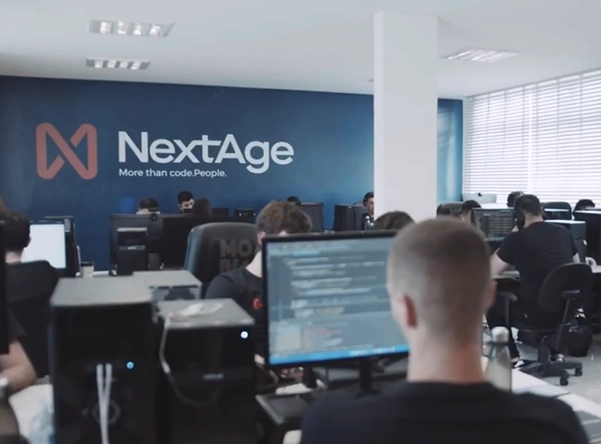
NextAge office

Learn more

Want to understand more about how NextAge can help your business? Explore articles from our blog, testimonials from our clients and our other services to carry out your digital transformation in the best way.

Loading content...

Questions and answers

When should you use Node.js instead of Java, Python or Go on the back-end?
Node.js is the right choice when the system load is dominated by input/output operations, database calls, third-party APIs and integrations, because its non-blocking model serves thousands of simultaneous connections without allocating a thread per request. Java tends to be preferable in corporate systems with heavy internal transactional processing, Python in data and machine learning workloads, and Go in very high-concurrency, CPU-intensive services. Development companies with broad stack expertise, like NextAge, make this choice in the architecture phase, based on the system's load profile rather than technology preference.
How do you hire Node.js developers for a corporate project?
There are three ways to hire Node.js developers: in-house hiring, contracting independent professionals, and outsourcing a managed team. In-house hiring offers more control but depends on a long recruiting cycle and concentrates attrition risk in the company. Independent contractors are fast to onboard, but have the highest turnover and no replacement guarantee. Managed outsourcing combines allocation speed with contractual stability. NextAge operates in this third model, with Node.js developers hired as full-time employees and professional replacement guaranteed in the contract.
How long does it take to hire a Node.js developer?
An in-house selection process for a Node.js developer usually takes one to three months, adding up job posting, screening, technical interviews, negotiation and the candidate's notice period. The timeline grows with the seniority required, since professionals experienced in asynchronous architecture and distributed systems are in demand and rarely actively looking. Outsourcing companies shorten this cycle because they keep continuous technical assessment of professionals, delivering already-vetted candidates. At NextAge, the allocation timeline is defined in the commercial proposal, according to the seniority and requirements of the project.
How do you assess whether a Node.js developer is truly senior?
Seniority in Node.js is not measured by years using the framework, but by understanding the event loop and the consequences of the asynchronous model. A senior professional knows how to identify what blocks the main thread, designs heavy processing outside the request flow, handles failures of external systems with retries and circuit breakers, and masters typing, testing and observability. Questions on these topics separate those who understand the architecture from those who just write endpoints. NextAge applies technical validation with this focus before any professional works on a client project.
Is it worth outsourcing Node.js development?
Outsourcing Node.js development pays off when the bottleneck is execution capacity, not product definition: a growing backlog, tight time to market and in-house hiring unable to keep up. It does not pay off when the company lacks scope clarity and minimum technical management capacity, because no vendor fixes a lack of direction. The safest model is one where the product decision stays with the company and the partner answers for execution and technical quality, which is how NextAge structures Node.js squads under the client's management.
What are the risks of outsourcing a Node.js team and how do you reduce them?
The three main risks of outsourcing a Node.js team are professional turnover, loss of system knowledge when someone leaves, and the absence of reliable progress metrics. Reducing these risks requires three contractual guarantees: a stable bond between the professional and the vendor, documentation and context handover built into the process, and periodic quality and progress reports. Contracts that only account for hours worked protect against none of these risks. NextAge covers all three with full-time employees, replacement guaranteed in the contract, and progress and development health reports.
Is Node.js safe for financial systems and critical applications?
Yes. Node.js is used in production by financial institutions for payment processing, banking integrations and Open Finance, scenarios dominated by network calls, where the asynchronous model delivers more transactions per server. Security in this context depends less on the language and more on the architecture: a complete audit trail, encryption of sensitive data at rest, queue-based processing of critical operations and isolation of CPU-heavy routines in dedicated services. NextAge builds financial systems in Node.js with these four controls applied from the architecture up.
How do you modernize a legacy system to Node.js without stopping operations?
Modernization without interruption is done through incremental replacement: one module at a time is rewritten in Node.js and put into production behind a routing layer, while the old system keeps answering for the remaining functionality. The critical point is the migration order, which should start with the lowest-risk modules to validate the architecture before touching the core of the operation. Automated tests comparing old and new behavior before each cutover make rollback possible at any stage. It is the method NextAge applies in modernization projects.
How do you guarantee code quality from an outsourced Node.js team?
The quality of an outsourced team is guaranteed by a verifiable process, not by trust in the vendor. Three mechanisms sustain it: technical validation of professionals before allocation, systematic code review on every commit and tracking of objective quality metrics every sprint. Contracts that only measure feature delivery allow technical debt to pile up silently. NextAge applies AI-assisted code review through the NextFlow AI methodology, with quality metrics reported to the manager throughout development.
What makes up the cost of a Node.js development team?
The cost of a Node.js team goes far beyond the developer's salary. With in-house hiring, add payroll taxes, benefits, infrastructure, recruiting costs and idle time between projects. There is also the invisible cost of turnover: each departure consumes weeks of productivity in offboarding, a new hire and the replacement's learning curve. With managed outsourcing, these components are consolidated into a predictable amount per allocated professional. NextAge structures the proposal with this breakdown in the open, according to seniority and squad size.

Have a Node.js project to get off the ground? NextAge guarantees delivery