
Company specialized
in JavaScript
NextAge builds software in JavaScript and provides specialized teams with predictable delivery and data-driven management. Less rework, more control over your roadmap.
What does a JavaScript
development company deliver?
See the types of projects NextAge delivers with a dedicated squad, fixed scope and guaranteed SLA. Understand when JavaScript is the most solid technical choice for your roadmap.


Front-end development
JavaScript is the foundation of virtually every modern web interface, from e-commerce to corporate dashboards. NextAge builds fast, accessible, component-based interfaces, with a front-end architecture designed to scale without piling up technical debt.
Technologies: React, Next.js, Angular, Vue.js, TypeScript, Redux, Tailwind CSS
Back-end development with Node.js
Node.js makes it possible to use JavaScript on the server as well, with high performance in applications that handle many simultaneous requests. NextAge designs scalable, well-structured back-ends for web and mobile applications, with typed, tested code ready to grow with the business.
Technologies: Node.js, NestJS, Express, Fastify, TypeScript, PostgreSQL, MongoDB, Redis
API creation and integration
REST and GraphQL APIs built in JavaScript for integration between systems, communication with third-party services and secure data exposure. NextAge ensures proper versioning, robust authentication, clear documentation and consistent performance in every endpoint delivered.
Technologies: NestJS, Express, GraphQL (Apollo), Swagger/OpenAPI, OAuth2, JWT, API Gateway
Mobile and cross-platform applications
With JavaScript, iOS and Android apps can be built from a single codebase, reducing cost and delivery time. NextAge delivers apps with near-native performance, a consistent experience across platforms and simplified maintenance.
Technologies: React Native, Expo, TypeScript, Ionic, Electron
Real-time applications
JavaScript and Node.js are ideal for systems that require instant communication, such as chats, live dashboards, notifications and tracking. NextAge builds event-driven architectures that keep data in sync between users and systems with low latency and high availability.
Technologies: WebSocket, Socket.IO, Node.js, Redis Pub/Sub, Apache Kafka, RabbitMQ
Legacy application modernization
Applications built with AngularJS, jQuery or untyped JavaScript can be migrated to modern architectures without interrupting operations. NextAge performs framework migration, TypeScript adoption, incremental refactoring and test coverage, with controlled risk and full predictability.
Technologies: Migration to React/Angular/Vue.js, TypeScript, Jest, Cypress, Docker, cloud migration
… and whatever else it takes for your digital transformation to happen now.
NextAge + JavaScript solutions
Proprietary methodologies and specialized services to maximize results in your JavaScript projects
Staff Augmentation
Allocation of specialist JavaScript teams. Unlike the traditional model, you get senior developers, JavaScript architects, tech leads and QAs focused on automated testing, all managed by us. We guarantee continuous code review and JavaScript architecture standards.
Choose it to scale JavaScript teams without the risks of traditional staffing

Get the best JavaScript
developers on your project
Hundreds of IT projects delivered
We have a solid project portfolio. Everything you need for software at the highest technical and strategic level.

Brazilian telecom operator with 67 million customers.
Challenge
In telecom, retaining customers is far cheaper than acquiring new ones. The company couldn't scale due to manual campaigns, lack of real-time data, and mistimed outreach that were pushing costs up and customer satisfaction down.
Solution
NextAge transformed raw data into meaningful customer relationships. We developed an AI agent platform that created personalized campaigns and journeys tailored to each customer, combining discounts, cross-selling, and cashback to drive maximum value.
Results
+6,7%
in revenue and retention
+12%
in satisfaction and engagement
-37%
in marketing costs



Want results like these in your company?
What sets our JavaScript
developers apart?
→ The differentials that made NextAge the number 1 choice of market leaders
Validated professionals
Our team is rigorously trained and validated before joining the project. You work with professionals who have already solved complex problems similar to yours.
Learning curve
Unlike traditional staffing, our teams are actively managed by us. Tech leads monitor developer performance and alignment with your goals, accelerating the learning curve.
Quality and testing culture
AI-powered automated testing, code review and CI/CD are part of our DNA. We deliver tested, production-ready code, reducing bugs and rework.
More agility
We adopt truly agile methodologies. Well-planned sprints, incremental deliveries and transparent communication. You follow progress in real time.
Knowledge as a foundation
Our JavaScript developers also have experience with databases (PostgreSQL, MongoDB, Redis), cloud (AWS, Azure), DevOps (Docker, CI/CD) and automated testing. Command from front-end to back-end, with a complete view of the ecosystem.
Cultural alignment
Our teams understand the context and culture of companies. Clear communication, productive meetings and natural alignment with technical and business stakeholders.

Why NextAge?
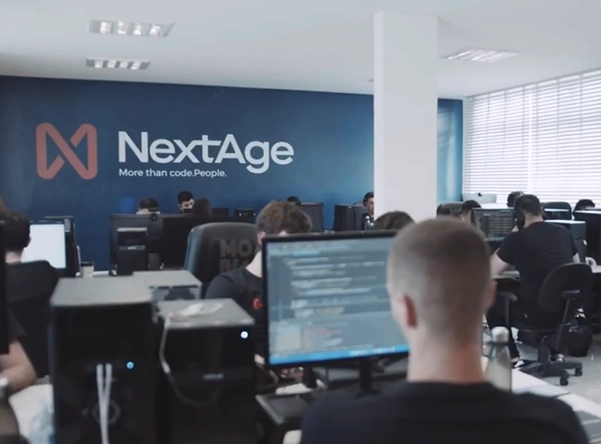
Founded in 2007, NextAge was born to make software development more disruptive, human, and effective.
Innovation has always been at our core. We revolutionized the technology market with Staff Augmentation, our exclusive methodology that brings up to 40% more productivity to teams.
And we didn't stop there! We went further with NextFlow AI, a new way of developing that combines AI and human expertise in every line of code.
Today, we are the partner that transforms complexity into clarity and accelerates your operation with the best talent.
Learn more →
Want to understand more about how NextAge can help your business? Explore articles from our blog, testimonials from our clients and our other services to carry out your digital transformation in the best way.
Loading content...