 English
  Português
By 2027, ten technologies common in corporate environments today are expected to lose relevance, as Zero Trust architecture, agentic AI, and incremental modernization take the place of static, legacy solutions. Below is the executive list: what’s losing ground, why, and what’s replacing each item.
It’s a trend reading based on reports from Gartner, KPMG, McKinsey, and Deloitte, cross-referenced with what we’ve observed in real modernization projects. The 2027 timeline isn’t arbitrary: it’s the horizon most of these studies use to mark the shift from an “AI experimentation” phase to an “execution with return on investment” phase (Gartner, 2027).

What Makes a Technology “Obsolete” in a Corporate Context
Obsolescence, in this context, isn’t synonymous with age. A system can be ten years old and still be the best option for what it does; another can have launched two years ago and already be lagging behind the pace of competition. The difference lies in function: an obsolete technology is one that still works, but no longer competes.
In practice, this shows up as rising maintenance costs, difficulty integrating with new tools (especially AI), exposure to security risks, and a loss of speed relative to competitors who have already modernized. Legacy systems, by definition, carry all four of these characteristics at once.
Why 2027 Is the Pivotal Year
Multiple institutes converge on the same timeframe. Gartner estimates that, by 2027, companies will use three times more small, task-specific AI models (SLMs) than generic LLMs, which requires structured data platforms as a prerequisite (Softdesign, based on Gartner). Gartner also projects up to a 70% reduction in modernization costs by 2027, driven by generative AI tools applied to the migration process itself (Framework Digital).
KPMG’s Global Tech Report 2026 shows that 88% of organizations already incorporate AI agents into their workflows, products, and value chains, and that high-performing professionals expect roughly half of their technology teams to be made up of humans by 2027 (with the rest orchestrated by agents) (KPMG Global Tech Report 2026). The report also notes that static IT planning is becoming obsolete given the pace of innovation.
The Executive List: 10 Technologies That Will Lose Relevance by 2027
1. Corporate VPN as the Sole Layer of Remote Access
What’s changing: the “once inside the network, full trust” model is losing ground.
Why it’s losing relevance: known, unpatched vulnerabilities in perimeter technology have already caused one of the largest data breaches in corporate history; the Equifax case, which affected 147 million people, originated from an Apache Struts flaw whose patch had been available for months before the attack but wasn’t applied in time (Blog ITSS).
What’s replacing it: Zero Trust Network Access (ZTNA), with continuous verification based on identity and context rather than network location.
Estimated timeline: 2026-2027, a priority in regulated industries.
2. Classic Rule-Based RPA
What’s changing: bots that follow rigid scripts, with no ability to make decisions in the face of exceptions, are falling behind the pace of business.
Why it’s losing relevance: Forrester’s “Predictions 2026: AI Agents” report projects that AI agents will fundamentally change business models by taking over the execution of entire processes, not just providing point support for repetitive tasks (IT2B, based on Forrester).
What’s replacing it: Agentic AI, with autonomous agents capable of decision-making and coordination with one another.
Estimated timeline: transition already underway, consolidating by 2027.
3. Mainframes and COBOL/AS400 Systems Without an API Layer
What’s changing: critical systems that only communicate through proprietary integrations, without API exposure, block any automation or AI initiative.
Why it’s losing relevance: the biggest obstacle to implementing AI in large corporations isn’t the algorithm, it’s the infrastructure these solutions try to run on; companies that remain dependent on this type of legacy hardware feel the direct impact on performance, cost, and their ability to innovate (Axians, based on Gartner).
What’s replacing it: incremental modernization with an API gateway, connecting the legacy core to modern architectures without a full replacement.
Estimated timeline: decision window through 2027; after that, the cost of delay grows nonlinearly.
4. Password-Only Authentication
What’s changing: login and password as the sole access factor, without biometrics or robust MFA, no longer meets minimum corporate security standards.
Why it’s losing relevance: market movement already points to passwords being replaced by biometric login (facial recognition, fingerprint) as the standard, not the exception (Human Resources Portugal).
What’s replacing it: passwordless authentication and biometrics integrated into corporate devices and applications.
Estimated timeline: accelerated adoption through 2027.

5. Decision-Tree Chatbots and IVR (Fixed-Menu Support)
What’s changing: support flows built on pre-defined options (“press 1 for…”) are losing ground to more natural interactions.
Why it’s losing relevance: companies still relying solely on this model face the same limitation as classic RPA: a lack of decision-making capacity in the face of exceptions, which creates friction and drives up the cost of escalating to human support.
What’s replacing it: conversational AI agents, integrated with CRMs, capable of interpreting context and acting on the customer journey.
Estimated timeline: already being replaced at more mature companies.
6. Overnight Batch ETL for BI
What’s changing: processes that refresh data once a day (or once per shift) can no longer support decisions that require real-time information.
Why it’s losing relevance: Gartner highlights that real-time-driven organizations will achieve higher levels of predictability and agility, anticipating scenarios and reacting quickly to critical events (Instituto ME, based on Gartner).
What’s replacing it: real-time (streaming) data pipelines, with structured data platforms serving as the foundation for AI.
Estimated timeline: consolidation by 2027, driven by AI’s demand for data.

7. Spreadsheets as the “Database” for Critical Processes
What’s changing: financial, operational, or risk controls kept in parallel spreadsheets, without governance or auditability, become a liability.
Why it’s losing relevance: there’s no reliable predictive analysis when data is scattered across multiple spreadsheets, nor security in an architecture that wasn’t designed to handle today’s volume and sensitivity of data (Entelgy).
What’s replacing it: structured platforms with centralized data, version control, and audit trails.
Estimated timeline: growing urgency as AI adoption over this data increases.
8. Manually Scripted Testing in Spreadsheets or Documents
What’s changing: QA that relies on manual scripts, executed by people with every new system version, can’t keep pace with continuous delivery cycles.
Why it’s losing relevance: automated test coverage, now AI-enhanced, reduces production bugs and generates real-time reports, something that’s not feasible at scale through purely manual work.
What’s replacing it: AI-assisted end-to-end test automation, regression scenarios, and assisted code review.
Estimated timeline: already standard among high-performing squads; likely to become a minimum requirement by 2027.
9. Customized On-Premise ERPs Without a Cloud Strategy
What’s changing: local ERP installations, heavily customized over the years, become expensive to maintain and difficult to update.
Why it’s losing relevance: studies indicate that companies spend between 70% and 80% of their IT budget just maintaining old systems, leaving only 20% to 30% for new projects; a Deloitte report found an average of 57% of IT budgets consumed by legacy system support. Organizations that keep running these systems spend up to 42% more in operational costs than those that have already migrated (Framework Digital).
What’s replacing it: incremental modernization toward cloud-native architectures, preserving the business value already validated.
Estimated timeline: decision window through 2027.
10. “Body Shop” Outsourcing Without Active Management
What’s changing: the model in which the vendor simply recruits and places professionals, without tracking productivity or delivery quality, is losing competitiveness.
Why it’s losing relevance: it lacks continuous technical validation, cultural alignment, and predictability; the result tends to be high turnover and rework, exactly when 69% of IT leaders already point to accumulated technical debt as a major threat to their ability to innovate.
What’s replacing it: outsourcing models with active management by Tech Leads, along with technical and behavioral validation of professionals.
Estimated timeline: already being replaced at more mature companies.
Summary Table
| Technology | Risk | Timeline | Replacement |
|---|---|---|---|
| VPN as the sole access layer | High | 2026-2027 | Zero Trust (ZTNA) |
| Classic rule-based RPA | High | Underway | Agentic AI |
| Mainframe/COBOL without API | High | Window through 2027 | Incremental modernization + API gateway |
| Password-only authentication | Medium | Through 2027 | Passwordless / biometrics |
| Decision-tree chatbot / IVR | Medium | Already being replaced | Conversational AI agents |
| Overnight batch ETL | Medium | Through 2027 | Real-time data pipelines |
| Spreadsheets as a critical database | High | Growing urgency | Structured platforms with governance |
| Manually scripted testing | Medium | Already being replaced | AI-powered test automation |
| Customized on-premise ERP | High | Window through 2027 | Cloud-native (incremental modernization) |
| Outsourcing without active management | Medium | Already being replaced | Squads with continuous technical management |
The Cost of Inaction: Technical Debt by the Numbers
Technical debt is the accumulated cost of short-term technical decisions that compromise maintainability, security, and performance in the long run. It rarely shows up as a single line item in the budget; instead, it manifests in a distributed way: in the IT team spending more than 25% of its time firefighting on systems that should already be stable (a benchmark cited by Gartner), and in more than 20% of new project budgets being quietly consumed by legacy fixes (a McKinsey benchmark) (Entelgy).
The most visible symptom tends to be strategic paralysis: initiatives with deadlines set by leadership get postponed or scrapped because “the foundation can’t support it.” When two of these three signals appear at the same time (excessive time spent on corrective maintenance, innovation budget captured by legacy systems, and projects blocked by architectural limitations), modernization stops being an isolated technical decision and becomes a matter of competitive continuity.
Modernizing Everything at Once Isn’t the Answer, Neither Is Waiting
Faced with this scenario, the temptation is to choose one of two extremes: replace everything at once (the so-called rip-and-replace) or delay the decision until the system stops working. Both are high-risk paths. The approach that has proven most effective in the market is incremental modernization: evolving the system in controlled stages, supported by specialized squads and, increasingly, by AI applied to the modernization process itself (code refactoring, documentation, regression testing).
That’s the rationale behind NextAge’s Sustentação & Modernização (Support & Modernization) service: dedicated squads that migrate legacy systems (such as mainframes without APIs, customized on-premise ERPs, or spreadsheets used as critical databases) to cloud-native architectures without disrupting the client’s operations, combining refactoring, performance optimization, and continuous support under a defined SLA. In practice, one of NextAge’s cases illustrates this well: a fashion and luxury marketplace operating in 12 countries was facing a technical debt of more than 1,400 cataloged bugs; with a dedicated agile squad and AI-assisted test automation, 100% of critical bugs were resolved, 89% of the total backlog was eliminated, and checkout conversion increased by 12%.
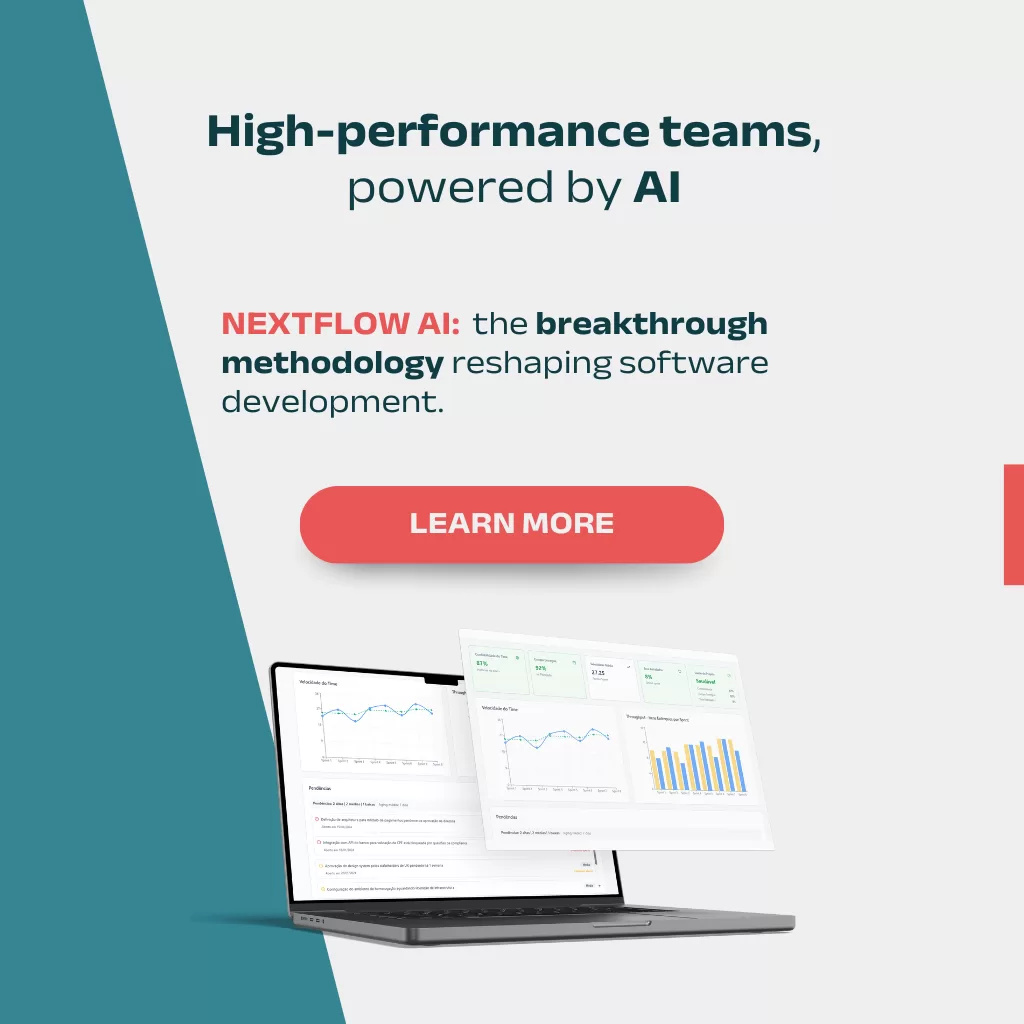
NextAge’s proprietary NextFlow AI methodology, which combines human expertise with AI at every stage of development, is exactly what makes this pace possible: up to a 10x increase in coding and documentation speed, and up to a 40% reduction in delivery time compared to the traditional development model.
When the bottleneck isn’t the architecture itself but the decision and process execution layer (the case of classic RPA and fixed-menu IVRs), the path usually runs through Agentes de IA (AI Agents): conversational and decision-making agents, integrated with ERPs and CRMs, with continuous adaptive learning. In a project for a telecommunications operator with 67 million customers, NextAge developed AI agents that run personalized campaigns and journeys based on each customer’s profile; the result was a 6.7% increase in revenue and retention, a 12% rise in satisfaction and engagement, and a 37% reduction in marketing costs.
How to Prioritize: Risk vs. Migration Effort Matrix
Not every legacy technology needs to be treated with the same urgency. A simple framework helps organize the decision:
- High risk, low effort: immediate priority. These are the “quick wins,” such as replacing password authentication with passwordless or closing a VPN gap with Zero Trust.
- High risk, high effort: require planning and clear executive sponsorship; these are typically mainframes without APIs and customized on-premise ERPs.
- Low risk, low effort: can go on the mid-term roadmap, without urgency, but shouldn’t be forgotten.
- Low risk, high effort: usually the least deserving of immediate investment; reassess periodically.
Before deciding which quadrant each system falls into, it’s common for companies to lack real visibility into their dependency on each legacy technology. A structured discovery and strategic mapping process, like the one offered through Ideação & Blueprint, is usually the first step before any large-scale modernization decision.
Executive Checklist: How to Know If Your Company Is at Risk
- Does more than 20% of the IT budget go toward corrective maintenance of legacy systems?
- Does the technical team spend more time fixing problems than building new capabilities?
- Have strategic projects already been postponed because “the foundation can’t support it”?
- Are there critical systems (mainframe, customized ERP) maintained by a small number of professionals with specific, hard-to-replace knowledge?
- Does any critical business process still rely on parallel spreadsheets, without governance or an audit trail?
- Have AI initiatives already run into integration limitations with older systems?
If the answer was “yes” to three or more of these, modernization has stopped being an IT topic and has become a matter of business continuity.
Frequently Asked Questions
Which technologies will become obsolete by 2027?
Among the main ones are corporate VPN as the sole access layer, classic rule-based RPA, mainframes without an API layer, password-only authentication, decision-tree chatbots, overnight batch ETL, spreadsheets used as critical databases, manually scripted testing, customized on-premise ERPs, and outsourcing without active management.
Why are legacy systems a risk for companies?
Because they concentrate maintenance costs, make it harder to integrate with AI and new tools, and become more vulnerable to security failures, since they receive fewer updates and depend on technical knowledge that’s increasingly rare in the market.
How much does it cost to maintain a legacy technology?
Studies indicate that companies spend between 57% and 80% of their IT budget solely on maintaining old systems, and that organizations that don’t modernize spend up to 42% more in operational costs than those that have already migrated.
What replaces legacy systems today?
It depends on the case, but the most common paths are incremental modernization (with an API gateway) toward cloud-native architectures, replacing classic RPA and IVRs with AI agents, and adopting Zero Trust in place of VPN as the sole security layer.
Is it worth fully modernizing or replacing a legacy system?
In most cases, no. Full replacement (rip-and-replace) is the highest-risk approach and has been losing ground to incremental modernization, which evolves the system in controlled stages without disrupting operations.
What is technical debt and how does it impact the IT budget?
Technical debt is the accumulated cost of short-term technical decisions that compromise maintainability, security, and performance in the long run. In practice, it consumes a significant portion of the IT budget through corrective maintenance, reducing the space available for innovation.
Conclusion
The 2027 timeline shouldn’t be read as an alarming deadline, but rather as a decision window. Companies that treat this list as a diagnostic tool, prioritizing what represents the highest risk with the lowest migration effort, will reach 2027 with a competitive advantage; those that delay the decision will end up in the same place, just paying more for it.
If your company wants to understand exactly where the highest-risk points are in its technology environment and what the most efficient modernization path looks like, NextAge’s specialists can help structure that diagnostic. Talk to our specialists and find the best solution for your challenge.