 English
  Português
Managing a software factory means managing results, not people. The client defines goals, priorities and acceptance criteria, and tracks deliverables, quality and indicators; the factory manages the team, architecture and process. To make it work, combine a clear discovery phase, defined roles, governance on a regular cadence, measurable SLAs and verifiable transparency.
Anyone who has hired a software factory knows the risk: status reports with no working software, budget surprises, decisions made in conversations nobody recorded. This guide shows how to avoid that scenario, with practices you can apply in your next meeting with your vendor.
30-second summary
- Define who decides: a Product Owner on the client side and a single point of contact at the factory.
- Start with discovery: scope, prioritized backlog and estimate before any coding.
- Choose the right model: fixed scope, dedicated squad or support and evolution.
- Track 3 to 7 indicators covering delivery, stability, quality and business.
- Demand evidence: a demo every sprint, plus access to the board and the code.

What does it mean to manage a software factory?
It means steering the outcome of the delivery, not the daily work of the developers. There are two scenarios: you hire a software factory (the most common) or you lead an in-house one. This article focuses mainly on the first, with a final section for the second.
At NextAge’s software factory, for example, a complete team handles the entire cycle, from discovery to system evolution, while the client tracks deliverables, indicators and results. This is what sets a factory apart from staff augmentation, where the team follows the client’s management. If you are still comparing models, read the guide Software Factory vs Outsourcing and the article on the difference between a software factory and a software house.
Market context explains why the model is in such demand. A Brasscom study released in December 2021 estimated a demand for 797,000 ICT professionals in Brazil between 2021 and 2025, with a shortfall of 106,000 per year: the country trains around 53,000 against a need of 159,000 (Convergência Digital, on the Brasscom study, in Portuguese). For many companies, hiring a software factory is a pragmatic response to this scarcity. Outsourcing execution, however, does not eliminate the need for management: it only changes what you manage.
Who manages what: client and factory
The client manages product and value; the factory manages team, architecture, quality and delivery. Putting this split in writing prevents most expectation conflicts. The table below is a starting point, to be adapted to your contract.
| Activity | Client | Factory |
|---|---|---|
| Product vision and business goals | Decides | Supports |
| Backlog prioritization | Decides | Estimates and flags technical dependencies |
| Acceptance criteria and sign-off on deliverables | Decides | Proposes and demonstrates |
| Budget and deadline | Approves | Estimates and tracks |
| Team composition and management | Informed | Responsible |
| Architecture and technical decisions | Consulted | Responsible |
| Quality (testing and code review) | Tracks indicators | Responsible |
| Continuous delivery and environments | Informed | Responsible |
| Technical and schedule risks | Decides mitigations that affect scope | Identifies and reports |
| Scope changes | Decides | Analyzes impact on schedule and cost |
| Documentation and knowledge transfer | Validates | Responsible |
| Relationship with users and business areas | Responsible | Supports |
How to manage a software factory: 10 practices
1. Start with a discovery that reduces uncertainty
Most schedule overruns are born before the first commit. Discovery maps goals, users, processes, integrations and risks, and produces three artifacts: a clear scope, a prioritized backlog and an estimate of timeline and investment. Without it, the project starts with requirements that each side interprets differently.
In its Deep Discovery, NextAge runs this mapping before development, with a realistic estimate of timeline and investment. The common mistake is to start developing without acceptance criteria; the antidote is to begin coding only when the initial backlog has an owner and a definition of done.
2. Define who decides: Product Owner and point of contact
Every factory needs a counterpart on the client side with the authority to prioritize and approve. That is the Product Owner (PO), responsible for the vision and the backlog. On the vendor side, a project manager or Process Owner is accountable for the team and its working environment. This separation between product owner and process owner is recommended by guides on managing outsourced teams.
Also record the escalation path: who decides when there is a conflict, and within what time frame. Decisions by committee and a backlog with no owner are the most frequent symptoms of missing roles.
3. Choose the engagement model based on the nature of the demand
Each model requires a different kind of management. At NextAge, there are three: fixed scope, dedicated squad, and support and evolution.
| Model | How it works | Best for | What you manage |
|---|---|---|---|
| Fixed scope | Price and deadline set for an approved scope | Projects with clear requirements | Milestone acceptance and formal change requests |
| Dedicated squad | Exclusive team, fixed monthly fee and SLA | Products in continuous evolution | Backlog, priorities and sprint goals |
| Support and evolution | Team dedicated to maintaining and evolving production systems | Critical systems that cannot stop | Incident SLA and improvement roadmap |
Be careful with fixed scope when requirements change every week: each change becomes a negotiation. If you prefer to direct the team yourself, Outsourcing 2.0 offers vetted professionals who follow your management. For criteria on choosing a partner, see how to choose a software factory .
4. Build layered governance on a regular cadence
Governance is not a status meeting; it is a set of recorded decisions made at different rhythms. In 2025 research on IT outsourcing, Gartner points out that weak formal governance tends to lead to ineffective management and failed contracts, and proposes five dimensions: relationship, operational, demand, value and innovation (Gartner summary).
A practical cadence, which is a suggestion of this guide and not a Gartner prescription:
- Daily (factory team): blockers and plan for the day.
- Every two weeks: demo, retrospective and sprint planning, with the PO and the point of contact.
- Monthly: indicators, risks, changes and SLA, with the IT manager and the factory manager. Output: minutes with decisions and owners.
- Quarterly: value delivered, roadmap, goal review and innovation, with the executive sponsor.
5. Contract SLAs and KPIs that measure results
A good SLA (service level agreement) measures outcomes, not hours worked. Gartner recommends outsourcing contracts with transparent, outcome-based models and shared accountability (Gartner summary, March 2026).
Choose 3 to 7 indicators, each with a formula, data source, target and quarterly review. DORA, the research program at Google Cloud, defines five software delivery performance metrics: change lead time, deployment frequency, failed deployment recovery time (throughput), change fail rate and deployment rework rate (instability). According to DORA, speed and stability are not opposites.
| Category | Indicator | How to measure |
|---|---|---|
| Delivery (DORA) | Change lead time; deployment frequency | From commit to production; deployments per period |
| Stability (DORA) | Change fail rate; recovery time; deployment rework rate | % of deployments needing immediate intervention; time to restore; % of unplanned deployments |
| Predictability | Sprint goal met; schedule and scope variance | Planned vs delivered |
| Quality | Critical bugs in production; automated test coverage | Count and percentage |
| Business | One indicator tied to the goal (conversion, operating cost, NPS) | Baseline and target set in discovery |
| Support | Response and resolution time by severity | Hours, by ticket type |
Two cautions, both raised by DORA itself: apply the metrics per application or service, without comparing very different systems, and avoid rigid targets, which encourage gaming the number instead of real improvement.
6. Build quality into the process, not the end
Quality that depends on “QA tests it later” arrives late and costs more. The minimum you should require: dedicated QA, automated tests, code review and a definition of done that includes a deployable increment in a staging environment. Track test coverage, critical bugs in production and the change fail rate.
NextAge’s Quality Center applies dedicated QA, automated testing and AI-assisted code review to every delivery. When evaluating any vendor, ask to see the pipeline and the merge criteria, not just the promise.
7. Demand verifiable transparency
Transparency means being able to inspect, not receiving reports. A useful practice is the “24-hour artifacts test,” described by Selleo: at any moment, ask the team for a backlog change, a merged piece of code and a demoable increment in staging from the last 24 hours. If the team cannot show them, progress is not verifiable.
In practice, combine a demo every sprint with working software, access to the project board and the repository, and a dedicated point of contact. A status report with no link to real work is the classic sign that management has turned into theater.
8. Control scope changes with clear rules
Changing your mind is part of any project; the problem is changing it without a visible cost. Set up a simple change request: description, impact on schedule and cost, PO decision and a record in the backlog. Changes agreed in informal conversations are the most common source of budget overruns.
In dedicated squad models there is more flexibility, but the rule still applies: every change in priority goes through the backlog, and whatever comes in pushes something else out or extends the timeline.
9. Protect intellectual property, knowledge and security
The code, the repository and the documentation must belong to the client, and the contract needs to say so. At NextAge, intellectual property, source code and documentation belong to the client. Ask for repository access from day one.
Also reduce dependence on two or three people: require documentation, deployment and rollback runbooks, and a handover checklist (repository, pipeline, credentials, environments). Consider as well the requirements of LGPD (Brazil’s data protection law) for data handling. For the legal points, see the guide on software factory contracts.
10. Plan for evolution and support from the start
Going live does not end the project. Before go-live, define who monitors the system, what the incident SLA is by severity and how the technical debt backlog will be handled. Without this, a newly delivered system starts to age in its first month.
NextAge’s Application Managed Services handle fixes, improvements and continuous evolution after deployment, which avoids an improvised transition between project and operations.
How AI changes software factory management in 2026
AI accelerates what already exists, for better and for worse. The DORA 2025 report concludes that AI acts as an amplifier of an organization’s strengths and weaknesses, and that the biggest return comes from the organizational system, not the tools. A factory with a weak process simply delivers the same rework faster.
On the contract side, Gartner observes that the market is moving toward outcome-based services orchestrated by AI (Gartner summary, February 2026). When evaluating a vendor, ask four questions:
- At which stages does AI enter the process?
- Who reviews the generated code?
- What gain has been measured, and in which indicator?
- How does it affect rework, security and documentation?
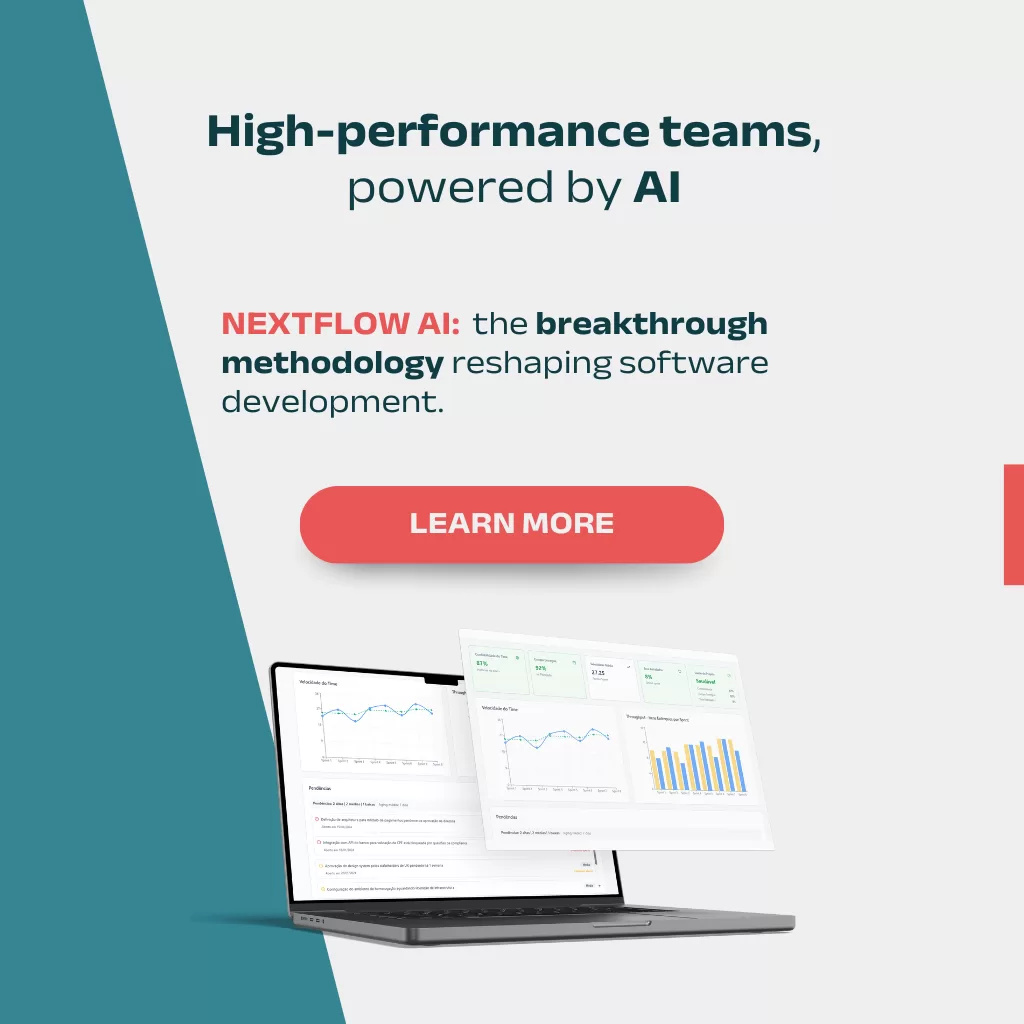
NextAge combines human expertise and AI at every stage through NextFlow AI, and also develops AI agents integrated into clients’ systems. The criterion applies to any partner: a speed gain only counts when it shows up in an indicator.
7 signs your software factory is not well managed
- Demos do not show working software. Ask for the increment in staging.
- The backlog is outdated or has no owner. Define the PO and a refinement routine.
- There are only hour reports. Replace them with delivery, quality and business indicators.
- The budget changes without a formal change request. Set up a change log.
- Team turnover is high. Ask for a continuity plan and documentation.
- Knowledge is concentrated in a few people. Require documentation and rotation.
- You have no access to the repository or the board. This is a red flag for governance.
What good management changes in practice
At a fashion and luxury marketplace operating in 12 countries, technical debt had grown past 1,400 cataloged bugs, and the in-house team, focused on new products, could not clear the backlog. NextAge set up an agile squad with QAs and senior developers, working in sprints and reporting directly to the CTO, with AI-assisted E2E test automation and code review. The result: 100% of critical bugs resolved, 89% of the backlog cleared and a 12% increase in checkout conversion.
At an insurance company, in-person inspections created a queue of up to 15 days. NextAge built a digital inspection platform with computer vision, powered by a historical base of 500,000 claims. The results: R$ 18 million in operational costs, 41% higher NPS and 23% better fraud detection. The two cases share something: defined roles, built-in quality and clear indicators from the start.
What if the software factory is your own?
Those who lead an in-house factory face the same problem from the other side: keeping predictability and quality without the discipline of a contract. Brazilian academic literature defines the software factory as an organizational concept, not a technological one (CONTECSI, in Portuguese), and there are experiences structuring development as an IT service with a service level agreement (SBQS, in Portuguese).
In practice, this means: a service portfolio and clear roles (manager, PO, architect, QA, DevOps), a standardized process, continuous measurement and an internal SLA with the business areas. The indicators from practice 5 apply here in the same way.
Software factory management checklist
- Client PO and factory point of contact defined
- Discovery completed, with prioritized backlog and estimate
- Engagement model suited to the demand
- Governance cadence (daily, biweekly, monthly, quarterly)
- 3 to 7 indicators with formula, target and quarterly review
- QA, automated tests and code review built into the process
- Access to the board and repository; demo every sprint
- Scope change log
- Code ownership, documentation and handover plan
- Support SLA and technical debt backlog
Frequently asked questions
What does it mean to manage a software factory?
It means steering the outcome of the delivery, not the daily work of the developers. The client sets goals, priorities and acceptance criteria and tracks deliverables and indicators; the factory manages the team, architecture, quality and process. Governance relies on clear roles, regular meetings, measurable SLAs and verifiable transparency.
Who manages the team in a software factory?
The factory itself. The vendor takes responsibility for delivery and for managing the team; the client keeps the product vision, the priorities and the approval of deliverables. With staff augmentation, it is the opposite: the team follows the client’s management.
Which metrics should you track in a software factory?
Combine a few indicators of delivery, stability, quality and business. The five DORA metrics (change lead time, deployment frequency, failed deployment recovery time, change fail rate and deployment rework rate) are a good starting point, together with one indicator tied to the business goal defined in discovery.
How do you follow the progress of the project?
Through demos every sprint, access to the project board and repository, indicator reports and a dedicated point of contact at the factory. At NextAge, deliveries happen every two weeks, with review meetings and access to the board.
How do you define an SLA with a software factory?
Define scope and deliverables, choose 3 to 7 indicators with a formula and data source, and set targets, reporting format, incident handling, change rules and consequences for non-compliance. Review the targets every quarter and prioritize outcomes over hours worked.
How do you avoid schedule and budget overruns?
Start with a discovery that produces a clear scope, a prioritized backlog and a realistic estimate. Deliver in short cycles with demos, track predictability indicators and handle changes through a formal process that states the impact on schedule and cost before approval.
Does the client own the code that is developed?
It should, and the contract must say so. At NextAge, intellectual property, source code and documentation belong to the client, as set out in the contract. Require repository access from day one and verify the handover of the pipeline, deployment runbooks and credentials.
How much does it cost to hire a software factory?
It depends on the scope, integrations, platforms and engagement model. That is why the best approach is to start with a discovery, which produces a realistic estimate of timeline and cost before development. Be wary of a fixed price before the scope is understood.
Conclusion
Managing a software factory is an exercise in clarity: who decides, what will be delivered, how it will be measured and how the client sees progress. With defined roles, governance on a regular cadence and simple indicators, the factory stops being a black box and becomes a predictable extension of your operation.
NextAge was founded in Curitiba, Brazil, in 2007 and serves companies across the country with remote teams; for local context, see how to choose a software factory in Curitiba. If you want to structure your next project, tell us about your challenge and start with Discovery.