 English
  Português
In a software factory, development follows five stages: discovery, architecture and design, sprint-based development, validated quality, and deployment with ongoing support. The factory takes over execution and team management; the client defines the business goal, validates what is delivered and tracks results.
In a McKinsey study with the University of Oxford that analyzed more than 5,400 IT projects, large projects (above US$15 million) ran, on average, 45% over budget and 7% over schedule, and delivered 56% less value than predicted. The study dates from 2012 and covers large-scale initiatives, but the lesson applies to any project: the risk is not only in the technology, it is in how the work is organized.
That is why understanding the process before you hire makes a difference. In this guide, you will see what happens at each stage, what you receive, what you need to decide and which mistakes to avoid, as well as how artificial intelligence is changing the cycle in 2026.

What is a software factory and how does it organize development?
A software factory is a contracting model in which the supplier takes responsibility for delivery: a full team handles the entire cycle, from discovery to the evolution of the system, with standardized, repeatable processes. The client does not manage developers; the client follows deliveries, indicators and results.
The word “factory” does not mean mass production. Each system is designed for a specific business process. What is standardized is the method: defined stages, clear roles, tracking rituals and quality criteria.
At NextAge’s Software Factory, for example, you define the goal and a multidisciplinary NextAge team handles discovery, architecture, design, development, testing, deployment and evolution. Want to understand the concept in more depth?
What are the stages of software development in a software factory?
There are five stages: discovery, architecture and design, sprint-based development, validated quality, and deployment and support. The first three define and build the system; the fourth runs in parallel with the sprints; the fifth keeps the software running and evolving after it goes into production.
| Stage | Objective | Deliverables | What the client does |
|---|---|---|---|
| 1. Discovery | Understand goals, users, processes, integrations and risks | Clear scope, prioritized backlog, time and investment estimate | Aligns goals, takes part in interviews and approves the scope |
| 2. Architecture and design | Define how the system will be built and used | Stack, architecture, data model, clickable prototype | Validates the experience in the prototype |
| 3. Sprint-based development | Build incrementally | Deliveries every 2 weeks, with a demo | Follows progress, adjusts priorities and joins the reviews |
| 4. Validated quality | Ensure the system works as expected | Automated tests, regression, code review | Defines and validates acceptance criteria |
| 5. Deployment and support | Go live and maintain | System in production, monitoring, documentation, continuous evolution | Approves the go-live and prioritizes improvements |
Here is each stage in detail.
Stage 1: what is discovery and why does it come before everything else?
Discovery is the stage that turns an idea into an executable plan. The factory maps goals, users, processes, integrations and risks before writing any code, and delivers a clear scope, a prioritized backlog and a realistic estimate of time and investment.
What happens:
- Business immersion: interviews with stakeholders and users to understand operational pain points and contextual constraints.
- Mapping of functional requirements (what the system does) and non-functional requirements (performance, security, usability), plus technical dependencies and success criteria.
- Prototyping and validation with decision makers and users.
- A business case with timeline, cost and expected return, to support the investment decision.
What you receive: documented scope, prioritized backlog, validated prototype, risk map and a time and cost estimate.
What you decide: which business goals the system must achieve, how success will be measured and what goes into the first release.
Common mistake: skipping discovery to “save time.” The result is usually the opposite: postponed decisions, poorly defined requirements and rework. The logic is well known in software engineering: the later an error is found, the more expensive it is to fix (there are widely cited estimates of this rising cost, although the multipliers vary by source).
At NextAge, this stage is led by Deep Discovery, which combines strategic immersion, validated prototyping and a business case with ROI, so the project starts with scope, risks and estimates defined before the first sprint.
Stage 2: what happens in architecture and design?
In this stage, the factory defines how the system will be built and how it will be used. The result is the technology stack, the architecture, the data model and clickable prototypes the client can test before development begins.
What happens:
- Stack selection according to the project (for example Java, .NET, Node.js, Python, PHP, Angular, React, Vue.js, TypeScript or Flutter).
- Design of the architecture and of integrations with ERPs, payment gateways, partners and internal systems.
- Data modeling.
- Interface design and creation of a clickable prototype.
What you receive: architecture document, data model and clickable prototype.
What you decide: whether the designed experience solves the users’ problem. Adjusting a prototype is far cheaper than adjusting a finished system.
Common mistake: treating design as finishing touches. It determines how people will use (or reject) the system.
In this phase, the software architect and the UX/UI designer, part of the factory’s multidisciplinary team, take the lead.
Stage 3: how does sprint-based development work?
In sprint-based development, the system is built incrementally, in short cycles. In NextAge’s factory, deliveries happen every two weeks, with a demonstration of the work done, and the client can adjust priorities at each cycle.
What happens:
- The backlog is prioritized and broken down into tasks for the sprint.
- Front-end, back-end and mobile developers build the features, with code review.
- Continuous integration and delivery (CI/CD) pipelines automate repetitive steps and reduce the risk of human error.
- At the end of the cycle, there is a demo (review) and planning for the next sprint.
What you receive: working features, demonstrated every two weeks, access to the project board and a dedicated point of contact.
What you decide: what comes first and whether the delivery meets the acceptance criteria.
Common mistake: not having a decision maker available at the reviews. Late feedback becomes rework.
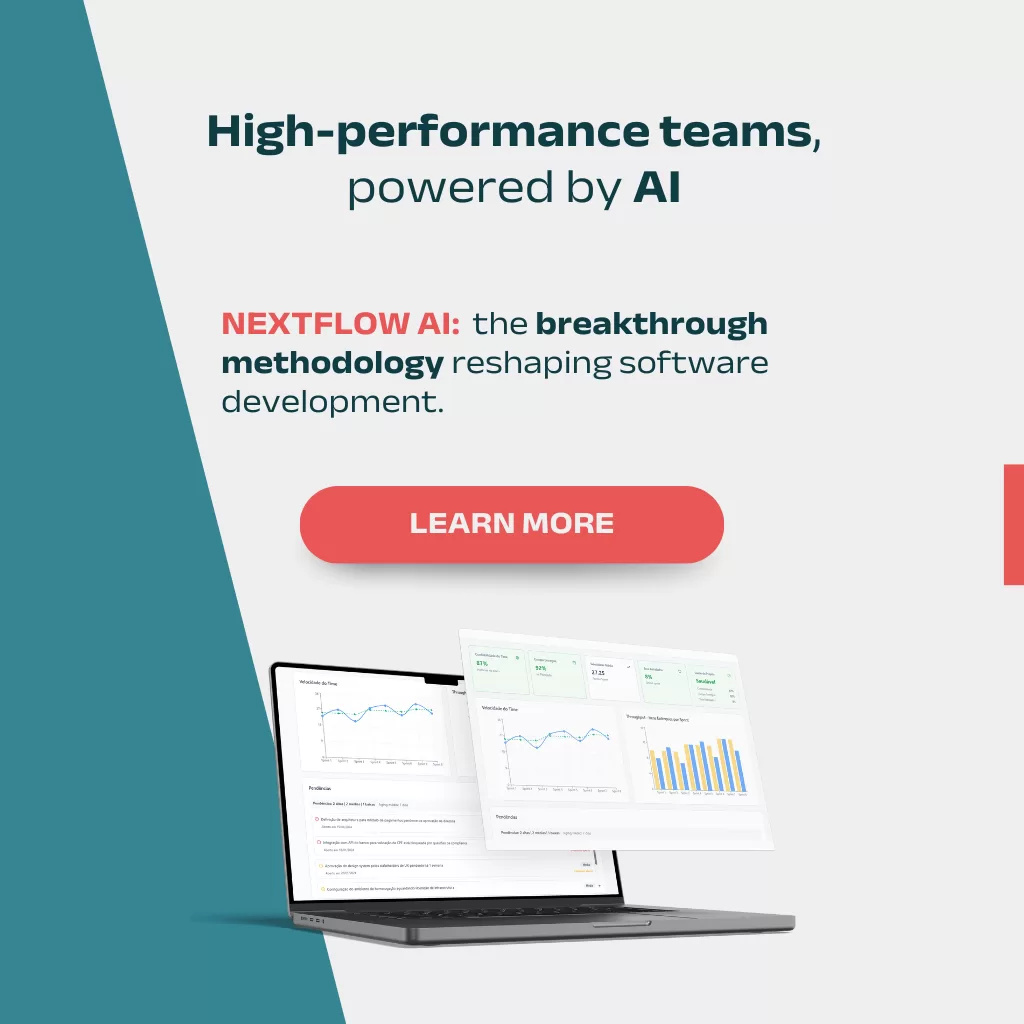
This is where NextFlow AI comes in, NextAge’s methodology that combines senior squads with AI at every phase of the project, with 1-click validation, real-time dashboards and a Zero Trust security model. According to NextAge, deliveries can be up to 40% faster.
Stage 4: how is quality ensured?
Quality is not an isolated phase at the end of the project: it runs alongside the sprints. A dedicated QA, automated tests and code review validate each delivery so that defects are caught before they reach the user.
What happens:
- Functional, regression, integration, API and usability testing.
- Test automation, so each new version does not break what already works.
- Code review, supported by AI.
- Results reports for the client and the team.
What you receive: test coverage, clear reports and evidence that the acceptance criteria were met.
What you decide: the acceptance criteria and the level of risk tolerable for each release.
Common mistake: leaving testing for the end. When an error shows up close to go-live, cost and schedule take the hit.
This matters even more in the age of AI. According to the 2025 Stack Overflow Developer Survey, 46% of professionals distrust the accuracy of what AI tools produce, and only 33% trust it. Human review and testing remain indispensable.
A practical example: at a fashion and luxury marketplace operating in 12 countries, the in-house team could not keep up with a technical debt of more than 1,400 bugs. NextAge assembled a squad of QAs and senior developers, using AI-powered automated E2E testing, and the result was 100% of critical bugs resolved, 89% of the backlog eliminated and a 12% increase in checkout conversion. This work is part of the Quality Center, which also validates deliveries from other factories through independent technical analysis.
Stage 5: what are deployment and support?
At deployment, the system goes into production with monitoring and documentation. Support starts right after and ensures fixes, improvements and continuous evolution, because software in use needs maintenance to keep working and keep up with the business.
What happens:
- Production deployment, with a contingency plan.
- Monitoring of performance and errors.
- Delivery of documentation and knowledge transfer.
- Handling of fixes, improvements and new requests.
What you receive: a live system, documentation, repository and access to the project history. In NextAge’s factory, intellectual property, source code and documentation belong to the client, as set out in the contract.
What you decide: the timing of the go-live and the priorities for evolution.
Common mistake: treating delivery as the end of the project. Critical systems cannot stop, and software without maintenance accumulates defects and vulnerabilities.
NextAge’s Application Managed Services (AMS) covers this ongoing cycle, with a dedicated team to maintain and evolve systems in production.
How do the factory stages map to the classic SDLC phases?
The factory stages correspond to the phases of the software development life cycle (SDLC), under different names. References such as Atlassian describe seven phases; other sources use five or six, but the logic is the same.
| Classic SDLC phase | Stage in the factory |
|---|---|
| Planning, feasibility and requirements analysis | Discovery |
| Design and architecture | Architecture and design |
| Implementation (coding) | Sprint-based development |
| Testing | Validated quality (in parallel with sprints) |
| Deployment | Deployment |
| Maintenance | Support |
The difference lies in the method. In the waterfall model, the phases happen once, in sequence. In agile methods such as Scrum, used in the factory, they repeat every sprint, which allows course corrections more often and reduces the risk of discovering a problem only at the end.
How is AI changing the development stages?
AI is already part of everyday development, but it amplifies whatever the process has, good or bad. Teams with method and review gain speed; teams without process tend to accumulate rework.
According to Google’s 2025 DORA report, which surveyed about 5,000 professionals, 90% of software professionals already use AI (14 percentage points more than in 2024) and 59% see an improvement in code quality. The same report describes AI as an amplifier: the gain depends on the organization’s culture, processes and the maturity of its systems.
In practice, this means productivity gains come from using AI inside a disciplined process: clear discovery, review by senior professionals, automated testing and real-time metrics. That is the logic behind NextFlow AI, in which AI automates repetitive tasks, speeds up validations and documents each sprint, while critical technical decisions stay with senior tech leads.
For those who want to go beyond development and embed AI in the business itself, NextAge also builds AI agents. In an insurance company case, a digital inspection platform with computer vision cut a queue of up to 15 days, saved R$ 18 million in operating costs and raised NPS by 41%.
Who is on a software factory team?
Each project has a multidisciplinary team. At NextAge, it is made up of in-house professionals, validated on previous projects. Size and composition are defined in discovery, according to complexity.
- Project manager / Scrum Master: leads the process, the rituals and the tracking.
- Product Owner / business analyst: translates the business goal into a prioritized backlog.
- Software architect: defines the architecture and technical standards.
- Front-end, back-end and mobile developers: build the system.
- UX/UI designer: designs the experience and the interfaces.
- DevOps: automates deployment and keeps the environment stable.
- QA: validates the quality of each delivery.
8 tips to follow the process and avoid rework
- Define the business goal and the success metric before talking about features.
- Appoint a point of contact with decision-making power and time available for the reviews.
- Invest in discovery. It is the cheapest stage in which to correct mistakes.
- Prioritize by value. When there is uncertainty, start with an MVP (minimum viable product) and evolve based on real usage.
- Follow progress through the board and dashboards, not only meetings.
- Require written acceptance criteria for each delivery.
- Confirm in the contract who owns the code, the repository and the documentation.
- Plan for support from the start. A system in production needs a team behind it.
Which engagement model should you choose?
A software factory usually works with three formats, and the choice depends on the stage of the product:
- Fixed scope: price and timeline set for an approved scope. Suited to projects with clear requirements, with full predictability of investment and schedule.
- Dedicated squad: a team exclusive to your product, with a fixed monthly fee and SLA. Suited to digital products in continuous evolution, with speed and flexibility on priorities.
- Support and evolution: a team dedicated to maintaining and evolving systems in production. Suited to critical systems that cannot stop.
If the question is between a factory and staff augmentation, read the comparison Software Factory vs Outsourcing: which model is best in 2026?.
How do you start a project with NextAge?
The path is simple, in three steps: a diagnostic conversation, at no cost, to understand your challenge; discovery, which defines scope, risks and estimate; and a proposal with the most suitable engagement model, followed by the team kickoff, which usually happens immediately or within a few days after approval.
NextAge has operated since 2007, is headquartered in Curitiba, Brazil, and serves companies across Brazil and abroad with remote teams. Talk to a NextAge specialist and start with discovery.
Frequently asked questions
What are the stages of software development in a software factory?
There are five: discovery, architecture and design, sprint-based development, validated quality, and deployment with support. Discovery defines scope, backlog and estimate; sprints deliver every two weeks; QA validates each delivery; and support maintains and evolves the system after it goes into production.
How long does it take to develop software in a software factory?
It depends on scope, integrations and platforms. That is why discovery comes first: it produces a realistic estimate of time and cost before development. After the proposal is approved, the team usually starts immediately or within a few days, with deliveries every two weeks.
What is discovery and why does it come before development?
It is the phase in which goals, users, processes, integrations and risks are mapped. It comes first because fixing a requirements error before coding costs far less than fixing it afterwards. The result is a clear scope, a prioritized backlog and an estimate of time and investment.
Does the client take part in the process?
Yes, at the right points: validating the prototype, approving the scope, attending the demos at each sprint and adjusting priorities. NextAge provides access to the project board and a dedicated point of contact. You follow deliveries, indicators and results, without managing developers.
Who owns the code that is developed?
The client. In NextAge’s Software Factory, intellectual property, source code and documentation belong to the client, as set out in the contract. Confirm this clause with any supplier before signing.
How does AI fit into the development process?
It supports code generation, review, testing and documentation. According to DORA 2025, 90% of professionals already use AI, but it amplifies whatever the process already has, good or bad. In NextFlow AI, senior tech leads review what the AI produces, under a Zero Trust security model.
What is the difference between a software factory and outsourcing?
In a factory, the supplier is accountable for delivery and manages the team. In outsourcing, external professionals join your team and follow your management. A factory suits projects with a defined scope; outsourcing suits ongoing or variable demand. NextAge’s Outsourcing 2.0 follows the second logic, with validated professionals.
Can a factory take over existing systems?
Yes. NextAge performs a technical diagnosis of the current system and can take over support, evolve it or plan its modernization, without stopping operations.
Conclusion
Understanding the stages of software development helps you hire better and hold suppliers accountable for what matters. In a factory, the process is organized into five stages (discovery, architecture and design, sprints, quality and support), each with clear deliverables and decision points for the client. With AI speeding up the work, the differentiator is no longer the tool but the method: well-defined scope, expert review and data-driven tracking.
If you have a system to build, modernize or sustain, talk to NextAge. Your next system starts with a conversation.
Read also: