 English
  Português
Python is a general-purpose, open-source programming language known for its simple syntax, used today in web development, artificial intelligence, data science, task automation, and cloud infrastructure. According to the TIOBE Index, it has been the most popular language in the world since 2022, a position it still holds by a wide margin in 2026.
That’s not just a curiosity for people who write code. For anyone making decisions inside a company (whether you’re a CTO, a product manager, or a business owner), understanding what Python is used for, and more importantly where it actually makes a difference, helps you decide whether it’s worth investing in and how to build the right team to get a project off the ground. That’s what this guide breaks down.
What is Python?
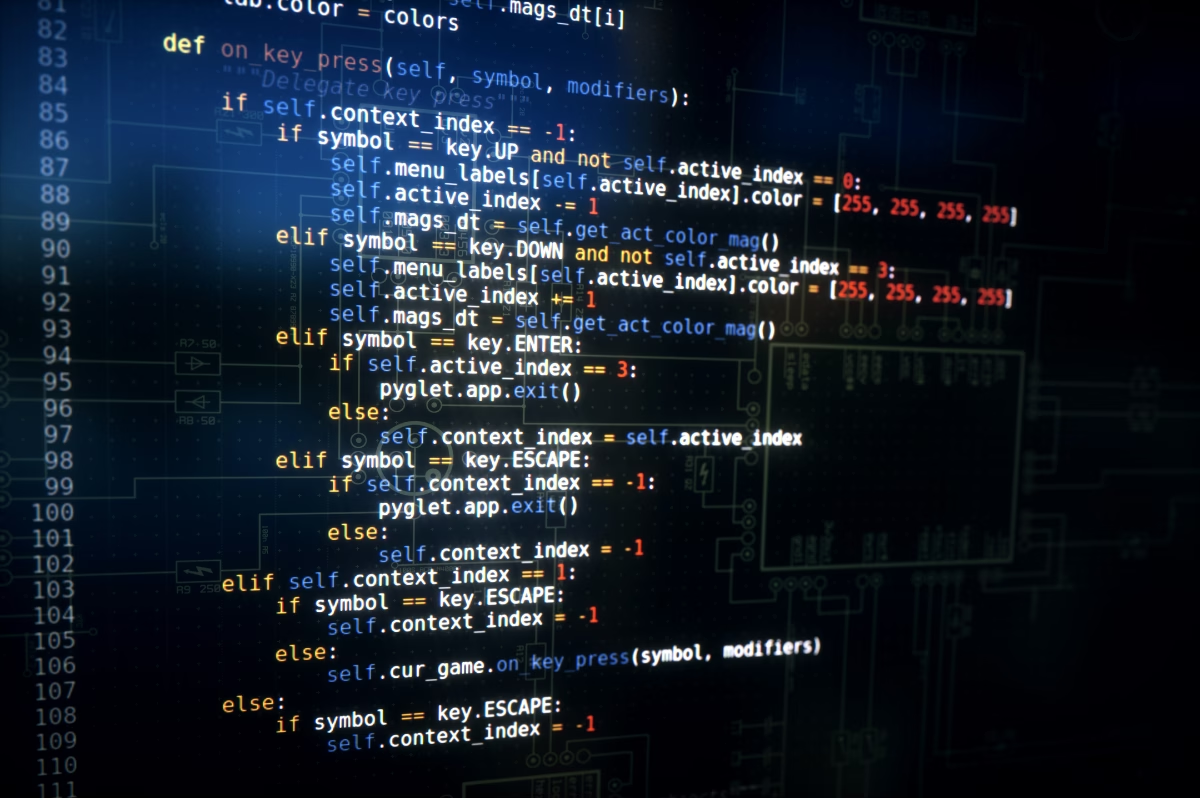
Python is an interpreted, high-level, object-oriented programming language created by Dutch programmer Guido van Rossum in the late 1980s and officially released in 1991. “Interpreted” means the code runs directly, without going through a separate compilation step first; “high-level” means its syntax is close to human language, which lowers the barrier to entry both for people learning to code and for professionals in other fields (statisticians, engineers, data analysts) who need to write code without being full-time developers.
One curious detail: the name has nothing to do with the snake. Van Rossum named the language after the British comedy troupe Monty Python, since he was looking for something short, a little irreverent, and easy to remember.
What is Python used for? Main use cases
Web development
On the back end, Python is used to build the logic that powers websites and applications: data processing, database communication, user authentication, API integrations. Frameworks like Django, Flask, and FastAPI (the latter has gained strong traction in recent years for its performance in building APIs) speed up that process while keeping it secure, so teams don’t have to rebuild common functionality from scratch on every project.
In short: Python is used in web development because it shortens the distance between an idea and a working product, without sacrificing security or scalability.
Artificial intelligence and machine learning
This is the language’s main growth driver today. Libraries like TensorFlow, PyTorch, and scikit-learn have become the market standard for training and deploying AI models, and virtually the entire LLM (large language model) ecosystem was built on Python. According to the Stack Overflow Developer Survey 2025, Python’s adoption grew by 7 percentage points between 2024 and 2025, the largest jump of any language during that period, driven largely by the explosion of generative AI.
In short: if a project involves training, fine-tuning, or deploying an AI model, Python is very likely at the center of the stack.
Data science and data analysis
Libraries like Pandas and NumPy turned Python into the standard tool for cleaning, manipulating, and visualizing data. That applies both to one-off analyses (understanding a quarter’s sales performance, for example) and to data pipelines that run continuously inside a company.
In short: Python has become the “advanced spreadsheet” for people working with data at scale, combining ease of use with real processing power.
Task automation and scripting
One of the most practical, if less glamorous, applications: automating repetitive work. Report generation, API integrations between systems, automated software testing, backup routines; all of this is commonly handled with relatively simple Python scripts, without requiring the structure of a full application.
In short: when the goal is to eliminate manual, repetitive work, Python is usually the fastest path to get there.
Finance, DevOps, and cloud infrastructure
Python has strong support across the major cloud providers (AWS, Google Cloud, Azure) and is widely used in serverless functions, infrastructure scripts, and CI/CD pipelines. In financial markets, the language is used to automate market data analysis, strategy backtesting, and system integrations.
In short: from the infrastructure that keeps a system running to the analysis that informs an investment decision, Python shows up as the connective tissue between technical and business teams.
Why is Python so popular?
Three factors explain that leadership position:
- Simple syntax and a gentle learning curve: Python code tends to be shorter and more readable than languages like Java or C++, which speeds up both learning and day-to-day maintenance for a team.
- A massive community and open-source ecosystem: Being open source since its creation, Python has built up decades of ready-made libraries for almost any need, saving teams from reinventing solutions the market has already validated.
- Consistent popularity data across multiple sources: Beyond the TIOBE Index, the PYPL Index, which measures language popularity based on tutorial searches on Google, also ranks Python first, with a lead of more than 20 percentage points over the second-place language in nearly every country analyzed. Three different methodologies (general search volume, tutorial searches, and direct developer surveys) arriving at the same conclusion is a strong signal that this lead isn’t a passing trend.
It’s worth being upfront about the limits: because it’s an interpreted language, Python tends to run slower than compiled languages like C++ or Java, which can matter for applications that require extreme real-time performance (high-frequency trading systems, for instance, or parts of a game engine). For the vast majority of use cases in web, automation, data, and AI, though, that isn’t a limiting factor.
Which companies use Python?
Python is part of the technology stack at companies like Google, Netflix, Spotify, Instagram, and NASA, among many others. That kind of presence at scale isn’t a coincidence: it reinforces that the language scales well, both technically and in terms of the availability of professionals to support critical systems over time.
Is it worth using Python for my project or company?
In most scenarios involving AI, automation, data analysis, or MVPs that need to launch quickly, Python tends to be a solid choice. For projects that depend on extreme real-time performance or native mobile apps, other languages (Kotlin, Swift, Go, Rust, depending on the case) are usually a better fit.
The question that comes up for a lot of companies, though, isn’t really whether Python is the right language: it’s whether they currently have access to the right Python developers to actually get the project built. And that’s where the real bottleneck in the Brazilian market shows up.
How to hire or build a team of Python developers
Finding good Python developers in Brazil isn’t trivial. It’s one of the most in-demand languages right now, driven by the AI boom, and the supply of senior professionals hasn’t kept pace with that demand. According to a study by Brasscom, Brazil graduates an average of 53,000 technology professionals per year, against an average annual need of 159,000; a gap that keeps accumulating and keeps competition for strong development teams intense, especially for AI- and data-related languages like Python.
Given that, companies typically weigh three paths: direct hiring, building an in-house team from scratch, or outsourcing to already-validated developers. Each model has its place, but it’s worth understanding the real costs involved before deciding (we have a complete guide on how much a development squad costs if you want to go deeper on that).

This is exactly the bottleneck NextAge’s Staff Augmentation was built to solve. Instead of months of recruiting and the risk of a hire that doesn’t work out, your company gets access to Python developers who’ve already been technically and culturally validated, ready to perform from day one: with technical management included (a Tech Lead dedicated to the project), none of the overhead of direct hiring, and the flexibility to scale the team as the project evolves. That methodology is backed by more than 19 years in the market, 600 projects delivered, and 150 active professionals, which is why companies like Sicredi, XP, Rumo, and WEG chose this model over traditional outsourcing.
Check out NextAge’s Staff Augmentation and see how to build a Python development squad without the risks of a long hiring process or a generic vendor.
Frequently asked questions about Python
Is Python an easy language to learn?
Yes, it’s considered one of the most accessible languages for beginners, thanks to its simple syntax that reads close to human language. That doesn’t mean mastering Python at a professional level is trivial: the initial learning curve is gentle, but the technical depth needed for complex projects (architecture, performance, best practices) still requires real experience.
Is Python used in artificial intelligence?
Yes, it’s the reference language today for training, fine-tuning, and deploying AI models in production, with libraries like TensorFlow, PyTorch, and scikit-learn widely adopted across the market.
What’s the difference between Python and languages like Java or JavaScript?
Python prioritizes readability and development speed. Java is more common in large-scale enterprise systems that require strict static typing. JavaScript dominates the front end and is also used on the back end via Node.js. The right choice depends on the type of project; there’s no single “best” language in absolute terms.
Can Python be used to build a website?
Yes, mainly on the back end (the logic behind the site), using frameworks like Django or Flask. For the front end (the visual part), the market still predominantly relies on HTML, CSS, and JavaScript.
Which companies use Python?
Google, Netflix, Spotify, Instagram, and NASA are among the organizations using Python in significant parts of their technology infrastructure.
How do I hire a Python developer?
The main options are direct hiring, building an in-house squad, or outsourcing with a specialized partner. The right choice depends on timeline, budget, and project complexity; for a closer look at real costs, check the development squad cost guide.
How much does a Python developer cost in Brazil?
Rates vary significantly by seniority and hiring model, but in outsourcing arrangements, market ranges tend to start around R$ 6,000–9,000 monthly for junior profiles and can exceed R$ 20,000 monthly for specialized senior professionals, according to market references such as Robert Half’s 2026 Salary Guide.
Conclusion
Python is, today, the most popular language in the world (according to TIOBE, PYPL, and Stack Overflow) precisely because it balances simplicity and power: it’s used across web development, AI, data, automation, and cloud infrastructure, backed by an ecosystem mature enough to support everything from a simple script to mission-critical systems at large enterprises.
If your company has already decided Python is the right path, the next step is having the right team to execute on it. Check out NextAge’s Staff Augmentation and see how to build a validated Python development squad, without the risks of traditional outsourcing.