 English
  Português
If you have ever accessed a website, filled out a form, logged into a platform, or made an online purchase, there is a good chance you have interacted with an application that uses PHP.
But what exactly is PHP, and what is it used for? PHP is an open-source programming language primarily used to develop web applications and executed on the server side. In practice, it can process information, apply business rules, access databases, integrate systems, generate dynamic pages, and support different types of applications.
Despite having been around for decades, PHP remains present across a significant portion of the web. According to W3Techs, as of September 2026, PHP was used by 69.9% of websites where the server-side programming language is known.
This helps explain why PHP remains relevant for companies developing new digital products, as well as organizations that need to maintain, modernize, and evolve existing systems.
In this article, you will learn what PHP is, how the language works, what it is used for, its main applications, advantages, and challenges. You will also understand when working with specialized PHP professionals can make a difference in a software project.
What Is PHP?
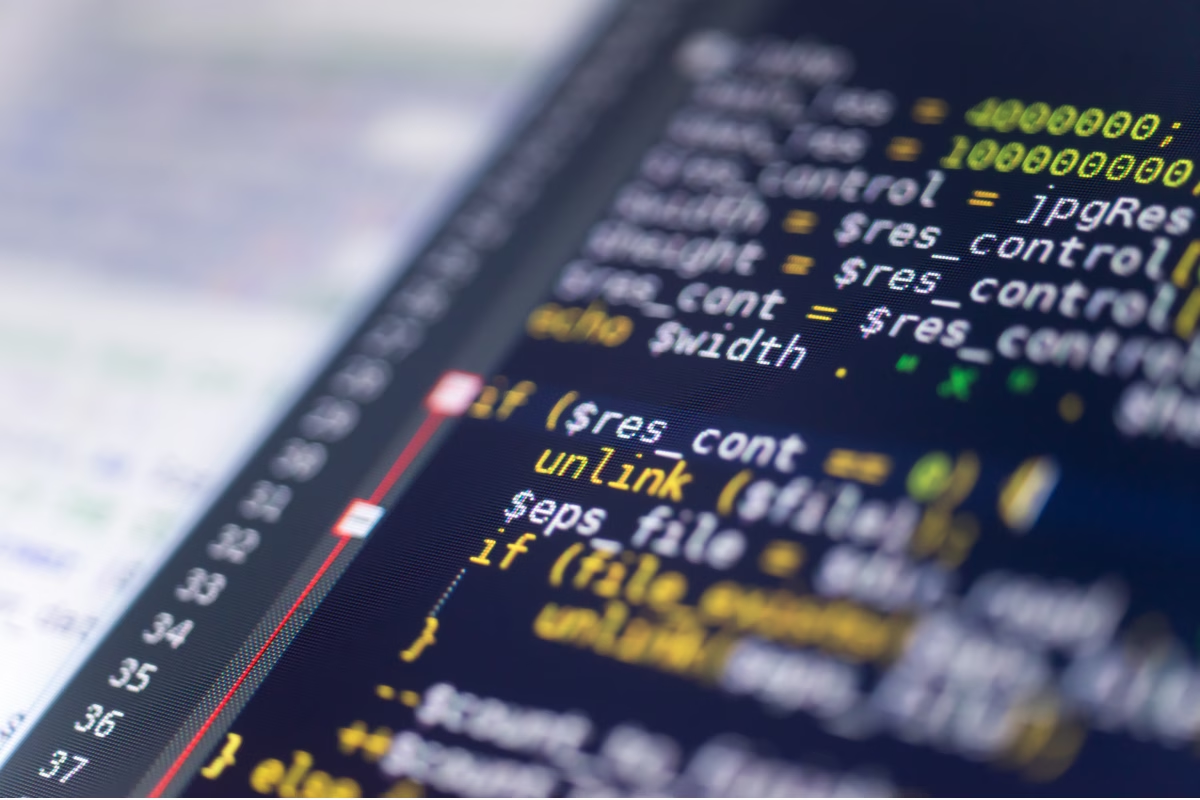
PHP is an open-source scripting language designed for general-purpose use, with a particular focus on web development. Its name is a recursive acronym for “PHP: Hypertext Preprocessor”, as explained in the official PHP documentation.
One of the language’s main characteristics is that it runs on the server.
This means that when someone accesses an application developed with PHP, the browser does not need to receive and execute the PHP code. Instead, the server processes the code, performs the necessary operations, and sends the result back to the browser.
In simple terms:
User → browser → server → PHP → database and other services → response → browser
This architecture allows PHP to be used to create applications that process information, control access, query databases, perform calculations, integrate APIs, and execute business rules.
PHP can also be used outside traditional web applications. The official PHP documentation describes, for example, how PHP can be executed directly from the command line, without relying on a browser or web server.
How Does PHP Work in Practice?
To understand PHP, it helps to imagine a common scenario: a person accesses the login area of a corporate system.
After entering their username and password, the browser sends a request to the server. The server receives the request and executes the code responsible for processing authentication.
This code may:
- receive the information submitted by the user;
- validate the data;
- query a database;
- check whether the user has permission to access the system;
- create an authenticated session;
- return a response to the browser.
The user only sees the final result. The processing performed on the server happens behind the scenes.
This is one of the key characteristics that differentiates PHP from languages traditionally executed in the browser. As explained in the official PHP documentation, PHP code is executed on the server and can generate HTML that is subsequently sent to the browser.
A Simple PHP Example
Here is a basic example:
<?php

$name = "Maria";

echo "Hello, $name!";
In this example, PHP creates a variable called $name and uses the echo command to generate a message.
The browser does not need to receive this code in order to display the result. The server executes the PHP code and can send the browser only the generated output:
Hello, Maria!
In real-world applications, of course, the complexity is much greater. PHP can be involved in authentication, order processing, financial business rules, API integrations, database communication, document generation, and many other operations.
What Is PHP Used For?
PHP is primarily used to develop applications that require server-side processing. Its applications include dynamic websites, enterprise systems, e-commerce platforms, APIs, portals, integrations, and content management systems.
The official PHP documentation highlights features for processing forms, generating dynamic content, using cookies, accessing databases, communicating with other services, generating files, and running scripts.
In practice, some of the main applications of PHP can be divided into the following categories.
Websites and Web Applications
One of the best-known uses of PHP is the development of websites and web applications.
The language can be used to generate dynamic pages, process forms, manage user sessions, and connect different components of an application.
This makes it possible to build everything from institutional websites to complex platforms with different access levels and business rules.
Enterprise Systems
PHP can also be used to develop and maintain corporate systems.
An enterprise application may use PHP to process information related to customers, orders, contracts, inventory, payments, reports, users, and permissions, for example.
In this context, what matters most is not the programming language alone, but how the application is architected, developed, tested, monitored, and maintained.
E-commerce
E-commerce platforms need to process large amounts of information and business rules.
These may include:
- product catalogs;
- shopping carts;
- pricing;
- promotions;
- orders;
- payments;
- inventory;
- customer accounts;
- integrations with logistics providers;
- tax-related information;
- communication with other systems.
PHP can support many of these operations on the application’s backend.
APIs and Integrations
Modern applications rarely operate completely in isolation.
A system may need to communicate with payment platforms, CRMs, ERPs, logistics services, marketing tools, data platforms, and other internal or external systems.
PHP can be used to create APIs and support these integrations.
WordPress
Another well-known example is WordPress.
WordPress uses PHP on the server, and its ecosystem relies on the language for themes, plugins, and different functionalities.
According to the official WordPress requirements, the platform currently recommends PHP 8.3 or higher, along with MySQL 8.0 or MariaDB 10.11 or higher and HTTPS.
This is another example of how PHP continues to be part of technologies that are widely used across the web.
Scripts and Automation
PHP does not necessarily have to be associated with a web page.
The language’s official documentation describes its use through the command line. This makes it possible to develop scripts for automated tasks, file processing, scheduled routines, and other activities.
For companies, this can be useful in certain integration, data processing, and automation scenarios.
Is PHP Frontend or Backend?
PHP is primarily used for backend development, meaning the server side of an application.
The frontend is the part of an application that users interact with directly. It typically involves technologies such as HTML, CSS, and JavaScript.
The backend, on the other hand, is responsible for operations such as:
- business rules;
- authentication;
- database access;
- information processing;
- integrations;
- APIs;
- access control.
This is where PHP traditionally operates.
This does not mean that a PHP application has to be built exclusively with PHP. In fact, it is common for an application to combine PHP on the backend with JavaScript and other technologies on the frontend.
PHP and Databases: What Is the Relationship?
Applications rarely work only with static information.
Imagine a sales system. When a user checks an order, the system needs to retrieve information stored in a database, process it, and present the result.
PHP can play a role in this communication.

The language supports different databases and data access technologies. The official PHP documentation describes, among other options, database-specific extensions and tools such as PDO.
In practice, an application may follow a flow like this:
User requests information → PHP receives the request → PHP queries the database → system processes the data → PHP returns the response
This type of processing is present in virtually every corporate system that needs to work with data dynamically.
What Are the Main PHP Frameworks?
The PHP ecosystem also includes frameworks that help structure applications and accelerate development.
Well-known examples include Laravel, Symfony, and CodeIgniter, along with numerous libraries, tools, and components used across the ecosystem.
Frameworks can contribute to code organization, development standards, component reuse, and the implementation of common features.
In enterprise projects, however, choosing a framework is only one part of the decision.
It is also necessary to consider factors such as:
- application architecture;
- functional requirements;
- security;
- performance;
- integration with existing systems;
- maintainability;
- availability of skilled professionals;
- product lifecycle;
- technology evolution strategy.
For this reason, the most appropriate question is not always “Which PHP framework should I use?”, but rather “Which architecture and technology stack make the most sense for this product?”
PHP vs. JavaScript: What Is the Difference?
PHP and JavaScript are different technologies, but they can work together within the same application.
In simple terms, PHP is traditionally used on the backend, while JavaScript has a strong presence on the frontend. Today, however, JavaScript can also be used on the backend through environments such as Node.js.
The distinction is therefore less about a rigid separation between the two languages and more about the role each technology plays within the application’s architecture.
For example:
Frontend: HTML, CSS, and JavaScript
Backend: PHP, databases, APIs, and business rules
An application can use PHP to process a request, access a database, and return information to an interface built with JavaScript.
Therefore, PHP and JavaScript do not necessarily need to be viewed as competitors. In many projects, they are complementary technologies.
What Are the Advantages of PHP?
PHP’s relevance is related to a set of characteristics that remain useful for different development scenarios.
Mature Ecosystem
PHP has decades of development behind it, along with extensive documentation, libraries, frameworks, and tools.
This is particularly important for companies that need to maintain systems over long periods.
Significant Presence on the Web
PHP continues to have a significant presence across the web. According to W3Techs, 69.9% of websites where the server-side programming language is known used PHP as of September 2026.
W3Techs also identifies PHP across well-known websites and platforms, including WordPress.org and Wikipedia.org.
Database Integration
PHP applications can work with different databases and data access mechanisms.
This makes the language suitable for systems that need to store, query, and process large amounts of information.
Flexibility
PHP can be used across different operating systems and server environments. The official documentation also highlights the language’s support for different programming approaches and a broad range of extensions.
Large Professional Ecosystem
The longevity of the technology also means there is a large pool of professionals, projects, and systems developed with PHP.
For companies that already have applications built with the language, this can be an important factor in their maintenance and technology evolution strategy.
What Are the Challenges and Disadvantages of PHP?
Like any technology, PHP is not automatically the best choice for every project.
One of the main challenges companies encounter is related to older applications.
A PHP system may have been developed many years ago and still be essential to business operations. In this scenario, the problem is not necessarily the language itself. It may be the architecture, lack of testing, outdated dependencies, insufficient documentation, or accumulated technical debt.
Keeping the PHP version up to date is also important.
The official PHP supported versions page shows that each version has a defined period of active support and security support. Once a version reaches the end of its lifecycle, it no longer receives official fixes.
Therefore, maintaining a healthy PHP application requires more than simply having “a system that works.”
Companies need to monitor updates, security, dependencies, architecture, performance, and the application’s ability to evolve.
Is PHP Still Worth Using in 2026?
Yes. But for businesses, the more accurate answer is: it depends on the context.
Usage data shows that PHP remains one of the most widely used technologies on the web. As of September 2026, W3Techs reported PHP on 69.9% of websites where the server-side programming language was known.
PHP is also still receiving new versions and updates. The official PHP supported versions page shows that versions 8.2, 8.3, 8.4, and 8.5 are within the official support lifecycle as of September 2026, with different periods of active and security support.
This does not mean every company should choose PHP for a new project.
Technology selection should consider the product, architecture, technical requirements, available ecosystem, team capabilities, maintenance costs, and long-term strategy.
On the other hand, if a company already has a working PHP system, automatically migrating to another programming language is not necessarily the best decision either.
In many cases, modernizing the architecture, updating versions, improving testing, addressing security issues, and evolving the system can generate more value than replacing the entire technology stack.
Which PHP Version Should You Use?
The recommendation is to use a version that is still within its official support lifecycle.
As of September 2026, PHP 8.5 is the latest version of the language. It was released in November 2025, and according to the official lifecycle, security support is scheduled to continue through December 31, 2029.
This does not mean that every existing system should be upgraded directly to the latest version without planning.
In enterprise applications, a version upgrade can involve libraries, frameworks, integrations, and internal components. For this reason, it is important to evaluate compatibility, conduct testing, and plan the migration carefully.
For critical systems, a well-executed upgrade should be part of a broader application lifecycle management strategy.
When Does a Company Need PHP Specialists?
At a certain point, the question stops being “What is PHP?” and becomes:
How can I find professionals who can work with PHP within the reality of my business?
This challenge can arise in different situations.
A company may need specialists when it:
- has a PHP application that needs to be modernized;
- needs to develop new features;
- needs to upgrade its PHP version;
- needs to address performance issues;
- needs to integrate the system with new APIs;
- needs to temporarily increase its development capacity;
- has a backlog larger than its internal team can handle;
- needs professionals with experience in a specific framework;
- needs to maintain a business-critical system without disrupting operations;
- needs to accelerate a software project.
In these situations, simply hiring “a PHP developer” may not solve the entire problem.
Enterprise projects require technical expertise, but they also require an understanding of architecture, processes, business rules, system integrations, software quality, and the ability to work alongside existing teams.
That is why staff augmentation and squad-based models can be a strategic alternative.
How Can NextAge’s Staff Augmentation Help Companies Working With PHP?
When a company needs to increase its development capacity, one option is to hire professionals internally. Another possibility is to work with a specialized team through staff augmentation.
The challenge is finding a model that goes beyond simply providing individual professionals.
NextAge’s Staff Augmentation was created with this approach in mind: providing a more structured model for accessing technology talent and teams.
NextAge’s methodology includes validated professionals, accelerated onboarding, flexibility in team composition, and management support. The company also works with squads that can bring together developers, Tech Leads, QAs, Scrum Masters, analysts, UX/UI professionals, and other specialists according to each project’s needs.
For a company working with PHP, this can be especially relevant when there is a specific need for professionals specialized in the language, while also requiring that expertise to be combined with other software engineering skills.
For example, imagine a company with an established PHP platform that needs to accelerate the development of new features.
Instead of permanently expanding its internal structure, the organization can complement its team with specialized professionals, keeping strategic knowledge in-house while adding technical capacity according to demand.
The same approach can be applied to modernization, maintenance, integration, and system evolution projects.
The official NextAge’s Staff Augmentation page presents the service as a proprietary methodology that combines validated professionals, fast adaptation, flexible allocation, and the option of working with individual professionals or complete squads.
Learn more about NextAge’s Staff Augmentation.
What Should You Consider When Hiring PHP Professionals?
Experience with the language is important, but it should not be the only criterion.
For enterprise projects, it is also worth evaluating:
Architecture Experience
Professionals need to understand how the code fits into the application’s overall architecture.
Database Knowledge
Many PHP applications rely heavily on database queries, transactions, and integrations.
Framework Experience
Knowledge of relevant frameworks can be important depending on the application and its technology stack.
Security
Web applications need to consider authentication, authorization, data protection, input validation, and other security practices.
Testing and Quality
A critical application needs to evolve without creating new problems. Automated testing and sound engineering practices can help support this process.
Integrations
Corporate systems typically need to communicate with other platforms. Experience with APIs and integrations can therefore be critical.
Ability to Work as Part of a Team
Enterprise software development is rarely an isolated activity. Developers need to interact with product, business, infrastructure, QA, UX, management, and other areas.
Technical experience should therefore be combined with the ability to understand the business context.
Is PHP Secure?
PHP can be used to develop secure applications, but no programming language guarantees security automatically.
Security depends on several factors, including architecture, code quality, environment configuration, dependencies, credential management, authentication, authorization, data handling, and ongoing maintenance.
One of the most important practices is avoiding outdated and unsupported versions.
The official PHP supported versions page makes clear that versions that reach the end of their lifecycle no longer receive official fixes. Similarly, WordPress recommends PHP 8.3 or higher and highlights the risks associated with older versions.
In enterprise environments, security should be treated as part of the software lifecycle rather than as an isolated step at the end of a project.
Is PHP a Good Choice for Enterprise Systems?
It can be.
The answer depends on the project’s characteristics and the company’s objectives.
PHP can make sense when there is an established ecosystem, an existing application, available professionals, suitable frameworks, and requirements that align with the technology.
It can also be an interesting option when a company needs to develop web applications, APIs, platforms, portals, or systems that can benefit from its ecosystem.
At the same time, a responsible technology decision should consider factors such as scalability, security, integration, maintainability, professional availability, architecture, and total cost of ownership.
The best technology is not necessarily the one that appears most often in technology trends. It is the one that meets the product’s requirements and can be maintained and evolved sustainably.
What Have We Learned About PHP?
PHP is an open-source programming language primarily used for backend development and web applications.
Its main role is to execute code on the server, process information, and generate responses that can be presented to users or consumed by other systems.
Some of its main applications include:
- dynamic websites;
- enterprise systems;
- e-commerce platforms;
- APIs;
- integrations;
- digital platforms;
- WordPress;
- automation and scripts.
Despite its long history, PHP remains relevant. Data from W3Techs shows that the language continues to be present across a significant portion of the web, while the PHP project maintains current versions within an official development and support lifecycle.
For businesses, however, the most important question is not simply whether PHP is a “modern” or “old” language.
The real question is whether the technology, architecture, and team are prepared to meet the business’s current and future needs.
This is particularly important for organizations that rely on business-critical PHP systems.
When there is a need to accelerate development, modernize an application, or add specific capabilities to an existing team, working with specialized professionals can reduce the learning curve and increase execution capacity.
NextAge provides specialized software development professionals and squads and offers NextAge’s Staff Augmentation, a proprietary methodology designed to connect companies with technology talent, providing accelerated onboarding, validated professionals, and the flexibility to adapt teams to each project’s needs.
Frequently Asked Questions About PHP
What is PHP?
PHP is an open-source programming language primarily used to develop web applications. Its code runs on the server and can process information, access databases, apply business rules, and generate responses for the browser.
What is PHP used for?
PHP is primarily used to develop web applications, dynamic websites, enterprise systems, APIs, digital platforms, e-commerce applications, integrations, and automation scripts.
Is PHP frontend or backend?
PHP is primarily used on the backend, meaning the server side of an application. It can process data, execute business rules, access databases, and return information to the frontend.
Is PHP still used?
Yes. According to W3Techs, PHP was used by 69.9% of websites where the server-side programming language was known as of September 2026.
Is PHP used in WordPress?
Yes. WordPress uses PHP on the server. The platform currently recommends PHP 8.3 or higher for a modern installation, along with specific database and HTTPS requirements.
What is the latest version of PHP?
As of September 2026, the latest version is PHP 8.5. The official PHP supported versions page provides the support lifecycle for each version.
Is PHP secure?
PHP can be used to build secure applications, but security depends on architecture, code quality, configuration, dependencies, development practices, and ongoing maintenance. Using supported versions and keeping components up to date are important parts of this strategy.
What is the difference between PHP and JavaScript?
PHP is traditionally used on the backend and runs on the server. JavaScript is widely used on the frontend, but it can also run on the backend. The two technologies can work together within the same application.
When does a company need a PHP developer?
A company may need PHP specialists to develop new features, maintain existing systems, upgrade versions, modernize applications, create integrations, improve performance, or temporarily increase development capacity.
Is it worth hiring a team specialized in PHP?
It can be worthwhile when a company has an important PHP application and needs to increase its development, modernization, or maintenance capacity without necessarily expanding its internal team permanently. In these cases, NextAge’s Staff Augmentation can be an alternative for adding specialized professionals or complete squads according to demand.
Work With PHP Specialists for Your Software Projects
Understanding what PHP is is only the first step. In enterprise projects, the real challenge is turning technology into software that is secure, sustainable, and capable of evolving alongside the business.
If your company has PHP systems, needs to develop new applications, or is facing challenges in expanding its technology team, working with specialized professionals can accelerate the process.
NextAge works with software development professionals and squads and offers NextAge’s Staff Augmentation, a proprietary methodology designed to connect companies with technology talent through accelerated onboarding, validated professionals, and the flexibility to adapt teams to each project’s needs.