 English
  Português
Imagine discovering, on the eve of a major order, that half the products listed in your spreadsheet simply do not exist in the physical warehouse. Or the opposite: a storage area packed with idle merchandise, capital tied up that could be financing growth. These scenarios are more common than they appear and, in most cases, share the same root cause: inventory management that failed to keep pace with the complexity of the business.
According to Sebrae, material costs account for approximately 60% of a company’s total costs. Managing that volume poorly is not just an operational problem; it is a financial, strategic and competitive one.
Digitalizing inventory management is no longer a differentiator. It has become a prerequisite for any company that wants to reduce losses, make decisions based on real data and scale with predictability.
In this guide, you will learn what it truly means to digitalize inventory, which technologies are available today, how to choose the right solution for your size and industry, and what practical steps to take to make this transition without disrupting operations.
What Does It Mean to Digitalize Inventory Management?
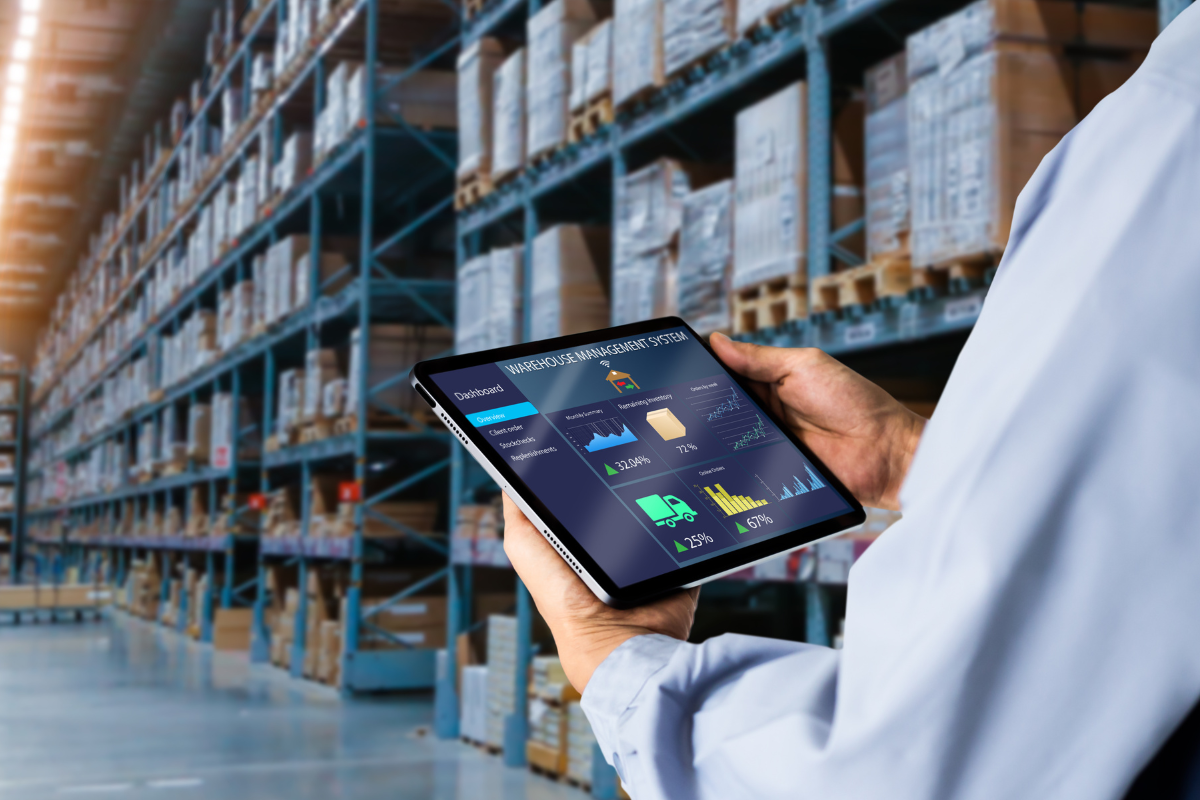
Digitalizing inventory management means replacing manual controls (spreadsheets, notebooks, periodic physical counts and isolated processes) with integrated technological systems that record inflows and outflows, track movements and generate real-time analysis, connecting inventory to other areas of the business such as sales, purchasing and finance.
It is not simply a matter of swapping Excel for software. Real digitalization involves three pillars:
Software system: a platform that centralizes inventory data, automates entries and eliminates dependence on manual recording for every movement.
Cross-department integration: inventory updated automatically with every sale recorded, every invoice issued or every purchase order approved, with no need for double entry.
Real-time visibility: any manager, from any location, can check current inventory levels, movement history and turnover indicators without having to call the warehouse team.
The maturity journey of most companies follows a well-known progression: paper or notebook control, migration to spreadsheets, adoption of inventory software, implementation of an ERP (Enterprise Resource Planning) and, in more advanced operations, integration with artificial intelligence for demand forecasting and automated replenishment.
Each step represents a leap in control and decision-making capacity. The challenge is identifying where your company stands in this journey and what the appropriate next step looks like.
Every company has a different maturity level in this digitalization journey. For some, migrating from a spreadsheet to an off-the-shelf software solves the problem. For others, with more complex operations, specific integrations or accelerated growth, the ideal solution is a custom-built system, developed around the specific needs of the business. That is exactly the work NextAge has been doing for 19 years: building software that adapts to the business, not the other way around.
Spreadsheet vs. System: When Excel Becomes a Liability
Spreadsheets have their merits. For a company with few SKUs, a small team and low transaction volume, they are a legitimate entry point for inventory control. The problem is not the spreadsheet itself: it is insisting on it beyond the point where it can sustain the operation.
According to a G2 and LEAFIO research (2025), approximately 67% of supply chain professionals still use spreadsheets as their primary inventory management tool. In many of those cases, the file has already become a silent time bomb.
The five clearest signs that it is time to migrate:
1. Growing SKU volume. Spreadsheets do not scale well. Beyond a few hundred products with variations, the tool slows down, formulas break and the risk of error grows proportionally.
2. Teams in different locations. When more than one person needs to edit the same file, version control becomes chaotic. Whoever saved last is right, and that is not management.
3. Fiscal integration requirements. Invoice issuance, tax control, regulatory compliance: none of this connects automatically to a spreadsheet. Rework is inevitable.
4. History of errors, corrupted files or lost data. A spreadsheet has no automatic backup, no record of who changed what and can be overwritten with a single careless click. There are real cases of factories brought to a standstill by corrupted files at the most critical moment of the operation.
5. Inability to audit. If someone asks “who removed those 200 items from inventory last Tuesday?”, the spreadsheet has no answer. A management system does.
| Dimension | Spreadsheet | Management System |
|---|---|---|
| Data accuracy | Subject to human error | Automated and validated |
| Cross-department integration | Isolated by file | Connected to sales, purchasing and finance |
| Audit trail | Virtually impossible to track changes | Complete log of every movement |
| Scalability | Breaks down under high volume | Grows with the business |
| Cost of error | High and invisible until it becomes a problem | Low, with automated prevention |
The experience of companies that delayed migration is consistent: by the time the problem surfaces, it has already accumulated months of divergence between physical and virtual inventory. Correcting that retroactively costs far more than prevention would have.
Concrete Benefits of Digitalizing Inventory Control
Digitalization is not a modernization expense. It is an investment with measurable returns, and companies that make this transition in a structured way start seeing results within the first weeks of operation.
Reduction of stockouts and overstock. With real-time visibility, managers do not need to wait for the monthly count to know an item is running low, nor discover at delivery time that a product “in stock” had already been committed to another channel. Balancing shortage and excess is the central objective of any well-managed inventory operation.
Working capital freed up. Excess inventory is idle capital. A system that signals the ideal replenishment point, based on consumption history and supplier lead time, prevents impulse purchasing or fear-based overstocking.
Decisions based on real data. ABC curve analysis (identifying which products account for 80% of turnover), inventory turnover reports and days-of-coverage indicators are unworkable in a spreadsheet and trivial in any minimally structured management system.
Automatic cross-department integration. Every sale recorded at the point of sale or on the e-commerce platform updates inventory in real time. Every approved purchase order already enters the system. Finance sees the cost of goods without manual reconciliation. Integrated digitalization ensures operational agility, cost reduction and strategic data for decision-making.
Traceability and loss prevention. The system records every movement with the user, date and time. Deviations, losses and discrepancies become visible long before they turn into a larger problem.
Scalability without loss of control. A company that doubles in size does not need to double its warehouse staff if it has the right system. Automation absorbs growing volume without loss of precision.
The World Economic Forum highlighted predictive analytics applied to inventory management as one of the most effective tools for increasing the resilience and efficiency of global supply chains (World Economic Forum, 2025). Companies that digitalize their inventory operations report significant reductions in operational costs and improvements in customer satisfaction within the first months.

Technologies That Enhance Digital Inventory Management
The technology market for inventory management has evolved considerably over the past five years. Understanding the available technology landscape is the first step toward choosing the right combination for each operation.
Cloud ERP: the Core of Integrated Management
An ERP (Enterprise Resource Planning) is an integrated system that centralizes, in a single platform, the management of inventory, finance, purchasing, sales, production and other business processes. Cloud ERP is accessed via browser or smartphone, with no local installation required, and its data is updated in real time for all users simultaneously.
For inventory management, ERP delivers what no spreadsheet or isolated system can: an integrated view of the business. A sale on the e-commerce platform updates inventory, generates the billing request and feeds the financial system in the same instant. Cloud ERP is today the most advanced type of inventory control system, with reliable validations, full integration and data security far superior to locally installed solutions.
WMS: For Complex Logistics Operations
A WMS (Warehouse Management System) is software specialized in the physical management of the warehouse: product addressing, picking routes, receiving, checking and shipping. While the ERP handles the financial and fiscal view of inventory, the WMS handles the operation inside the warehouse.
WMS and ERP integration is considered the gold standard for mid to large-scale logistics operations: the WMS synchronizes the physical inventory with the virtual one, eliminating the need for manual updates and ensuring that the inventory recorded in the system matches what is actually on the shelf.
RFID and Barcodes: Automating Inflows and Outflows
RFID technology (Radio Frequency Identification) allows simultaneous reading of dozens or hundreds of products without visual contact, using electronic tags and readers. Companies that adopt RFID report inventory counts up to 15 times faster and accuracy rates close to 99.99%.
Barcodes, more accessible and already widely adopted, serve a similar purpose in smaller operations: automating the recording of product inflows and outflows without manual entry, eliminating errors at the source.
IoT: Continuous and Intelligent Monitoring
The Internet of Things (IoT) applies sensors connected to the physical warehouse environment to monitor temperature, humidity, asset location and product movement in real time. For sectors such as food, pharmaceutical and sensitive inputs, this technology moves from optional to essential.
IoT applied to inventory management involves smart sensors, RFID and connected devices that continuously monitor product movement, enabling real-time monitoring, integrated automation and predictive analysis to adjust replenishment before a stockout occurs.
Predictive Artificial Intelligence: the Next Level
AI applied to inventory management goes beyond automating records. It learns from sales history, seasonality, customer behavior and external events to forecast future demand with far greater accuracy than any traditional statistical model.
In practice, the system identifies that a given product tends to spike in demand in the weeks leading up to a key date and automatically triggers the supplier order with enough lead time to avoid a stockout. Or it flags that a batch has been sitting longer than normal and suggests action to prevent obsolescence. AI replaces traditional statistics with adaptive models that predict multiple seasonalities, calculate dynamic lead times and improve daily, reducing costs, stockouts and freeing up working capital.
The next frontier, according to the World Economic Forum (2025), is near-autonomous supply chains: systems that not only suggest actions but execute them within management-defined parameters, negotiating with suppliers, adjusting prices and reorganizing inventory in real time.
NextAge builds integrated management systems with AI agents capable of predicting stockouts, triggering replenishments automatically and generating reports in natural language. For operations with data complexity that off-the-shelf ERPs cannot handle, learn how we work on Software Projects.
Step by Step: How to Digitalize Inventory Management in Your Company
Inventory digitalization does not happen all at once. It follows a logical sequence that, when respected, drastically reduces implementation risks and increases team adoption.
Step 1: Diagnose the current situation
Before choosing any technology, map what you have: how many SKUs, what the monthly transaction volume is, how many inventory points exist (branches, warehouses, third parties), what integrations are required (fiscal, e-commerce, existing ERP) and what the main bottlenecks in the current operation are.
Without this diagnosis, the risk is high of implementing a solution that solves the wrong problem or underestimates the real complexity of the operation.
Step 2: Choose the solution model
With the diagnosis in hand, it is possible to evaluate which type of solution makes sense: off-the-shelf SaaS software, robust ERP or custom-developed system. Each option has its appropriate company profile, detailed in the next section.
For companies with specific processes (sectors such as healthcare, industry, omnichannel marketplace or operations with differentiated business logic), off-the-shelf models are rarely sufficient. NextAge structures the project discovery, validates the operational specifics and delivers a system with a guaranteed SLA. Learn more about Software Projects.
Step 3: Integrate with other departments
The inventory system needs to communicate with purchasing, sales and finance. Define which integrations are mandatory from day one and which can be implemented in later phases. Fiscal integrations (electronic invoice issuance, regulatory compliance) tend to be critical from the start.
Step 4: Data migration and initial setup
The quality of the initial setup determines the quality of everything that follows. Well-described SKUs, standardized units of measure, registered suppliers and correct opening balances are the foundation of the new system. Underestimate this step and problems surface quickly.
Step 5: Team training and adoption
The best technology fails if the team does not use it correctly. Invest in training before go-live and define a close monitoring period in the first weeks. Resistance to change is normal; what resolves it is demonstrating, quickly, how the new process makes daily work easier.
Step 6: Monitoring and continuous improvement
With the system in operation, track the essential KPIs: inventory accuracy (percentage of items with correct balance), inventory turnover, days of coverage, stockout rate and storage cost. These indicators reveal where the process still has room for improvement and justify future investments in automation.
How to Choose the Right Inventory Management System
There is no universal answer to this question. The right choice depends on the scale of the operation, the complexity of the processes, the available budget and growth plans.
The main evaluation criteria:
- SKU volume and transaction flow: operations with few products and low movement do not need a robust ERP; operations with thousands of SKUs and multiple channels do.
- Integration requirements: e-commerce, marketplaces, fiscal systems, CRM, legacy systems; the more integrations needed, the more important it is to choose an extensible platform or a solution developed specifically for that ecosystem.
- Access model: on-premise (locally installed) vs. cloud (browser access); cloud is the current standard for new implementations due to ease of remote access and lower infrastructure costs.
- Support and SLA: evaluating the vendor’s response time, the existence of a service level agreement and the reputation of support is as important as evaluating the system’s features.
- Total cost of ownership (TCO): the monthly subscription price is only part of the cost. Implementation, data migration, training, customizations and potential rework all need to be factored in.
Off-the-shelf SaaS solutions (such as eGestor, Conta Azul, SOFTClass): ideal for SMEs with relatively standardized processes that need a fast-to-implement solution with accessible monthly costs and included support. The limitation lies in customization: the system works the way the vendor defined it, and adapting very specific processes may be difficult or impossible.
Robust ERPs (such as TOTVS and SAP): indicated for large companies with complex operations, multiple branches and the need for integrated HR, finance, supply chain and production modules. The investment is significantly higher, as is the implementation timeline.
Custom-developed systems: the alternative for companies with differentiated processes, integrations not covered by off-the-shelf systems or specific business logic that no standard ERP delivers. A practical example from NVSoft: the development of a custom system allowed an industrial company to monitor approximately 3 million items per month, with significant waste reduction and full inventory control. Custom development has a higher initial cost but delivers full process alignment and eliminates the recurring costs of forced adaptation.
If your operation has outgrown what off-the-shelf systems can deliver, it is time to talk to specialists in custom development. NextAge has delivered over 600 projects, with agile methodology powered by AI (NextFlow AI) and a guaranteed SLA. Talk to our specialists.
The Future of Inventory Management: AI, Robotics and Autonomous Supply Chains
The inventory digitalization movement that seems advanced for many companies today is already considered the bare minimum in leading global operations. The next cycle of evolution is underway, and understanding where the market is heading helps make technology decisions that will not be obsolete in two years.
Predictive AI as a decision engine. Current artificial intelligence models for inventory management go beyond seasonal demand forecasting. They calculate dynamic lead times, identify real-time customer behavior patterns, correlate external events (such as logistics strikes or currency fluctuations) with inventory level impact and suggest or execute replenishment actions automatically.
Autonomous supply chain agents. The most advanced frontier consists of systems that not only recommend but act: issue purchase orders, negotiate deadlines with suppliers within pre-approved parameters, adjust prices on slow-moving products and reallocate inventory between branches without human intervention. Inventory and logistics automation has evolved: it is no longer about digitalizing processes, it is about making them intelligent, integrated and AI-driven.
RFID integrated with AI. The combination of RFID sensors with machine learning models enables continuous inventory (without needing to stop operations for counting), automatic detection of discrepancies and alert triggering before the problem becomes a stockout or a loss. AI can transform data collected by RFID into automatic decisions that eliminate bottlenecks and reduce waste, from triggering alerts to autonomously reorganizing logistics.
Robotics and AMR (Autonomous Mobile Robots). In mid to large-scale distribution centers, autonomous mobile robots already operate side by side with human teams, performing order picking with superior precision and speed. AMR and AI-driven warehouse automation is now a competitive prerequisite, no longer a differentiator.
ESG and inventory management. The pressure for more sustainable operations has reached supply chain management. Intelligent systems that reduce waste from products nearing expiration, optimize replenishment routes to lower emissions and facilitate reverse logistics are becoming relevant competitive advantages, particularly for companies with public ESG commitments. The World Economic Forum (2025) reinforces that integrating ESG metrics into management algorithms strengthens brand reputation and prepares operations for future regulatory requirements.
Inventory digitalization, viewed from this angle, is not the destination: it is the starting point for a continuous journey of operational intelligence.
FAQ: Frequently Asked Questions about Inventory Digitalization
What does it mean to digitalize inventory management?
It is the process of replacing manual controls (spreadsheets, notebooks, isolated physical counts) with integrated technological systems that record inflows and outflows, track movements and generate real-time analysis, connecting inventory to other areas of the business such as sales, purchasing and finance.
What is the difference between an inventory control system and an ERP?
An inventory control system focuses exclusively on product and movement management. An ERP (Enterprise Resource Planning) is an integrated platform covering inventory, finance, sales, purchasing, production and other areas in a single environment. For growing companies, ERP is generally the natural evolution after adopting an isolated inventory system.
When should I migrate from a spreadsheet to an inventory management system?
The right moment comes when you notice: increasing data entry errors or frequent discrepancies, difficulty integrating inventory with sales and purchasing, the need for remote access by teams in different locations, multiple people editing the same file or significant growth in SKU and order volume. If any of these signs are present, the migration should already have happened.
How much does an inventory management system cost?
SaaS solutions for SMEs cost between R$ 150 and R$ 600 per month, with fast implementation and included support. Robust ERPs such as TOTVS and SAP involve significant upfront investment and higher monthly costs, suited for large-scale operations. Custom-developed systems vary according to project complexity but deliver full process alignment and eliminate recurring costs from forced adaptation.
Is artificial intelligence already being used in inventory control?
Yes, and increasingly so. AI is applied today in demand forecasting, automatic replenishment, consumption pattern analysis, anomaly detection (deviations, fraud, discrepancies) and, in more advanced operations, in autonomous agents that execute actions without human intervention, from triggering purchase orders to reorganizing warehouse layouts.
What is a WMS and when does my company need one?
A WMS (Warehouse Management System) is software specialized in the physical management of the warehouse: product addressing, order picking, receiving and shipping. It complements the ERP, which handles the fiscal and financial view. Companies operating with high physical transaction volumes, multiple warehouse addresses or high order-picking complexity generally benefit from ERP + WMS integration.
How can NextAge help with inventory digitalization?
NextAge develops custom inventory management systems with integration to legacy ERPs, predictive AI modules and autonomous agents. With the NextFlow AI methodology, projects are delivered up to 40% faster than the traditional model, with AI-assisted code review and a guaranteed SLA. The starting point is always a complete discovery process to understand the real operation before writing the first line of code.