 English
  Português
No company hires software development expecting the project to fail. But the numbers tell a different story: about 40% of software projects fail to deliver what was promised, according to the Standish Group Chaos Report. Another 19% are canceled before completion, and 52% exceed their deadline or budget.
The most revealing part: most of these failures are not caused by technical issues. According to the Forbes Tech Council, technology failures rank last on the list. Projects sink long before the first sprint, in the decisions made when choosing a vendor, defining the scope, and structuring the contract.
If you are evaluating hiring a software development company, or if you have already been through a frustrating experience in this process, this guide was made for you. Below, we detail the 8 most common mistakes and what to do differently in each one of them.
Why do so many software projects fail?
Before getting into the mistakes, it is worth understanding the pattern. The Standish Group has tracked technology projects for decades and identified the main causes of failure: poorly defined requirements lead the list, present in 39% of cases; scope creep appears in 33%; inadequate planning in 29%; and communication failures in 25%. Technical problems rank last, at only 17%.
This means that hiring well is, to a large extent, a matter of process, clarity, and judgment in choosing the right partner — not luck or budget size.
The 8 most common mistakes when hiring software development
Mistake 1: Hiring without clear objectives
Imagine starting a construction project without a blueprint. That is exactly what happens when a company approaches a vendor with a vague idea: “I need a system,” “I want an app,” “I want to digitize this process.”
Without clear objectives, any delivery can seem acceptable during the project, and any failure can be disputed at the end. The vendor delivers what they understood; the client expected something else. The result: rework, conflict, and extra cost.
Before contacting any vendor, document at least:
- What problem the software will solve
- Who will use the system and in what context
- Which features are essential (and which are merely desirable)
- What the success criteria look like at 6 and 12 months
That one-page document is the starting point for any honest scope definition. Without it, you are asking the vendor to guess — and the cost of that guessing will show up later.
How NextAge approaches this: every project begins with an AI-assisted scope mapping before the first sprint, to ensure that what was agreed upon is exactly what will be delivered.
Mistake 2: Leaving the scope open and making room for scope creep
Scope creep is the technical term for a very common problem: the project starts with a defined scope and gradually expands throughout execution — one small feature here, a quick adjustment there — until the original budget and timeline no longer make sense.
It is the second leading cause of software project failure, present in 33% of cases according to the Standish Group. And it rarely arrives with a warning sign: it starts small and grows silently.
The IBM Systems Sciences Institute documented a figure that explains the impact well: a requirements change in the first week of a project costs, on average, 1 hour of engineering work. The same change in week 8 costs 10 times more.
An extreme case that illustrates the risk: the ECSS program of the United States Air Force spent US$ 1.1 billion over several years trying to modernize its logistics with an ERP system. It was canceled without delivering anything usable. Uncontrolled scope creep was cited as one of the main causes.
To avoid it: require a prioritized backlog before development begins, with a formal change request process for any scope modification. Changes happen in every project, but they need to go through an impact assessment before any execution takes place.
How NextAge approaches this: the backlog is structured before the first sprint. Any scope change goes through a formal impact assessment on timeline and cost before being incorporated into the project.
Mistake 3: Choosing a vendor based solely on the lowest price
The cheapest proposal is rarely the most economical. A price well below the market average can indicate three things: lack of experience, a poorly understood scope, or a team that is not adequate for the project. In any of these cases, the real cost shows up later.
The McKinsey Global Institute documented that the median cost overrun in large IT projects exceeds 45% of the original value. And 17% of large projects reach a point that threatens the very existence of the company.
Beyond price, what to evaluate before signing a contract:
- Portfolio with cases from projects similar to yours (size, complexity, and industry)
- Documented work methodology (how a sprint works, how tests are conducted, how code review is done)
- Contractual SLA with defined acceptance criteria
- Team stability (is there a professional replacement clause?)
- Communication process and direct access to the technical team
Red flags to watch for: no documented testing process, team without specialized roles (QA, DevOps, analyst), no completed project cases, generic proposal without scope detail.
How NextAge approaches this: with more than 600 projects delivered over 19 years in the market and clients such as Sicredi, XP, and WEG, NextAge brings a concrete track record — not a promise of the lowest price.
Mistake 4: Not requiring SLA and quality metrics
SLA stands for Service Level Agreement: the contractual document that turns expectation into obligation. In software development, it defines what the vendor must deliver, at what quality level and by what deadline — and what happens when that does not occur.

Hiring without an SLA means signing a contract based on hope.
What a solid software project SLA should include:
- Acceptance criteria per sprint (what needs to work for the delivery to be validated)
- Response and correction time for critical bugs
- Escalation process in case of timeline deviation
- Minimum test coverage per delivery
- Progress metrics accessible to the client
Metrics a quality vendor should report: sprint velocity, test coverage, number of bugs per sprint, and accumulated technical debt. If a vendor cannot explain what these metrics are, that is a warning sign.
Worth noting: according to the Standish Group, 29% of software project failures are directly attributed to insufficient testing and the absence of quality assurance.
How NextAge approaches this: the SLA is contractual and code review is AI-assisted across 100% of the development process. The client receives updated progress, quality, and project health reports — without needing a status meeting to know what is happening.
Mistake 5: Underestimating the importance of communication
“The project was delayed because communication broke down.” That sentence summarizes a large share of technology failures: according to the Standish Group, communication failures are identified in 57% of failed projects.
The problem is that communication, in this context, does not simply mean holding meetings. It means having direct channels with the technical team, documenting decisions, recording requirement changes, having clear acceptance criteria per sprint, and a defined feedback process.
Each layer of intermediaries between the client and the developer adds latency. The Project Management Institute estimated that 56% of budget at risk in projects is directly tied to communication problems. On a $500,000 project, that represents $280,000 exposed to waste due to communication friction.
Before hiring, ask: “Can I speak directly with the tech lead or the developer who will work on my project?” The answer says a great deal about how the vendor is structured.
How NextAge approaches this: the squad operates under the client’s direct management. There are no layers of intermediaries between you and the team building your product.
Mistake 6: Not verifying the stability of the allocated team
Replacing the lead developer mid-project carries a real and often invisible cost: the new professional needs weeks to understand the codebase, the business logic, and the technical decisions made up to that point. That onboarding cost, in most contracts, is absorbed by the client — in the form of delays.
There is also a common market practice known as “bait and switch”: the vendor presents a senior team during the proposal and, after the contract is signed, allocates less experienced professionals to the execution. Without a contractual team stability clause, the client has little recourse.
Another pitfall: teams that are too small for the scope. A single “full-stack developer” does not replace a squad with specialists in front-end, back-end, QA, and DevOps. Each role exists for a reason; condensing everything into one person is a cost-saving measure that turns into a technical problem.
What to require before signing:
- Named presentation of the professionals who will work on the project
- Documented experience level for each role
- A replacement clause in case of departure, with a defined timeline and no extra cost to the client
- Minimum squad composition by project type
How NextAge approaches this: professional replacement is guaranteed in the contract. If anything changes in the squad, NextAge handles it — with no impact on the timeline and no additional cost to the client.
Mistake 7: Confusing hours worked with value delivered
The hourly billing model, without a defined scope, has a structural problem: the longer the project takes, the more hours are billed. The vendor’s incentive and the client’s interest become misaligned from the very beginning.
This does not mean the hourly model is always wrong. For ongoing maintenance, unpredictable demands, or exploratory project phases, it can make sense. But even in those cases, it should come with a budget cap, an SLA, and a periodic progress report.
For projects with a defined scope, the recommended approach is a fixed-scope model, with sprint-by-sprint validated delivery and payment tied to delivery milestones. This way, the client knows what they will receive, when they will receive it, and how much they will pay.
The numbers reinforce the risk of an unstructured model: according to the Standish Group 2024, 66% of software projects exceed their timeline or budget. Most of them were operating under contracts without a fixed scope or cost control mechanism.
How NextAge approaches this: NextAge’s Software Projects service operates with a closed scope, defined timeline, and investment agreed upon before the start. You know what you will receive, when you will receive it, and how much you will pay.
Mistake 8: Neglecting the testing and validation phase
When deadlines tighten, the testing phase is the first to be cut. It is also where projects most frequently collapse after launch.
The IBM Systems Sciences Institute is direct: fixing a bug identified during the design phase costs, on average, 1 hour of work. The same bug identified in production can cost 100 times more to resolve.
The consequences go beyond the technical. In Brazil, failures that expose user data can trigger penalties under the Lei Geral de Proteção de Dados (LGPD) — Brazil’s General Data Protection Law. A software product with vulnerabilities is not just an IT problem; it is a legal and reputational risk for the entire organization.
According to the Standish Group, 29% of project failures are directly attributed to insufficient testing and quality practices.

What to require: a documented test plan before development begins, a dedicated QA professional in the squad, acceptance criteria per sprint, and automated regression testing. Before closing a contract, ask to see how the vendor’s quality process works. The answer will be telling.
How NextAge approaches this: validations are performed using proprietary AI that covers all test scenarios before each delivery — ensuring quality before deployment, not after.
Checklist: what to ask before signing the contract
Use this list as a guide in your conversations with vendors. Any vague or absent answer deserves attention:
✅ Did the vendor document the scope before submitting the proposal?
✅ Is there a contractual SLA with clear acceptance criteria per sprint?
✅ Was the team that will work on the project introduced by name?
✅ Is there a professional replacement clause with no extra cost?
✅ Is the code review process documented?
✅ Is there a dedicated QA professional in the squad?
✅ How are delays and sprint deviations communicated?
✅ Are the cases presented from projects of similar complexity and size to yours?
✅ What is the change request process in case of scope modification?
✅ Does the contract include delivery milestones with payments tied to them?
Frequently asked questions
What are the most common mistakes when hiring software development?
The most frequent mistakes are: hiring without clear objectives, leaving the scope open (which creates room for scope creep), choosing a vendor based solely on price, not requiring a contractual SLA, underestimating communication, ignoring team stability, confusing hours worked with value delivered, and neglecting the testing and QA phase. Together, these mistakes explain the majority of projects that fail, run late, or exceed their budget.
How do you prevent a software project from running late?
Prevention starts before development begins: a well-defined scope, a prioritized backlog, and a contractual SLA in place. During execution, it is essential to maintain a validation cadence with the team through sprints with acceptance criteria, control scope changes through a formal change request process, and track progress through objective reports — not subjective perception.
Is it worth hiring a dedicated squad instead of freelancers or a generic software factory?
For medium and high-complexity projects, a dedicated squad offers more predictability and quality. Generic software factories may allocate the same team across multiple simultaneous projects, reducing focus. Individual freelancers rarely cover all the necessary specializations (front-end, back-end, QA, DevOps). A dedicated squad with a closed scope and SLA is the safest choice for strategic projects.
What is an SLA in software development?
SLA (Service Level Agreement) is the contractual agreement that defines the minimum quality and timeline standards the vendor must meet. In software projects, it should include sprint acceptance criteria, response time for critical bugs, an escalation process in case of deviations, and progress metrics accessible to the client. A contract without an SLA is a promise without a guarantee.
How do you know if a software vendor is reliable?
Evaluate: a track record of similar projects with documented cases, a quality process (QA and code review), a team structure with specific roles and experience levels, a communication model with direct access to the technical team, and stability guaranteed by a contractual replacement clause. Be wary of proposals without detailed scope, anonymous teams, and the absence of a testing process.
What is the real cost of a poorly hired software project?
Beyond direct financial waste (the median cost overrun exceeds 45% of the original budget in large projects, according to the McKinsey Global Institute), there are indirect costs: leadership time lost in crisis management, wasted market opportunity, technical rework, and, in some cases, exposure to data protection regulations due to security failures. Projects that need to be rebuilt from scratch typically cost 2 to 3 times the original budget.
Conclusion: a well-hired software project starts before the code does
Hiring software development does not have to be a gamble. The mistakes listed here — vague scope, no SLA, unstable team, ignored testing — are known, predictable, and avoidable. The difference between a project that delivers and one that disappoints lies, in most cases, in decisions made before the first line of code is written.
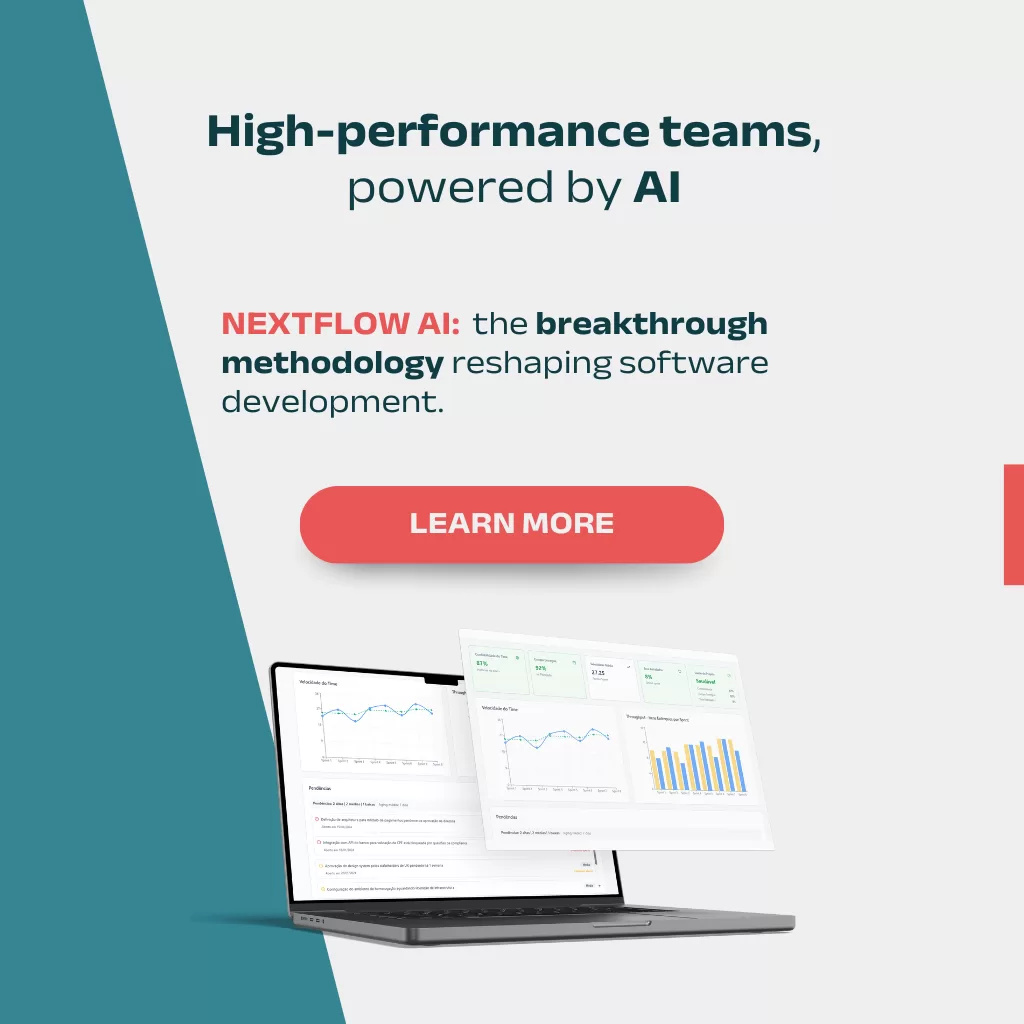
NextAge exists to be the safe side of that equation. With more than 19 years in the market, over 600 projects delivered, and a proprietary methodology (NextFlow AI) that applies artificial intelligence at every stage of development, NextAge assembles dedicated technical squads with a guaranteed SLA, closed scope, and full progress visibility.
If you have a project waiting for the right moment — the available team, the approved budget, the clarity on scope — that moment may be now.
Talk to a NextAge specialist and find out what it takes to finally get your project off the ground.
No cost, no commitment. You leave the conversation with clarity on the next step.