 English
  Português
Agribusiness accounts for roughly a quarter of Brazil’s GDP and about half of the country’s exports, yet today’s producer faces a tough equation: produce more, with fewer resources, under growing environmental pressure. Precision agriculture emerged to solve exactly that impasse. By treating each part of the field according to its specific needs, instead of managing the entire area as if it were uniform, it turns data into decisions and decisions into productivity. In this article, you will understand what precision agriculture is, how it works, which technologies support it and, above all, what lies behind it all: the data and software that convert information into competitive advantage.
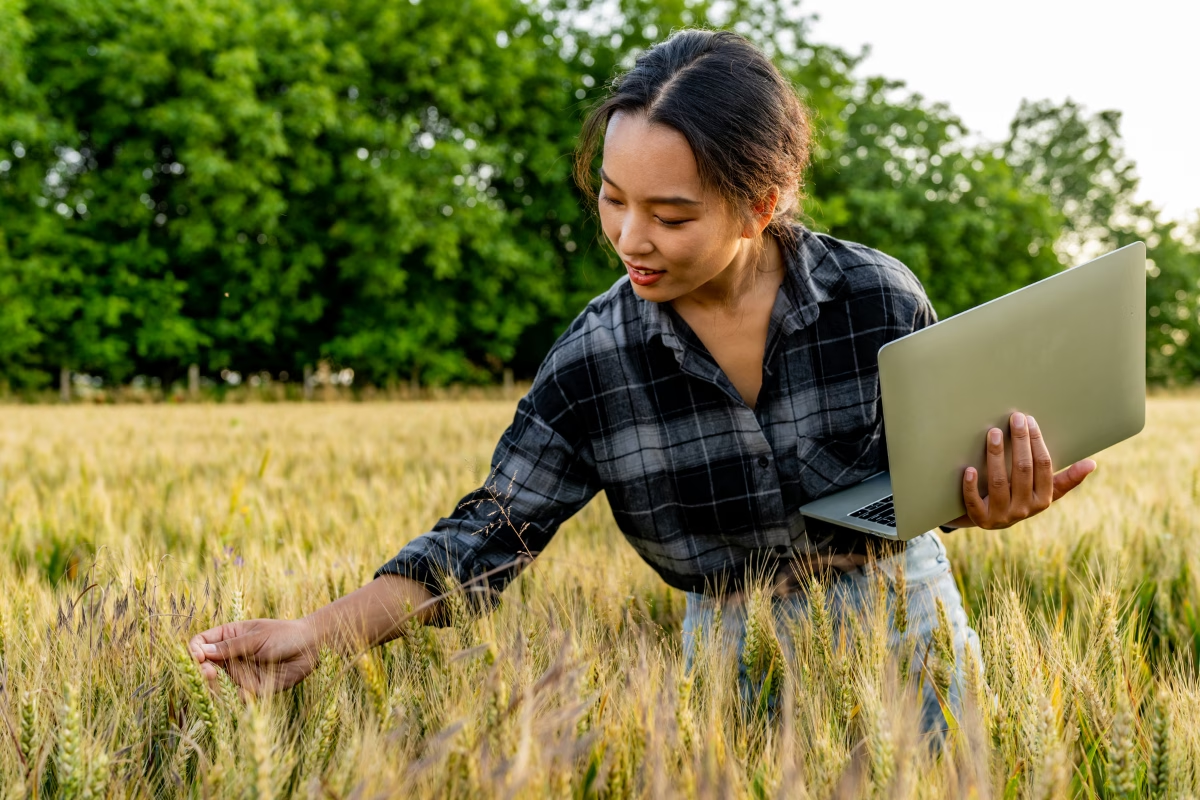
What is precision agriculture?
Precision agriculture is an agricultural management system that uses data and technology to apply inputs and make decisions in a localized way, respecting the differences within a single property. Brazil’s Ministry of Agriculture and Livestock (MAPA) defines it as a management system based on the spatial and temporal variation of the productive unit, aiming to increase economic return, promote sustainability and minimize environmental impact.
The difference compared to traditional agriculture is conceptual. Conventional management treats the field as a homogeneous block: the same amount of fertilizer, water or pesticide is applied from one end to the other. Precision agriculture starts from the opposite principle: soil, climate and productivity vary within the same area, and each part of the field deserves its own treatment. It is the difference between watering the whole garden with the same hose and adjusting the dose plant by plant.
How does precision agriculture work?
Precision agriculture works in a three-stage cycle: collect data, analyze that data and act in a localized way. Each stage relies on specific technologies that work in an integrated manner.
Collection. Soil and climate sensors, drones, satellites and GPS-equipped machines capture detailed information about moisture, fertility, pest presence, plant stage and terrain variations. The result is a granular portrait of the field, plot by plot.
Analysis. Raw data, on its own, is worth nothing. It is in processing that it becomes knowledge: software cross-references the information, generates variability maps and, increasingly, applies artificial intelligence to identify patterns the human eye cannot perceive. Collecting data, it is worth noting, is the easy part. The real challenge lies in transforming millions of points coming from sensors, drones and machines into a clear decision for the producer, which depends on software prepared to handle the volume and variety of these sources.
Application. With the analysis in hand, action becomes surgical. Variable rate technology (VRT) machines automatically adjust the input dose according to the position in the field; irrigation systems activate only where needed; pesticides go solely to critical points. Each resource is used in the right amount, in the right place and at the right time.
Main precision agriculture technologies
Precision agriculture is not a single tool, but the integration of several technologies. Understanding each one helps clarify the type of data it generates and the decision it enables.

- GPS and GNSS: geo-reference machines and samples, allowing the property to be mapped with accuracy that can reach the centimeter scale. It is the foundation everything else rests on.
- Soil and climate sensors: measure moisture, temperature, nutrients and other variables in real time, indicating exactly when and where to intervene.
- Drones (UAVs): fly over the field and identify, through imagery, areas affected by pests, planting failures or water stress, enabling fast and localized action.
- Satellite remote sensing: indices such as NDVI reveal vegetation vigor across large areas, useful for tracking crop development over time.
- Internet of Things (IoT): connects sensors, machines and systems in a network, enabling the continuous flow of data from the field to the decision center.
- Variable rate machines (VRT): execute, on the ground, the recommendation generated by the analysis, adjusting the application meter by meter.
- Artificial intelligence and machine learning: analyze large volumes of data, identify production patterns and generate predictive recommendations.
- Yield maps: consolidate harvest performance by region of the property, showing where yield was higher or lower and guiding the next season.
How precision agriculture boosts productivity in practice
Precision agriculture boosts productivity because it eliminates two forms of waste simultaneously: excess inputs where they are not needed, and a shortage of them where they would make a difference. The gain is not theoretical; it shows up in the numbers.
According to Revista Cultivar, based on data from the Brazilian Association of Precision and Digital Agriculture (AsBraAP), variable rate work has enabled gains of up to 6 bags per hectare of soybeans and up to 13 bags per hectare of corn, when properly used. In properties that adopted precision agriculture supported by artificial intelligence, surveys attributed to Embrapa point to savings of up to 30% in fertilizer use and an average productivity increase between 15% and 20%.
Three examples illustrate how these gains happen day to day:
- Smart irrigation: in a vegetable operation, moisture sensors send real-time data and an automated system triggers irrigation only when the soil actually needs it, avoiding excess water and reducing energy consumption.
- Localized spraying: on a coffee farm, drones fly over the fields and identify pest-affected areas; the technician then applies pesticides only to critical points, instead of treating the entire area.
- Yield map: during the corn harvest, the machine generates a map showing points of higher and lower yield, information that guides management adjustments in the following season.
In every case, the principle is the same: the decision is no longer based on the property’s average and instead respects the reality of each meter of field.
Benefits beyond productivity
While the increase in yield is the most visible gain, it is not the only one. Precision agriculture delivers value on several fronts:
- Cost reduction: applying inputs only where they are needed means spending less on fertilizers, pesticides, water and fuel.
- Sustainability and ESG: the rational use of resources reduces environmental impact and helps meet the growing demands of production chains for traceability and low carbon emissions.
- Traceability: the detailed record of each operation makes it easier to prove origin and comply with the standards of premium markets, both domestic and abroad.
- Risk management: decisions based on real data reduce uncertainty and make the producer more resilient to the volatilities of climate and market.
- Better decision-making: with reliable and up-to-date information, the manager acts in advance, instead of reacting to problems already in place.
Data is the new input: the challenge of integrating everything
Here is the point that usually separates those who merely bought technology from those who actually extract value from it. Sensors, drones and machines generate data all the time, but in practice each piece of equipment speaks its own language. The sensor from one brand, the drone from another and the harvester from a third produce information in different formats that rarely talk to each other. The result is familiar to anyone who has already advanced in adoption: data scattered across spreadsheets, systems that do not integrate, and no single, reliable view of the operation.
This is the silent bottleneck of precision agriculture. There is no point in investing in cutting-edge equipment if the information it generates remains isolated in islands. Value only appears when data is centralized, cross-referenced and transformed into decisions.
That is why many of the more mature agribusiness operations turn to custom software projects: platforms developed specifically to gather data from distinct sources, apply artificial intelligence to it and deliver a consolidated, reliable view of the field. This is precisely the kind of challenge that NextAge solves. With its Software Projects service, we assemble a dedicated technical squad to develop the platform your operation needs: from integration with sensors and agricultural ERPs to productivity dashboards and AI models, with defined scope, deadlines and SLA, plus AI-assisted code review on every delivery. You keep full control of the project; we guarantee the technical level.
How to get started with precision agriculture
Successful adoption of precision agriculture follows a logical path, and skipping stages tends to be costly. A recommended route:
- Property diagnosis: map soil fertility, productivity history and the specific challenges of your region. Each property has its own demands.
- Technology selection: choose sensors, drones and software according to the real need of each crop, not the novelty of the equipment.
- Team training: ensure people know how to operate the tools and, above all, interpret the data. Poorly used technology generates no return.
- Data integration: connect the different sources into a single platform. It is at this stage, often underestimated, that a partner specialized in software development makes the biggest difference, because it is what turns isolated equipment into a system that communicates.
- Continuous evolution: treat precision agriculture as a process, not a project with an end date. Each season generates new data that refines the following decisions.


The future: smart farms, AI and digital twins
The direction the sector is heading is already clear. Smart farms will be increasingly connected, monitored and automated, with sensors, machines and systems operating in an integrated way in real time. Artificial intelligence will move beyond merely describing what happened to predicting what will happen, anticipating pests, water stress and ideal planting and harvesting windows. Digital twins, virtual replicas of the operation fed by real data, will allow scenarios to be simulated before acting in the field.
This future depends on a foundation being built right now: rural connectivity. In 2025, about a third of Brazil’s agricultural area already had 4G or 5G coverage, and internet access reached approximately 85% of the rural population, according to a sector review published by Syngenta. As this infrastructure expands, the frontier shifts from access to technology toward the ability to turn data into software, and software into decisions.
Conclusion
Precision agriculture boils down to a chain that is simple to state and challenging to execute: reliable data, intelligent analysis and localized action. Those who master this chain produce more, spend less and decide better. The missing link is usually not in the field, but in the technology layer that connects everything: the platform capable of integrating different sources, applying AI and delivering a single, actionable view.
Precision agriculture only delivers its full potential when data becomes software, and software becomes decisions. If your agribusiness operation already generates data but does not yet turn it into competitive advantage, it is worth a conversation. Talk to the NextAge specialists and find out how to get the technology project your agribusiness needs off the ground.
Frequently asked questions
What is precision agriculture?
It is an agricultural management system that uses data and technology (GPS, sensors, drones and software) to treat each part of the field according to its specific needs, instead of managing the entire area uniformly.
How does precision agriculture boost productivity?
It boosts productivity by applying inputs in the right amount, in the right place and at the right time, based on real soil and plant data, which reduces waste and maximizes the yield of each plot.
Which technologies are used in precision agriculture?
The main ones are GPS/GNSS, soil and climate sensors, drones, satellite remote sensing, IoT, variable rate application machines and data analysis software with artificial intelligence.
Is precision agriculture only for large producers?
No. Although it began in large areas due to equipment costs, falling prices for sensors and drones and growing rural connectivity are making the practice accessible to medium-sized producers as well.
What is the role of software in precision agriculture?
Software is what transforms collected data into decisions. Without a platform capable of integrating and analyzing data from different sources, information stays isolated and the operation does not extract the value the technology offers.
How do you integrate data from different agricultural equipment?
Integration generally requires a custom-developed platform, capable of connecting sensors, machines and ERPs via APIs and consolidating everything into a single dashboard, a project usually led by a team specialized in software development.