 English
  Português
Without Alan Turing, computers, smartphones, and the internet as we know them would likely have taken decades longer to exist. And artificial intelligence, the technology transforming entire industries today, might not even have a name.
Turing was a British mathematician who lived only 41 years (1912–1954) and, in that time, accomplished something very few people manage in a lifetime: he permanently changed the course of civilization. He not only created the theoretical foundation of every modern computer, but also posed the questions that guide the development of artificial intelligence to this day.
At NextAge, we work daily with the technologies Turing made possible: AI agents, machine learning systems, custom-built software platforms. Understanding the origin of these technologies means understanding better what we do, why we do it, and where we are heading. That is why this article tells the story of the man who, before any technology company existed, had already imagined the future we are building.
In this text you will learn about Alan Turing’s trajectory, his main inventions and concepts, his decisive role in World War II, his contribution to the birth of artificial intelligence, and the legacy that remains alive in every line of code written in the world today.
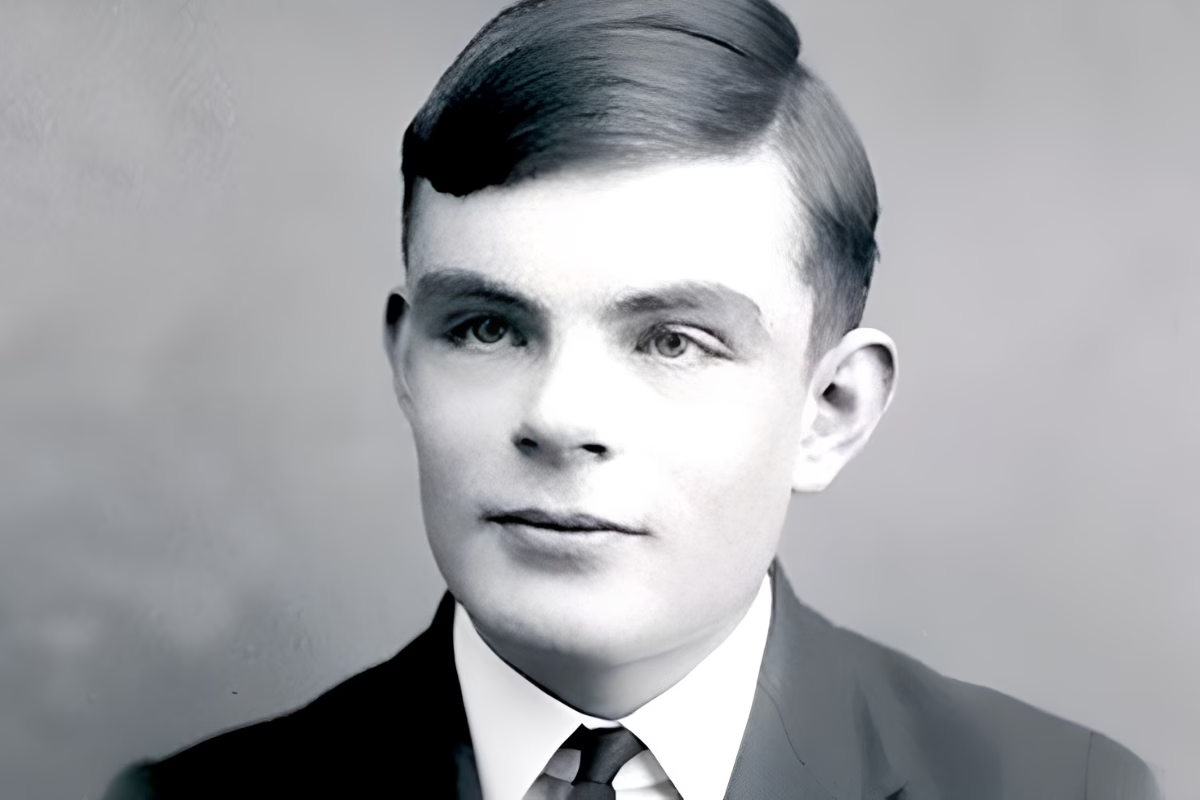
Who Was Alan Turing?
Alan Mathison Turing was born on June 23, 1912, in Westminster, London, England. From childhood, he demonstrated an extraordinary aptitude for mathematics and logic, with an intelligence clearly recognized by his own teachers. By the age of 13, he already showed a singular talent for numbers and exact sciences.
He studied at Sherborne School and later entered King’s College, Cambridge, where he graduated in Mathematics in 1934. The following year, he was elected a Fellow of the university for his dissertation on Bernoulli numbers (a sequence with great importance in number theory). In 1938, he earned his doctorate in Mathematics from Princeton University in the United States, where he was supervised by mathematician Alonzo Church.
It was during his years at Cambridge that Turing began to formulate the ideas that would change the world. Fascinated by mathematical logic and the nature of computation, he questioned the limits of what machines could do, and whether there were mathematical problems no machine would ever be able to solve. That question led him to create, in 1936, the most important concept of his career: the Turing Machine.
According to the Encyclopaedia Britannica, all modern computers are, in essence, a product of the technological advancement driven by Turing. (Source: Encyclopaedia Britannica — Alan Turing)
What Is the Turing Machine?
In 1936, Turing published the seminal paper “On Computable Numbers, with an Application to the Entscheidungsproblem” in the Proceedings of the London Mathematical Society. In that work, he introduced the concept that became known as the Turing Machine.
The Turing Machine is not a physical machine: it is a theoretical model. It describes a hypothetical device capable of reading, writing, and manipulating symbols on a tape according to a set of predefined rules. Through these simple operations, the device would be capable of simulating any computational process that could be described by an algorithm.
This may sound abstract, but it has an enormous practical consequence: Turing proved that a single device, following the right instructions, could solve any computable problem. That is the foundation of the general-purpose computer; the same principle that allows your laptop to run a text editor, a browser, an engineering application, and an AI model, all on the same machine.
Another direct legacy of this model is the conceptual separation between software (the logical instructions) and hardware (the physical structure that executes them). This distinction, which today seems obvious, was formalized by Turing decades before any commercial computer existed. (Source: Tecnoblog — Who Was Alan Turing)
At NextAge, the separation between software and hardware is the foundation of everything we build. When our squads develop an AI agent platform, a machine learning fraud prevention system, or a high-performance web application, they are operating within a paradigm that Turing formalized in 1936. The software we write today is a direct descendant of the Turing Machine.
Alan Turing and World War II: How He Shortened the Conflict
The work of Turing that had the greatest short-term impact on the world was not theoretical: it was practical, urgent, and secret.
During World War II (1939–1945), Nazi Germany used a sophisticated cryptography system to transmit military orders without enemies being able to intercept them. The machine behind this system was called Enigma, developed by German engineer Arthur Scherbius. It created encrypted messages through rotors that generated millions of possible combinations, and the settings changed every 24 hours, making manual decryption practically impossible.
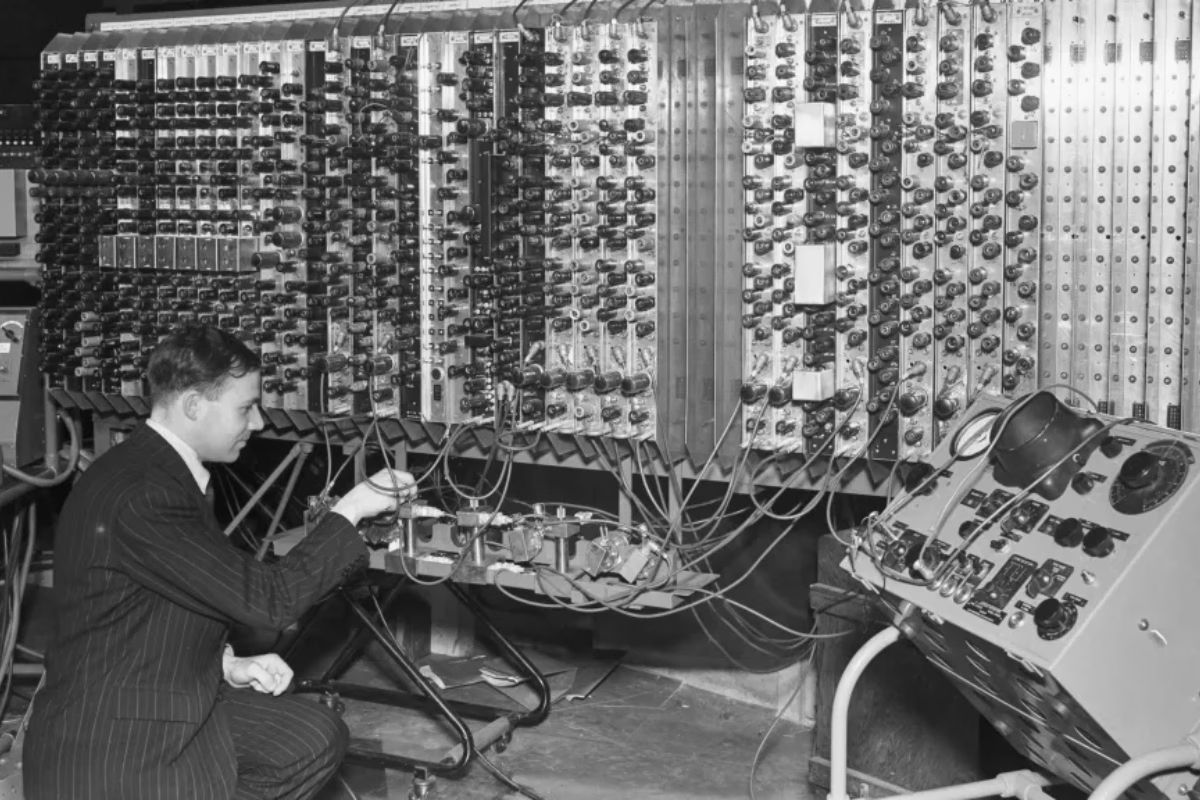
As soon as Britain entered the war, Turing was recruited to work at the Government Code and Cypher School, at the secret center of Bletchley Park. There, he led a team of mathematicians, cryptographers, and linguists with a single objective: break the Enigma.
Turing drew inspiration from an earlier machine, the Polish Bombe (created by mathematician Marian Rejewski), and developed a significantly more efficient British version. Turing’s Bombe was an electromechanical device capable of automatically testing Enigma code settings at high speed, reducing the search space to a manageable set that could be verified manually. More than 200 of these machines were built by the British during the war.
The result was decisive. With the ability to read enemy communications, the Allies were able to anticipate naval movements, prevent attacks, and plan operations with privileged information, including D-Day, the Normandy invasion in June 1944, which marked the beginning of the collapse of the Third Reich.
Historians estimate that the work of Turing and his team at Bletchley Park shortened the war by at least two years and saved millions of lives. (Sources: Medium — Turing Talks; Dry Telecom — The Architect of Digital Thought)
For decades, all of this work remained an absolute secret, protected by the British Official Secrets Act. Documents about Bletchley Park only began to be revealed to the public in the 1970s, which means Turing received no public recognition during his lifetime for what he did in the war.
Alan Turing and Artificial Intelligence: The Question That Changed Everything
After the war, Turing turned his attention to a question that had accompanied him for years: could machines think?
In 1950, he published the paper “Computing Machinery and Intelligence” in the philosophical journal Mind. The opening question was direct: “Can machines think?” Turing argued that this question was poorly formulated, because “thinking” was difficult to define. Instead, he proposed a practical experiment to evaluate whether a machine exhibited intelligent behavior: what he called the “imitation game,” later known as the Turing Test.
The test works as follows: a human evaluator interacts via text with two entities, a machine and a human, without knowing which is which. If the evaluator cannot consistently distinguish the machine from the human, the machine is considered capable of exhibiting intelligent behavior.
The elegance of the Turing Test lies in its practicality: it does not ask “what is intelligence?” (a philosophical question with no definitive answer), but rather “is this machine’s behavior indistinguishable from human behavior?” (an empirical, testable question). This methodological shift was the starting point for all artificial intelligence research that followed.
Turing was also one of the first scientists in the world to seriously consider the possibility of machines learning, the precursor of what we today call machine learning. According to Nature magazine, he was one of the first people to think of computers as a system capable of responding to any type of problem. (Source: National Geographic Brasil — Who Was Alan Turing)
At NextAge, the Turing Test is not just history: it is a real conceptual reference. When we develop conversational AI agents for companies, one of the quality metrics is precisely the fluency and naturalness of the interaction. The question Turing asked in 1950, “is this machine’s behavior indistinguishable from a human’s?”, remains one of the most relevant for anyone working with AI applied to business.
Other Contributions by Alan Turing
The Church-Turing Thesis
In collaboration with his doctoral supervisor, mathematician Alonzo Church, Turing formulated what became known as the Church-Turing Thesis. It postulates that any computable function can be executed by a Universal Turing Machine. In practical terms, this means that every problem that can be solved algorithmically can, in principle, be solved by a computer. This principle is the theoretical foundation of all modern computer science. (Source: HES Blog — Alan Turing: The Father of Modern Computing)
The ACE: One of the First Digital Computer Designs
After the war, Turing worked at the National Physical Laboratory and developed the design for the ACE (Automatic Computing Engine), one of the first detailed blueprints for a digital computer with programs stored in memory. He later moved to the University of Manchester, where he continued research in computer design and even created one of the first chess programs for a computer.
Mathematical Biology
In 1952, Turing published “The Chemical Basis of Morphogenesis,” proposing a mathematical model to explain how complex patterns (such as zebra stripes or leopard spots) form from simple chemical reactions. This work is considered one of the foundations of mathematical biology and complex systems, fields that today influence everything from epidemic modeling to ecosystem simulation.
The Tragic End of a Genius and His Belated Rehabilitation
Turing’s life ended in a profoundly unjust way.
In 1952, he was prosecuted by the British government for “gross indecency” after admitting to a homosexual relationship, conduct criminalized in England at the time. As an alternative to imprisonment, he was subjected to chemical castration, a hormonal treatment that caused him serious physical and psychological consequences. He also lost his security clearance and was barred from continuing to work for the government.
Alan Turing died on June 8, 1954, at the age of 41, from cyanide poisoning. The cause was presumed to be suicide, although some historians have raised the possibility of an accident.
Public recognition for his role in the war and in science took decades. In 2009, British Prime Minister Gordon Brown issued a formal public apology for the treatment Turing received. In 2013, Queen Elizabeth II granted him an official posthumous pardon. And on June 23, 2021 (his birthday), the Bank of England placed his portrait on the £50 note, making him the only scientist to appear on a British banknote.
In a BBC poll conducted in 2019 to elect the greatest scientist of the 20th century, Alan Turing was chosen as the winner by the public.
Alan Turing’s Legacy: From Algorithm to Generative AI
Turing’s legacy is diffuse in the best possible sense: it is everywhere, invisible and omnipresent.
Every time a developer writes a function, an algorithm, or a conditional loop, they are operating within the conceptual framework that Turing formalized. Every time a company uses machine learning to detect fraud, personalize experiences, or automate decisions, it is applying ideas that he was the first to imagine systematically.
The greatest institutional recognition of his legacy is the Turing Award, granted annually by the ACM (Association for Computing Machinery) since 1966. Frequently called the “Nobel Prize of Computing,” it recognizes the most important contributions to computer science: from artificial intelligence and databases to programming languages and operating systems. (Sources: Eurocid — A.M. Turing Award; Wikipedia — Turing Award)
NextAge was founded in 2007, more than half a century after Turing’s death. But carrying the DNA he helped create is a responsibility we take seriously. When we develop an AI agent platform that generated a 6.7% increase in revenue for a telecom operator with 67 million customers, or a machine learning system that analyzes 150 variables in real time to detect fraud with an 84% reduction in losses, we are building on the foundation he erected alone, at a time when no one knew exactly what was being built.
The question Turing asked in 1936 (“what can a machine compute?”) and the one he asked in 1950 (“can machines think?”) remain the most important questions in the technology sector. Every company working with software, data, or AI lives, in some way, within the answers he began to construct.
Frequently Asked Questions About Alan Turing
Who was Alan Turing?
Alan Turing was a British mathematician, computer scientist, and cryptographer (1912–1954), considered the father of modern computing and artificial intelligence. He created the Turing Machine in 1936 (the theoretical foundation of all computers), developed the Bombe to decipher the Enigma code during World War II, and proposed the Turing Test in 1950 to evaluate the intelligence of machines.
What is the Turing Machine?
The Turing Machine is a theoretical model created in 1936 that describes a device capable of reading, writing, and manipulating symbols on a tape according to predefined rules, simulating any computational process describable by an algorithm. It is the foundation of the theory of computation and formalized the distinction between software and hardware.
What is the Turing Test?
The Turing Test, created in 1950 in the paper “Computing Machinery and Intelligence,” is a method for evaluating whether a machine exhibits intelligent behavior indistinguishable from a human’s. A human evaluator interacts via text with a machine and a human without knowing which is which. If they cannot tell them apart, the machine is considered capable of exhibiting intelligent behavior. It remains a fundamental reference in AI research.
How did Alan Turing help in World War II?
Turing led the Bletchley Park team that developed the Bombe, an electromechanical machine capable of automatically testing Enigma settings (the Nazi cryptography system) at high speed. This allowed the Allies to regularly read enemy communications. Historians estimate that this work shortened the war by at least two years and saved millions of lives.
Why was Alan Turing persecuted?
Turing was homosexual, and homosexuality was criminalized in the United Kingdom at the time. In 1952, he was convicted of “gross indecency” and subjected to chemical castration as an alternative to imprisonment. He died in 1954. In 2009, the British government issued a formal public apology. In 2013, he received a posthumous pardon from Queen Elizabeth II.
What is the Turing Award?
The Turing Award is the highest recognition in computer science, granted annually by the ACM (Association for Computing Machinery) since 1966. Frequently called the “Nobel Prize of Computing,” it honors lasting and fundamental contributions to the field, in areas such as artificial intelligence, programming languages, databases, and algorithms.
Conclusion
Alan Turing left us a legacy that goes far beyond mathematical theory. He showed that the right question, asked with rigor and courage, can change the course of humanity. And he did so at a time when there was no vocabulary to name what he was creating: no commercial computers, no programming languages, no concept of software as we understand it today.
Everything that exists in the modern digital universe (every application, every AI system, every recommendation algorithm, every software platform) is, in some way, a descendant of the work he began alone in the 1930s and 1950s.
At NextAge, we honor that legacy not with words, but with what we build: technology that solves real problems, with technical rigor, agile methodology, and artificial intelligence applied with purpose. If your company wants to build software that makes a difference, with teams that deeply understand the technology they use, let’s talk.