 English
  Português
Road transport moves more than 60% of all goods in Brazil, and every shipment in transit carries a risk that keeps weighing on operations’ bottom line. In 2025 alone, there were roughly 8.5 thousand cargo theft incidents in the country, with direct losses estimated at approximately R$900 million, a figure that surpasses R$1 billion once the indirect effects on insurance, operating costs, and final product prices are taken into account, according to CNN Brasil.
Faced with increasingly complex operations and customers who demand transparency at every stage of delivery, real-time cargo tracking has stopped being a competitive edge: it has become a baseline requirement for anyone who wants to stay in the game. In this article, you’ll understand what this kind of tracking is, how it works in practice, which technologies support it, and, above all, why the quality of the software behind it determines who scales their operation and who falls behind.
What is real-time cargo tracking
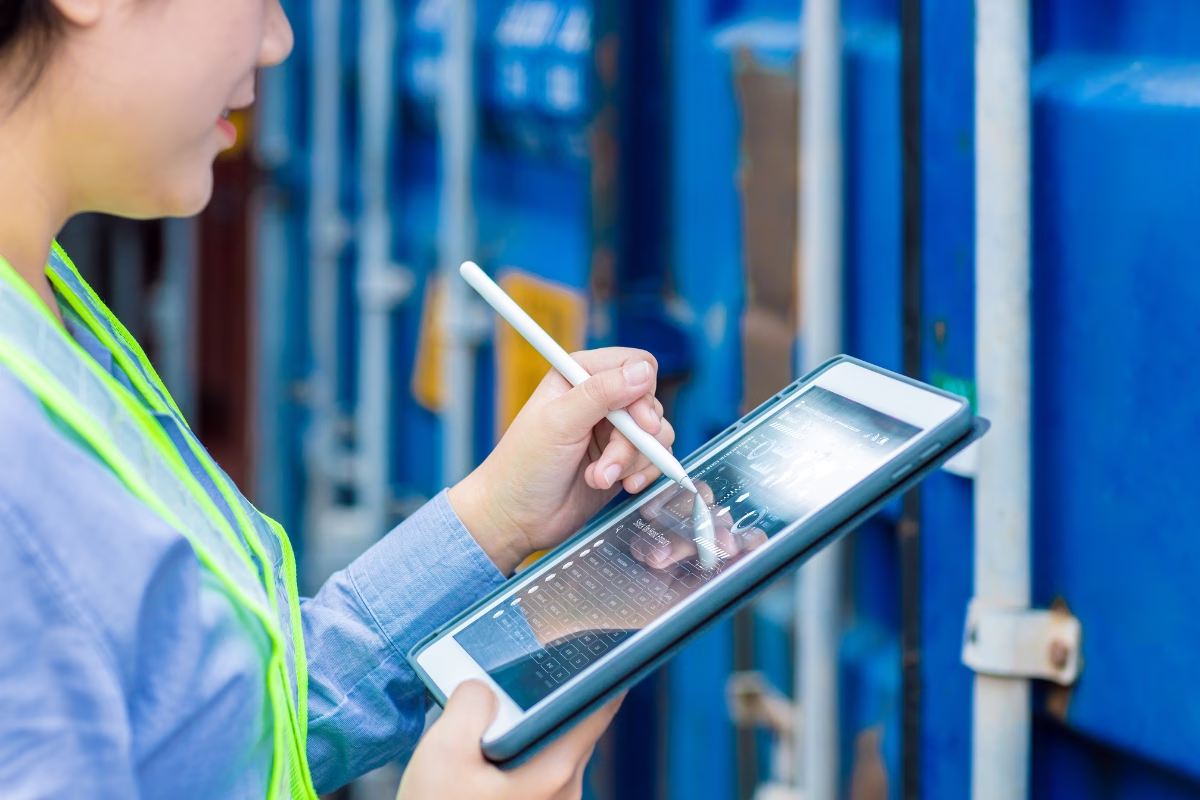
Real-time cargo tracking is the ability to continuously follow the location and status of a shipment from its point of origin to final delivery. More than knowing where the cargo is, it allows you to anticipate delays, identify deviations, and act quickly in the face of any unexpected event.
One distinction is worth making, since it often causes confusion. Tracking and monitoring are not the same thing. Tracking focuses on locating: answering the question “where is my cargo right now.” Monitoring is broader: it also follows transport conditions, such as temperature, humidity, vibration, and driver behavior, enabling more proactive and safer management throughout the journey. In practice, the most mature operations combine both.
How real-time cargo tracking works
Behind the screen where the manager watches the truck move across the map, there is a well-defined data flow. It can be summarized in four steps:
- Signal emission: a device installed on the vehicle or on the cargo itself captures the location, usually via satellite (GPS), and records movement data.
- Transmission: this information is sent over mobile networks, satellite, or radio frequency to a central hub.
- Processing: a monitoring center or software platform receives the data, organizes it, and cross-references the information.
- Visualization: the manager and the customer follow, on a dashboard or app, the cargo’s position, the route taken, the estimated delivery time, and any alerts for deviations or unauthorized stops.
In practice, the tracker is only the beginning. What turns a GPS signal into a decision is the software that receives, cross-references, and organizes that data into a clear dashboard. That’s why two operations using the same trackers can have completely different results: what changes is the intelligence behind the information.
The technologies behind cargo tracking
No single technology can handle everything. Modern tracking combines several layers, each solving part of the problem:
- GPS: the foundation of real-time location. A network of satellites determines the vehicle’s exact geographic position almost anywhere.
- RFID (radio-frequency identification): uses radio waves to identify and track items individually. It is especially useful in warehouses and for item-by-item inventory control.
- Telemetry: goes beyond location and collects data on the vehicle and the driver (speed, hard braking, idle time), supporting safe-driving programs as well.
- IoT and sensors: connected devices monitor temperature, humidity, and impact, offering visibility practically minute by minute and enabling predictive maintenance.
- Satellite and radio-frequency communication: ensure coverage in remote areas and enclosed environments, such as tunnels and warehouses, where conventional signals fail.
There is one detail that separates operations that merely collect data from those that actually use it. Isolated sensors generate a volume of information but little real gain without integration into management platforms and well-defined processes. In other words: technology generates data; software turns that data into intelligence.

Why your operation needs real-time tracking
The benefits go well beyond “knowing where the truck is.” The main ones are:
- Cargo security: allows you to prevent and respond quickly to theft, deviations, and losses, a problem that, even while declining, still costs the sector more than R$1 billion a year.
- End-to-end visibility: the manager sees every shipment in motion and can anticipate bottlenecks before they turn into delays.
- Route optimization and cost reduction: with real-time data on traffic and road conditions, it’s possible to reroute, save fuel, and improve fleet utilization.
- Customer experience: proactive notifications and reliable delivery estimates reduce friction and cut the volume of customer service calls.
- Data-driven decisions: indicators such as OTIF, cost per kilometer, and utilization rate stop being estimates and start guiding management.
- Compliance: meets increasingly strict traceability requirements, especially in sectors such as food and pharmaceuticals.
Real-time visibility, in fact, is cited as one of the biggest demands in the logistics market for 2026, according to the supply chain trends mapped by Maxitrans. Operating without it is already considered a risk to the business.
The challenge no one talks about: data that doesn’t connect
Up to this point, everything seems solved by a good off-the-shelf platform. The problem usually appears when the operation grows.
It’s common for the tracker to come from one vendor, the TMS from another, the ERP to be proprietary, and spreadsheets still in the mix. The result is fragmented data, rework, and decisions made on incomplete or outdated information. The promised “real-time visibility” becomes a puzzle no one can fully assemble.
The trend for the coming years moves in the opposite direction of this fragmentation. The TMS stops being merely a transport tool and takes on the role of a corporate data hub, integrating demand, inventory, distribution, and performance information, as described by Logweb in its analysis of logistics in 2026. Integration between TMS, WMS, and ERP is precisely what allows inventory accuracy to rise above 99%, according to Triadlog.
The point is that closed solutions handle the basics, but they rarely meet each operation’s specific rules, integrate with legacy systems, or scale at the pace of the business. When the operation needs custom dashboards, API integrations that connect tracking, TMS, WMS, and ERP, and its own business rules, the solution stops being an off-the-shelf system and becomes a software project.
This is exactly what NextAge does: assembling a dedicated technical squad that builds the integration and visibility layer the operation needs, with a defined scope, deadline, and SLA, while keeping you in full control of decisions. With more than 19 years in the market, over 600 projects delivered, and clients such as Sicredi, XP, WEG, and Scania, the company operates precisely where off-the-shelf solutions fall short.
How to implement real-time tracking in your operation
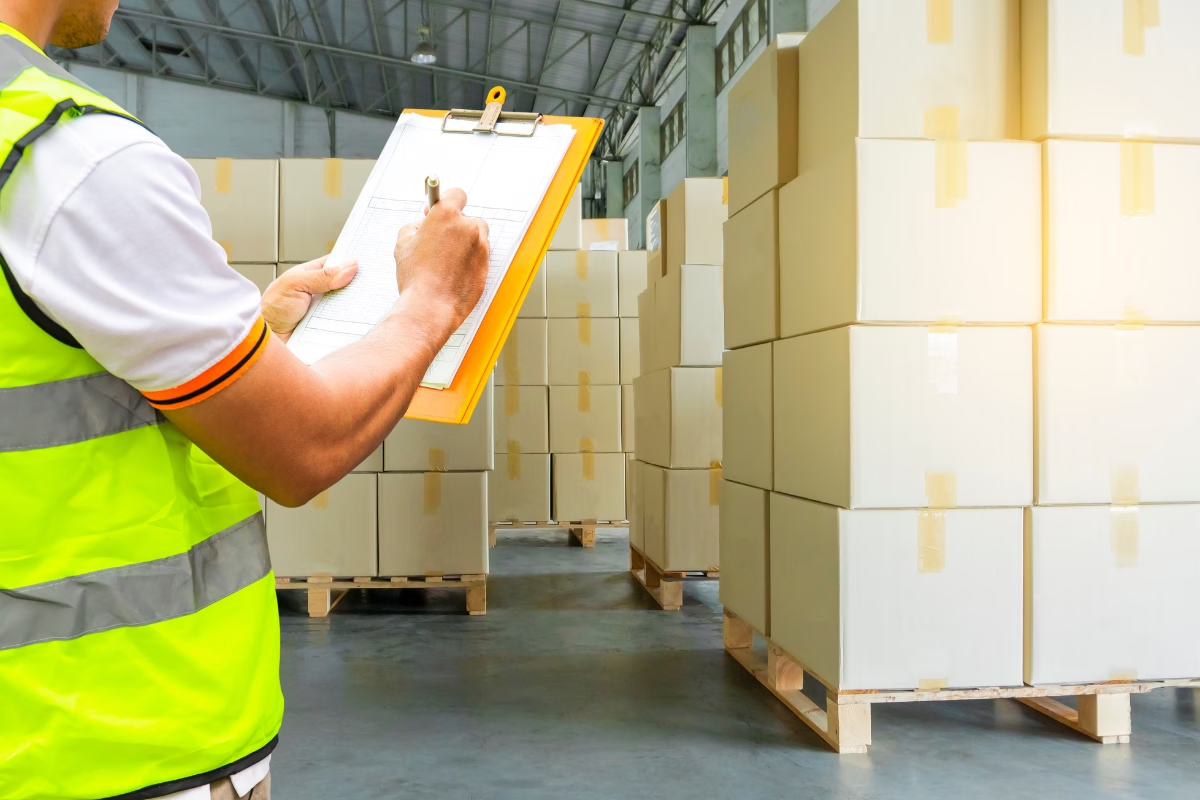
Adopting (or maturing) real-time tracking is a project, not a one-off purchase. A structured path usually follows these steps:
- Map the bottlenecks and objectives: is the focus on security, cost reduction, customer experience, or all of these? The priority guides everything else.
- Define clear KPIs: OTIF, cost per kilometer, incident rate, average delivery time. Without indicators, there’s no way to measure gains.
- Assess the technologies you need: the type of cargo defines what is essential. Sensitive products require temperature sensors; high-value cargo calls for extra layers of security.
- Analyze integration with your current systems: this is the decisive criterion. A powerful tool that doesn’t talk to your ERP or TMS is of no use.
- Decide between an off-the-shelf solution and custom development: consider volume, complexity, customization needs, and the ability to scale.
On that last point, an honest piece of guidance: for medium- and high-complexity operations, with legacy systems and their own rules, custom-built software tends to deliver more than any closed solution, because it is built for your reality, and not the other way around.
Frequently asked questions
What is real-time cargo tracking?
It is the ability to continuously follow the location and status of a shipment, from origin to delivery, through technologies such as GPS, IoT, and communication networks integrated into a software platform.
What is the difference between cargo tracking and monitoring?
Tracking focuses on locating the cargo (where it is). Monitoring is broader: it also follows conditions such as temperature, humidity, vibration, and driver behavior, enabling more proactive management.
Which technologies are used in cargo tracking?
The main ones are GPS, RFID, telemetry, IoT sensors, and satellite and mobile network communication. Each covers a specific need, and the greatest gain comes from integrating all of them into a single system.
Does real-time tracking reduce cargo theft?
It helps prevent and respond faster to deviations and theft. There are market cases, such as the one reported by Buonny, with up to a 35% reduction in incidents after adopting monitoring solutions, although the result depends on the operation and on integration with risk management.
Is it better to use an off-the-shelf system or develop custom software?
Off-the-shelf systems meet basic needs. Medium- and high-complexity operations, with multiple systems (TMS, WMS, ERP) and their own rules, tend to benefit more from custom-developed software, which integrates everything into a single view and scales along with the business.
How do I integrate tracking into my company’s management system?
Through APIs and the development of integrations that connect the tracker and telemetry to the TMS, WMS, and ERP, centralizing the data in a single dashboard. This work usually requires a development team with experience in systems integration.
Conclusion
Real-time cargo tracking has gone from being a luxury for large operations to a market requirement. The technologies that support it (GPS, RFID, telemetry, IoT) are already mature and accessible. What truly separates the operations that scale from those that fall behind is not the tracker itself, but the quality of the software that connects everything and turns scattered data into decisions.
If your operation already understands the importance of real-time tracking but keeps running into systems that don’t integrate, the next step is to build the right solution. NextAge develops software projects with a dedicated squad, guaranteed technical quality, and predictable delivery, to give your logistics the full visibility the market demands. Let’s talk.