 English
  Português
ControleNaMão, a Brazilian restaurant management platform, worked with NextAge to put Claude into production at the step that was capping its growth: configuring each new customer’s menu. What took an analyst 4 to 24 hours now takes 10 to 40 minutes, the dedicated team went from five people to two, and the company now onboards 100% of the month’s sales with no backlog.
| Customer | Controle na Mão, a complete restaurant management system with POS, delivery, inventory, tax document issuance and digital tabs, serving bars, snack bars and restaurants |
| Country | Brazil |
| Delivery partner | NextAge (member of the Claude Partner Network) |
| Use cases | Automated menu ingestion (document extraction) · Support conversation analysis (operational intelligence) |
| Anthropic product | Claude API (Claude Sonnet 5, on both fronts) |
| Engagement type | Project / Program (built, deployed and maintained by NextAge) |
| Status | Two fronts in production: ingestion since July 2026, support analysis since September 2026 |
The bottleneck sat in the customer’s first hour
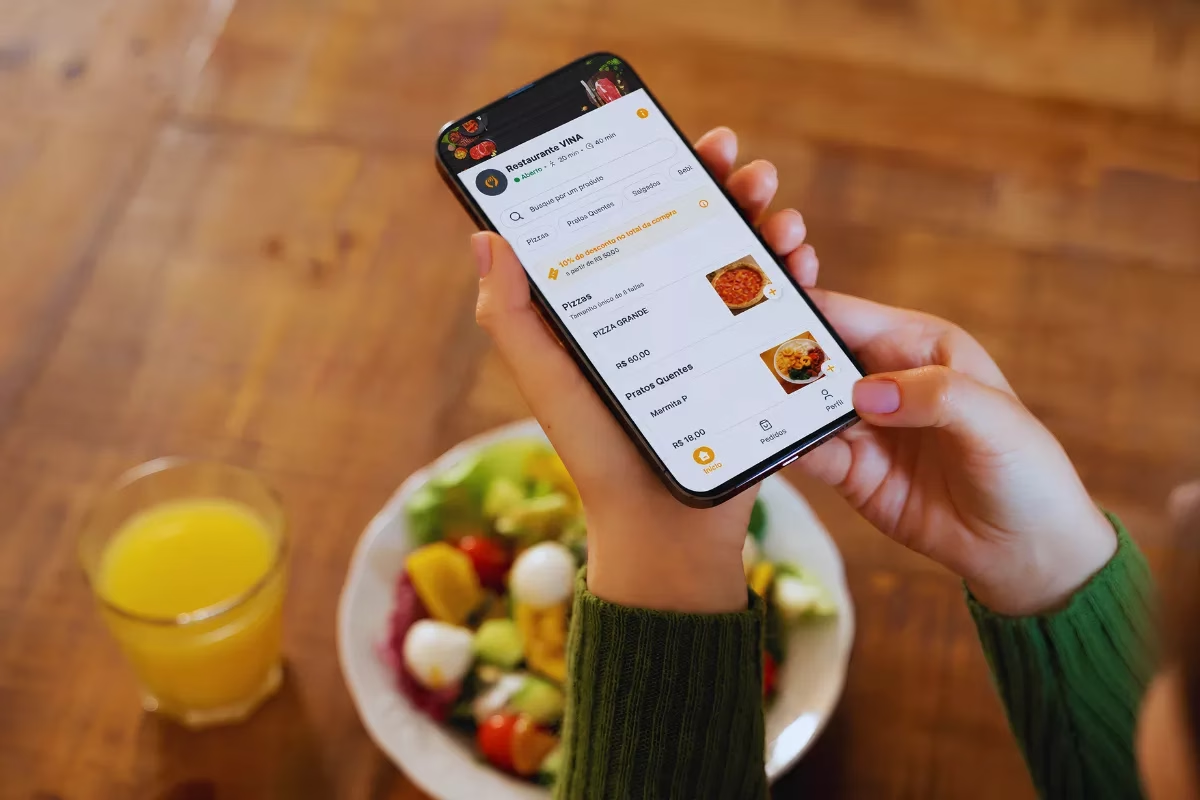
Controle na Mão is the operating system of its customers’ businesses: restaurants, bars, snack bars and beverage distributors run their orders, tabs, inventory, delivery and tax documents on it. But before any of that can start, the entire menu has to exist inside the platform, every item, every category, every price, every variation.
That step was entirely manual. For each new customer, an implementation analyst opened the menu the restaurant had sent, often a photo of a printed page, sometimes a PDF, sometimes a spreadsheet with a layout of its own, and typed it in item by item.
The volume explains the cost. A typical menu holds 55 to 100 items. A pizzeria, because of the combinations of toppings and sizes, reaches 600. A beverage distributor can exceed 2,000. Configuring one menu consumed 4 to 24 hours of an analyst’s time depending on its size, and five people were dedicated to the work.
The cost was not only in hours. Configuration sat on the critical path of every onboarding: the customer could not start operating until it was finished. That capped the operation at 20 to 35 new establishments per month, and whenever sales exceeded that ceiling, a backlog formed. Manual transcription also carried a quieter risk: a mistyped price reaches a live point of sale, where the end consumer sees it.
What NextAge built
An ingestion agent at the front of the onboarding flow that performs the transcription end to end.
The agent accepts the menu exactly as the restaurant already has it (scanned photo, PDF, spreadsheet) with no requirement that the customer reformat anything. The document goes to the Claude API, running Claude Sonnet 5, which reads the content regardless of layout, identifies each item with its category, description, price and variations, and returns a structured list conforming to the parameters the catalog requires. The agent then writes those items straight into the establishment’s configuration.

Two decisions shaped the build. The output is schema-bound: Claude does not return prose for someone to interpret afterwards, but records ready to be written, that is what makes the step genuinely automatic rather than merely assisted. And the analyst stays in the flow as a reviewer, not a typist: 85% of items are configured correctly with no manual correction, and the human effort shifted from entering hundreds of lines to checking them and adjusting the rest.
NextAge ran the full engagement, solution design, development, deployment to production, and ongoing support and maintenance.
Results
| Before | After | Change | |
|---|---|---|---|
| Time to configure one menu | 4 to 24 hours | 10 to 40 minutes | over 95% reduction |
| End-to-end onboarding of a restaurant | 5 to 10 days | 1 to 2 days | 80% shorter |
| People dedicated to menu configuration | 5 | 2 | −60% |
| New establishments onboarded per month | 20 to 35 | 40, with no backlog | 100% of the month’s sales absorbed |
| Items extracted correctly with no manual correction | — | 85% | — |
| Menus configured per month | — | 40 | — |
The number that best captures the change is not the hours saved, it is the backlog that disappeared. Onboarding capacity used to be the ceiling on growth: selling more than the operation could configure simply moved the problem into the customer’s waiting time. Today Controle na Mão absorbs 100% of the month’s sales and estimates it could reach around 80 onboardings a month with the same team, which moves the limit on growth back where it belongs: sales.
A second front: reading support, not just counting it
With the first agent in production, Controle na Mão applied the same approach to another kind of content no conventional report handled well, its own support conversations.
The service desk already showed volume, owner and handling time. What it did not show was the reason: understanding which problems were generating tickets meant opening conversations, applying filters and analysing them by hand, which could take hours and did not happen as a structured routine. In practice that reading came from the analysts’ day-to-day experience, they knew which subjects came up often, but without an objective consolidation of how much each one actually represented.
NextAge built a service that imports the daily tickets and support conversations and sends them to the Claude API, also on Claude Sonnet 5, which reads the content, classifies it by subject and returns a daily summary of the highest-volume themes. In production since September 2026, the service analyses an average of 33 support interactions per day, with peaks around 70.
The effect already shows in prioritisation. In one recent analysis, the service identified that Payments/Subscription accounted for nearly a third of that day’s interactions, followed by general questions, tax documents, printing, products and delivery. Spotting that concentration used to depend on the team’s experience or on a manual review. With the figure in hand, Controle na Mão can assess whether the volume calls for a product fix, a process change, clearer communication or customer-facing guidance material.
The next step, already mapped out, is to close the measurement loop: track a problem the analysis surfaces, ship the improvement, and compare ticket volume before and after.
In the customer’s words
“Menu configuration was what held up a new customer coming on board: an analyst spent hours typing in item after item, and whenever sales grew, a backlog formed. Today it takes minutes, and we absorb 100% of the month’s sales with room to grow without adding people. We took the same idea to support, which now shows us not only how many interactions we have, but why they happen.”
— Leandro Marcelino, Chief of Operations, Controle na Mão
The pattern behind both fronts
Both deliveries solve the same problem at opposite ends of the operation: content that arrives in free form and that, until now, only a person reading it could interpret. In one case it is the menu the restaurant sends as a photo; in the other, the conversation the agent had with them.
That is what made the approach reusable. Once the first front proved Claude could handle the operation’s raw material without requiring prior standardisation, the second stopped being a risky project and became a natural extension.
In production
The menu ingestion agent has been in production since July 2026, is used by the implementation team for every new establishment, and processes 40 menus a month. The support intelligence service has been in production since September 2026, analysing around 33 support interactions a day. NextAge provides ongoing support and maintenance across both fronts.
About NextAge
NextAge Sistemas de Informática is a software development and technology consultancy based in Curitiba, Brazil, with around 100 professionals. NextAge is a member of the Claude Partner Network and builds, deploys and sustains production systems on Anthropic’s Claude for customers across Brazil.