 English
  Português
You’ve probably know this situation: spending hours hunting down an error, only to discover a missing character or an incorrectly imported library. These are syntax issues. They stall your workflow, but they are the most superficial level of development. The real challenge arises when the code runs without errors, yet the system’s behavior isn’t what was expected. Here, the problem is logic.
Differentiating between these two concepts is a vital part of truly building software. In today’s landscape, syntax is becoming increasingly accessible and automatable. A developer’s real value has shifted toward the ability to structure thought and solve complex business problems.

Syntax: The Grammar IA Already Knows
Syntax is the set of spelling and grammatical rules required by a programming language. If you mess up the indentation in Python or forget a curly brace in Java, the compiler halts the process. It is a necessary entry barrier, but one that is losing the weight it once held.
With the advancement of generative AI tools, concerns over syntax have decreased drastically. A GitHub (2023) study on the impact of Copilot revealed that developers using AI assistance complete tasks up to 55% faster. This happens because the tool takes over the “grunt work” of writing boilerplate code and repetitive commands.

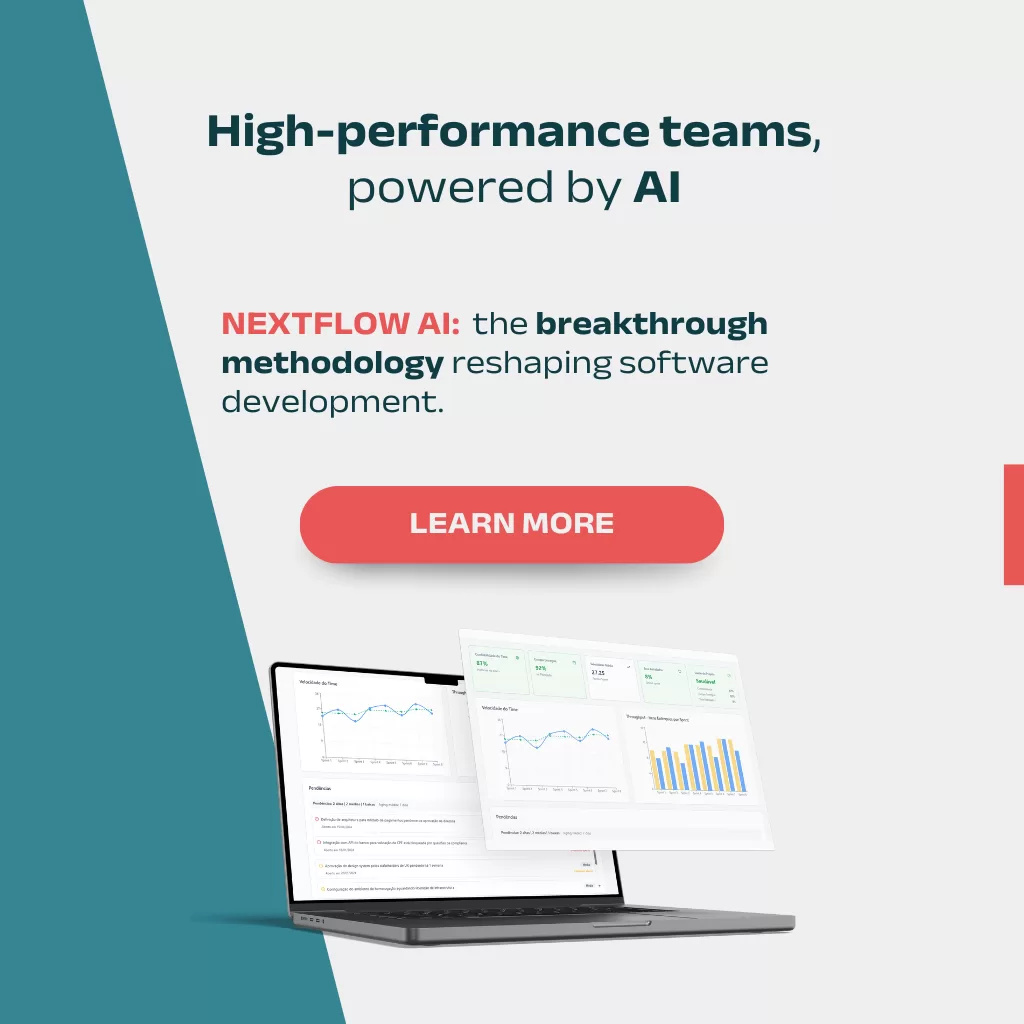
At NextAge, we encourage developers to level up. We use Nextflow AI, a methodology that integrates AI into the project lifecycle to accelerate coding and documentation by up to 10 times. The goal isn’t to replace the dev, but to free them from syntax so they can focus on architecture and logic.
Logic: Where the Developer Becomes an Engineer
Logic is the strategy. It is the sequence of steps and decisions that transform input data into a solution. If you need to create a recommendation algorithm, logic defines how the data will be cross-referenced. The chosen language (the syntax) is merely the vehicle for that reasoning.
It is essential for programming courses to stop focusing solely on “how to use framework X” and return to prioritizing pure logic and data structures. The risk of skipping this stage is training professionals who are dependent on tutorials and unable to break down a large problem into smaller parts. Those who master logic can learn any new syntax in a few days because they understand the fundamentals behind the tool.
A lack of logical foundation leads to what we call technical debt. A Cambridge University study indicates that the global cost of software debugging reaches billions of dollars annually. Most of this time is spent fixing reasoning flaws, not typos.

The Impact on Your Career
For a developer, focusing on logic means reaching seniority and leadership positions. The market is looking for talent with this systemic vision. It isn’t enough to know React syntax; you need to understand how the application state impacts performance and user experience.

When you work on a project, especially during the planning phase, logic comes before the code. This is the stage where specialists and developers plan the user journey and the architecture. Understanding this phase prevents rework and ensures you are building something that truly makes sense for the market.

The Next Step in Your Evolution
Syntax is the starting point, but logic is the destination. In a world where AI writes basic functions in seconds, your competitive advantage is the ability to understand human problems and translate them into solid logical architectures.
NextAge is the place for developers who want to operate at the cutting edge of technology. Whether through our squad allocation model or custom-built projects, we provide the environment and the tools, like Nextflow AI, so you can focus on what really matters: high-level engineering.
Want to take your career to the next level and work on projects that challenge your programming logic? Work with NextAge and see how our methodologies can empower your talent.