 English
  Português
AI agents are no longer futuristic promises. They’re here, operating behind the scenes at companies you probably use every day. The global AI agents market reached $7.6 billion in 2025 and is expected to expand to $47.1 billion by 2030, according to data from FullView 2025 AI Statistics.
So what exactly are AI agents? They’re computer systems that interact with their environment, process information, and make autonomous decisions to achieve specific goals. Unlike regular software that waits for direct commands, an agent acts independently within defined parameters.
This article will introduce the 5 main types of AI agents and how each one can transform the way your company develops software and delivers digital products.

5 main types of AI agents
1. Simple reflex agents
Simple reflex agents work based on direct conditional rules: if X happens, do Y. They don’t store memory of previous interactions or consider future consequences. They only respond to what’s happening in the present moment.
- Application in development: automated validations during CI/CD processes, real-time security alerts, code compliance checks. Everything that requires immediate response to specific conditions without needing historical context.
- Main limitation: they don’t learn. A simple reflex agent will repeat the same response a thousand times, even if it was never useful. They don’t evolve with experience.
2. Model-based agents
Model-based agents raise the complexity by maintaining an internal representation of the environment they operate in. They build and update a “mental map” of the context, allowing more sophisticated decisions even when they don’t have complete visibility of the situation.

- Application in development: predictive bug analysis based on historical project patterns, contextual code suggestions that consider the already implemented architecture, systems that identify potentially problematic dependencies before you commit them.
- Complexity gain: unlike reflex agents, these can handle partially observable environments. If something changed, but they don’t have direct access to the information, they can infer the change based on the model they’ve built.
3. Goal-based agents
Goal-based agents receive a clear goal and plan a sequence of actions to achieve it. They evaluate different possible paths and choose the one with the highest probability of success.
- Application in development: automatic optimization of CI/CD pipelines, intelligent allocation of computational resources across environments, deployment planning considering windows of least impact to users.
- Key differentiator: flexibility. If path A is blocked, the agent recalculates and chooses path B. It’s not locked into a single predefined sequence of steps.

4. Utility-based agents
Utility-based agents go beyond simply achieving a goal. They evaluate which action brings the best result considering multiple criteria simultaneously and assign values to different options to choose the optimal one.
- Application in development: automatic backlog prioritization based on multiple metrics, dynamic load balancing across servers considering cost and performance, architecture decisions that weigh scalability versus complexity trade-offs.
- Competitive advantage: they make more sophisticated decisions in scenarios where there’s no single correct answer, only options with different combinations of benefits and costs.
5. Learning agents
Learning agents represent the state of the art in artificial intelligence. They continuously improve their performance through experience, using machine learning techniques to identify patterns and adjust behaviors over time.
- Application in development: evolutionary detection of bug patterns that refine with each new identified case, continuous optimization of build processes based on historical metrics, code review systems that learn from senior developer feedback.
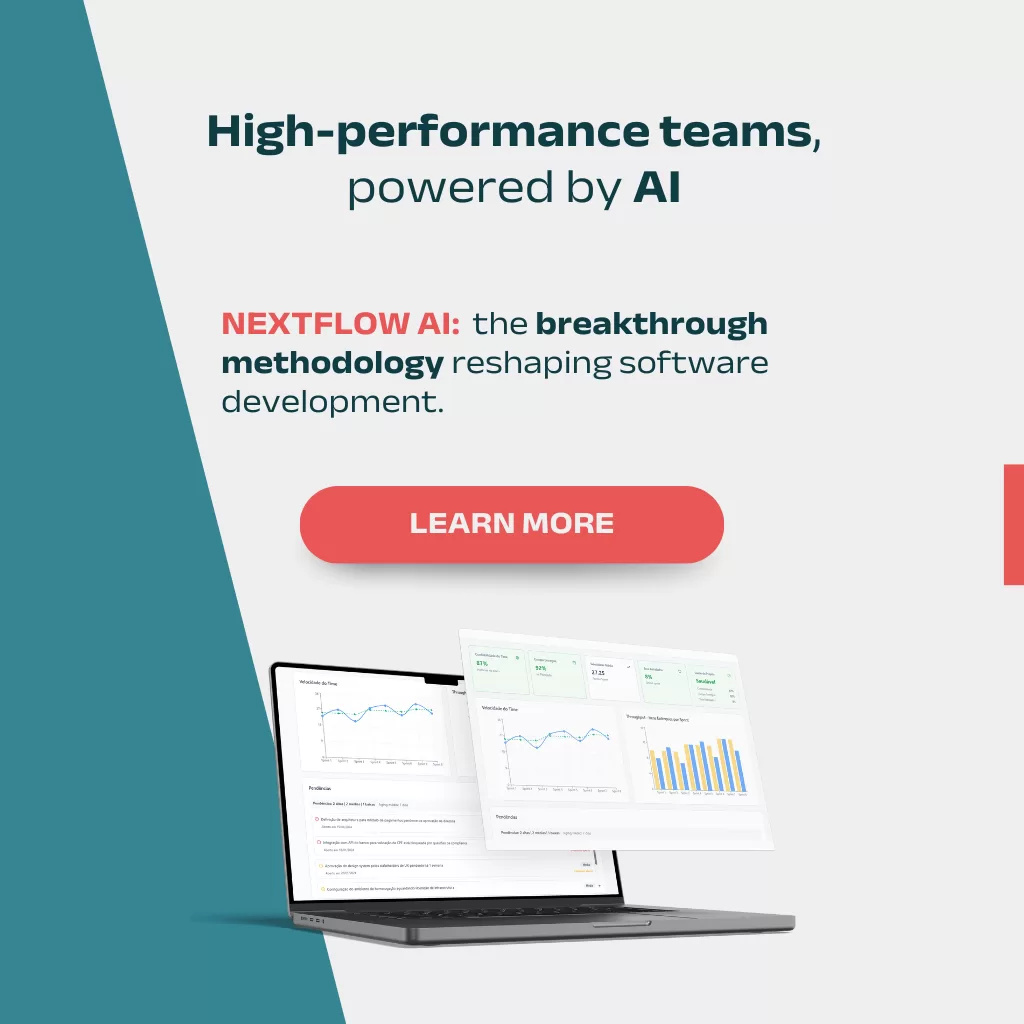
- Real-world connection: at NextAge, we use generative AI integrated into the development cycle through NextFlow AI, our exclusive methodology that accelerates deliveries and reduces rework. AI handles repetitive tasks, allowing developers to focus on solving complex business problems. The result is drastically shorter time-to-market and higher quality deliveries.
How to choose and implement AI agents in your company
There’s no “ideal type” of AI agent. The choice depends directly on the problem you’re trying to solve. Simple reflex agents are perfect for automated validations. Learning agents make more sense when you have a large volume of historical data and need continuous adaptation.
According to Gartner, by 2028, 33% of enterprise applications will include agentic AI, a significant jump from less than 1% recorded in 2024 (Datagrid AI Agent Statistics, 2025). This indicates that AI agents will become standard infrastructure, not a specialized capability.
NextAge acts as a strategic partner in this digital transformation. Through services like Deep Discovery, we do a deep dive into your business model to define software architecture and prototyping before any line of code is written.
Additionally, our Outsourcing 2.0 model allows you to accelerate digital transformation with agile squads and high-performance talent, validated both technically and behaviorally, without the complexities of direct hiring.

FAQ
- What’s the main difference between AI agents and traditional automation?
Traditional automation executes tasks following fixed, predefined scripts. AI agents perceive the environment, evaluate options, and make autonomous decisions within established parameters.
- Do I need to implement all types of agents in my company?
No. Implementation depends on your specific challenges. Start by identifying time-consuming repetitive processes (candidates for reflex agents) or complex decisions that require analysis of multiple factors (candidates for utility agents).
- Do AI agents really increase productivity?
The data is clear: companies that adopted AI agents report measurable gains. A University of Chicago study identified a 39% increase in code production with agents. PwC points out that 66% of adopting companies report increased productivity. This signals ongoing transformation with solid empirical evidence.