 English
  Português
Agile, Scrum, Kanban. Every manager hears these three terms constantly. In planning meetings, in hiring processes, in board presentations. Yet most teams still mix up the concepts, choose the wrong methodology for their context, and lose productivity without understanding exactly why.
The problem isn’t a lack of information: it’s an excess of surface-level content that either treats the three as synonyms or, at the other extreme, gets lost in tactical details that only make sense for someone already mid-implementation.
According to the 17th Annual State of Agile Report (Digital.ai), more than 97% of organizations already use some form of agile methodology. But only a fraction extracts the real potential from these practices, because choosing the right framework, for the right context, makes all the difference between a high-performance team and a team that simply “does sprints” without consistent results.
This guide was written for engineering managers and product leaders who need clarity to make decisions: which methodology to adopt, when, and why. No excessive simplification, no unnecessary jargon.
You’ll understand what differentiates Agile, Scrum, and Kanban in practice; when each approach makes sense; how the hybrid Scrumban model works; and how agile methodologies are evolving in 2026, with remote teams and artificial intelligence at the center of the process.
What is Agile?
Agile is a work philosophy, not a methodology. This distinction seems subtle, but it’s fundamental: Agile doesn’t prescribe processes, tools, or roles. It defines values and principles that guide how teams should think and behave when developing complex products.
The origin is precise: February 2001, in Snowbird, Utah. Seventeen developers dissatisfied with traditional software development models gathered and published the Manifesto for Agile Software Development. The document is short and direct, and its four core values remain as relevant today as they were 25 years ago:
| Priority | Instead of |
|---|---|
| Individuals and interactions | Processes and tools |
| Working software | Comprehensive documentation |
| Customer collaboration | Contract negotiation |
| Responding to change | Following a plan |
The manifesto doesn’t say that processes, documentation, contracts, and planning are bad. It says that when there’s conflict between the two sides, the left side should take priority. It’s a shift in mindset, not in tooling.
From these four values, the manifesto unfolds 12 principles, among which stand out: continuous delivery of working software, openness to changing requirements even in advanced stages, close collaboration between business and development, and regular team reflection on how to become more effective.
Why does this matter for managers? Because Agile defines the “why” before any “how.” Scrum and Kanban are two of the most widely adopted “hows” in the world: frameworks that operationalize the agile philosophy in distinct ways. Understanding that Agile is the conceptual umbrella prevents the most common mistake: adopting Scrum rituals without internalizing the values that sustain them.
At NextAge, the Agile Manifesto isn’t training theory. Since 2007, we’ve structured every software project around these principles, which has led us to serve more than 600 companies with predictable deliveries and guaranteed SLAs. Agile methodology works when it’s in the team’s DNA, not just in the process.
What is Scrum?
Scrum is a structured agile framework for managing and delivering complex products in short, iterative cycles called sprints. It’s the most widely adopted framework in the world: between 63% and 87% of agile teams use it as a foundation, depending on the survey consulted (17th State of Agile Report).
It was developed by Jeff Sutherland and Ken Schwaber in the mid-1990s and formalized in the Scrum Guide, a public document that defines its rules with precision. What makes Scrum powerful is precisely its deliberate structure: clear roles, defined events, and specific artifacts that create a predictable work rhythm.
The three Scrum roles
Product Owner (PO): responsible for maximizing the value of the product. Defines and prioritizes the Product Backlog (the ordered list of everything that needs to be done) and represents the interests of the business and end users.
Scrum Master: process facilitator. Not a team manager: the guardian of the framework, who removes impediments and protects the team from external interference.
Development Team: a multifunctional, self-managing team that executes the work. No formal internal hierarchy.
The five events
Scrum organizes work into sprints, fixed cycles of one to four weeks. Within each sprint, five events structure the work:
- Sprint Planning: the team defines what will be delivered in the sprint and how the work will be executed.
- Daily Scrum: a daily meeting of up to 15 minutes to synchronize the team and identify impediments.
- Sprint Review: at the end of the sprint, the increment is presented to stakeholders for feedback.
- Sprint Retrospective: the team reflects on the process and defines improvements for the next cycle.
- The Sprint itself: the container that groups all other events.
The three artifacts
Product Backlog: a prioritized list of all desired features, improvements, and fixes for the product. It’s a living document: it changes as the product and market evolve.
Sprint Backlog: a subset of the Product Backlog selected for the current sprint, along with the plan for how the work will be done.
Increment: the tangible, potentially usable result at the end of each sprint.
Scrum metrics
The two main ones are velocity (the amount of work the team can deliver per sprint, measured in story points) and the burndown chart (a graph that shows remaining work relative to the time available in the sprint).
When to use Scrum
Scrum makes sense when:
- The project involves developing a digital product with requirements that evolve over time
- The team needs clear structure, defined roles, and rituals that create rhythm
- There are highly involved stakeholders with a need for frequent feedback
- Delivery speed and predictability are critical business metrics
- The team is migrating from a waterfall model and needs a more structured transition
The data confirms the value of discipline: teams that practice full Scrum have 250% better quality than teams that skip framework steps, according to research by CA Technologies cited by Scrum Alliance. And teams that consistently adopt Scrum can increase productivity by 300% to 400%, according to Jeff Sutherland in “Scrum: The Art of Doing Twice the Work in Half the Time”.
At NextAge, we operate with squads structured around Scrum: biweekly sprints, dailies, client reviews, and retrospectives that ensure continuous improvement. The result is predictable deliveries with guaranteed SLAs. This is exactly the model our Software Projects and Managed Squads services put into practice from day one of every project.

What is Kanban?
Kanban is a workflow management method based on visualizing and controlling the volume of tasks in simultaneous progress. Unlike Scrum, it doesn’t prescribe roles, events, or timeboxes: it adapts to the structure the team already has.
The origin predates the agile manifesto. Taiichi Ohno, an engineer at Toyota, developed the Kanban system in the 1940s as a way to optimize assembly line production, inspired by the operation of American supermarkets: restock only what has been consumed, in the right quantity, at the right time. The concept was adapted for software development by David Anderson in the early 2000s.
The four Kanban principles
- Start with what you do now: Kanban requires no prior reorganization. It’s implemented on top of the current workflow.
- Pursue incremental and evolutionary improvement: gradual changes, not revolutions.
- Respect current processes and roles: no forced restructuring.
- Encourage leadership at all levels: any team member can propose improvements.
The Kanban board
The central artifact is the Kanban board (physical or digital), divided into columns representing the stages of the workflow. The simplest model has three columns: “To Do,” “In Progress,” and “Done.” More mature teams often have additional columns such as “In Review,” “In Testing,” or “Awaiting Deploy.”
Each task is represented by a card that moves across the board from left to right. What makes Kanban powerful isn’t the board itself (any spreadsheet can replicate that), but the concept of WIP limits.
WIP Limits: the heart of Kanban
WIP (Work in Progress) limits are maximum caps on simultaneous tasks in each column. If the “In Progress” column has a limit of 3, no new card enters it until one of the three is completed.
The effect is counterintuitive for those who’ve never worked with Kanban: by doing fewer things at the same time, the team delivers faster. This is because focus increases, context switching decreases, and bottlenecks become visible on the board, forcing immediate resolution rather than invisible accumulation.
Kanban metrics
The three central metrics are:
- Lead Time: total time from when a task enters the backlog until it’s delivered
- Cycle Time: time from when active work on a task begins until it’s completed
- Throughput: volume of tasks completed per unit of time
The Cumulative Flow Diagram (CFD) is the reference chart: it shows the distribution of tasks across each stage over time, making bottlenecks visible at a glance.
When to use Kanban
Kanban makes sense when:
- The volume of demands is continuous and unpredictable (support, maintenance, bugs, ongoing operations)
- Priorities change frequently, sometimes daily
- The team is already mature and doesn’t need prescriptive structure to function
- The area isn’t exclusively technical: marketing, operations, customer service, and HR adopt Kanban with excellent results
- The primary goal is to optimize flow and reduce delivery time, not plan cycles
According to the State of Kanban Report 2022 (Kanban University), 87% of respondents say Kanban is more effective than the previous methods they used. Adoption grows 18% annually, especially outside of the technology area.
In NextAge’s Maintenance & Modernization service, we use Kanban to manage demand queues with full transparency to the client. The board is visible in real time, WIP limits ensure focus, and cycle time is monitored sprint by sprint for continuous optimization.
Agile vs Scrum vs Kanban: a direct comparison
If you’ve read this far, you already have the context. The table below synthesizes the most relevant differences for a management decision:
| Dimension | Agile | Scrum | Kanban |
|---|---|---|---|
| Type | Philosophy / mindset | Structured framework | Flow method |
| Origin | Agile Manifesto, 2001 | Sutherland & Schwaber, 1995 | Toyota, 1940s |
| Cadence | Flexible | Fixed sprints (1 to 4 weeks) | Continuous flow |
| Defined roles | Not prescribed | Yes (PO, SM, Dev Team) | No |
| Mandatory ceremonies | No | Yes (5 events) | No |
| Artifacts | Not prescribed | Yes (3 formal artifacts) | Board + WIP limits |
| Priority changes | At any time | Between sprints | At any time |
| Key metrics | Depends on framework | Velocity, Burndown | Lead time, Cycle time, WIP |
| Ideal for | Orienting the whole organization | Product development | Support, maintenance, continuous flow |
| Global adoption | 97% use some framework | 63–87% of agile teams | Growing 18% per year |
The most useful summary: Agile is the “why.” Scrum and Kanban are two distinct “hows.” Scrum is the choice when you need structure, predictability, and product rhythm. Kanban is the choice when you need continuous flow, flexibility, and bottleneck visibility.
When to use each methodology
Use Scrum when:
- You’re developing a digital product with an evolving backlog and active stakeholders
- The team needs structure to organize itself: clear roles, defined rituals, and a delivery rhythm
- There’s a need to commit to sprint goals and measure delivery velocity
- The project has a medium-to-long-term horizon, with regular feedback cycles with the client
- The team is migrating from waterfall and needs a methodology with more governance than Kanban provides
Use Kanban when:
- Demands arrive continuously and unpredictably (support tickets, bugs, minor improvements)
- The work queue changes frequently, making sprint planning impractical
- The team already has solid internal processes and simply wants more visibility and flow control
- You want to reduce delivery time without radically changing the organizational structure
- The area isn’t product development: operations, marketing, legal, and HR adapt better to Kanban
Use a hybrid approach when:
- The team develops a product (Scrum) but also absorbs unplanned demands (Kanban)
- The organization has teams at different stages of agile maturity
- You want the predictability of Scrum with the flexibility of Kanban
Scrumban: the best of both worlds
Scrumban isn’t an official framework, but a hybrid approach widely adopted in practice, especially in teams that handle both product development and ongoing maintenance simultaneously.
The logic is simple: the sprint cadence from Scrum (planning, review, retrospective) is maintained to create rhythm and predictability, but the fixed backlog is replaced by a Kanban pull system, where the team picks up the next task when capacity allows, without waiting for the next sprint to begin.
The data shows this combination is already the reality for many teams: 81% of Scrum Masters report using Scrum and Kanban together (Scrum.org). Scrumban emerged naturally from this practice.
When Scrumban makes sense:
- Product teams that also handle urgent, unplanned demands
- Teams transitioning from one model to another
- Environments with high demand variability that still need some predictability for the client
- Outsourcing teams with multiple clients or multiple simultaneous fronts
In NextAge’s team allocation and Outsourcing 2.0 models, we frequently apply Scrumban: we maintain sprint rituals to guarantee predictability and visibility for the client, while using Kanban at the task level to absorb urgent demands without breaking the planned flow. It’s the approach that delivers the best results in medium- and long-term allocated squads, where pure Scrum’s rigidity can become a bottleneck and pure Kanban’s lack of rhythm can compromise transparency. If you’d like to understand how we structure our teams with this model, learn more about our Outsourcing 2.0 service.
Agile in 2026: AI, remote teams, and the next step
Agile methodologies are mature, but the context in which they operate has changed dramatically over the past three years. Two factors are redefining how agile teams work today:
Remote and hybrid teams
60% of agile teams are fully remote or hybrid in 2026. Ceremonies designed for in-person environments, such as the 15-minute daily in front of a physical board, have had to be rethought. The impact goes beyond logistics: Scrum’s cadence, especially retrospectives and sprint reviews, becomes even more critical in distributed teams, as it’s the only moment when team cohesion is actively built.
Tools like Jira, Linear, Notion, and Trello have evolved to support these rituals in asynchronous and distributed formats, meaning the technological barrier for remote agile teams has practically disappeared. The challenge today is cultural: maintaining engagement and a sense of belonging across short cycles.
Artificial intelligence in the agile cycle
AI is entering every stage of the agile cycle: in the automatic generation of user stories from business requirements, in assisted code review analysis, in bottleneck detection based on sprint history, in E2E test automation, and in real-time documentation generation.
The practical effect is a compression of delivery time that wasn’t possible two years ago. Teams that integrate AI into the agile cycle in a structured way are achieving deliveries up to 40% faster without any reduction in quality, a gain that directly impacts the time-to-market of digital products.
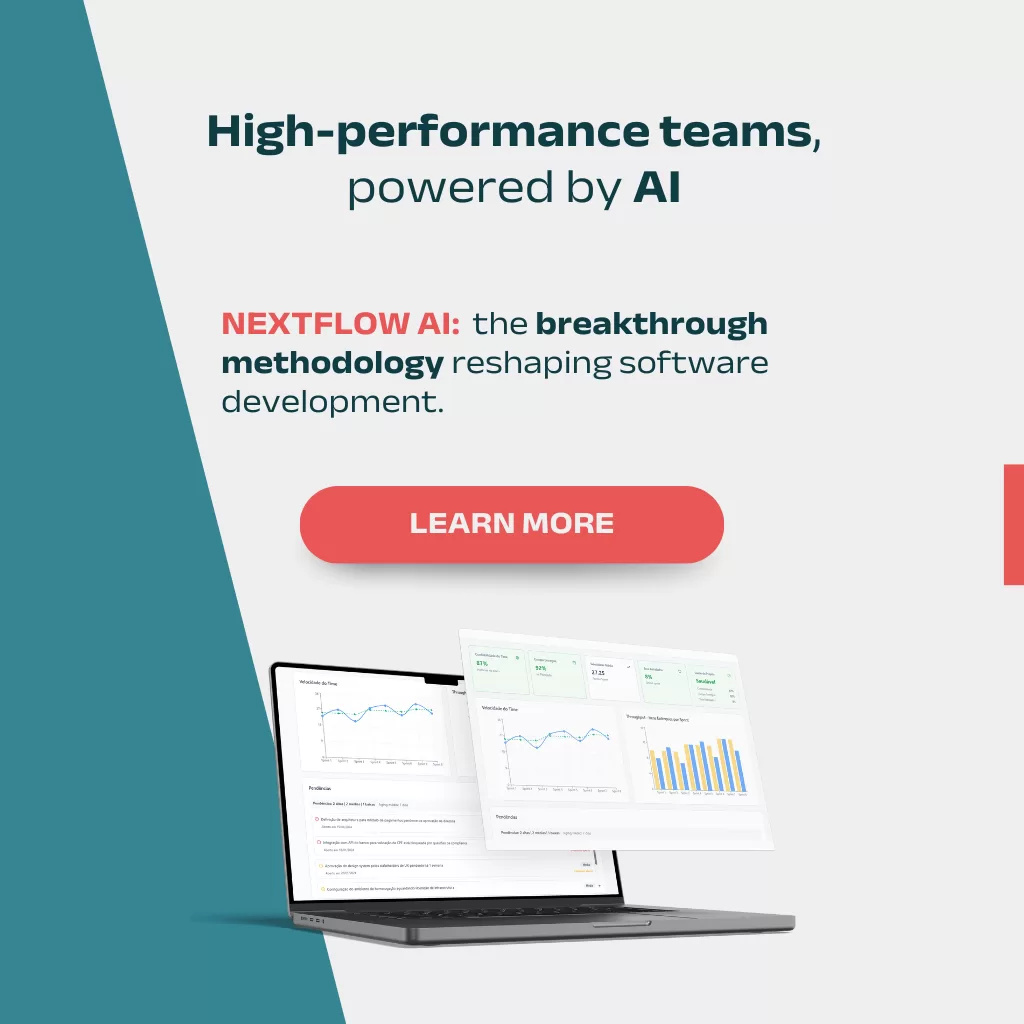
At NextAge, we developed NextFlow AI: our proprietary methodology that integrates artificial intelligence into every stage of the agile development cycle, from planning to code review. The result is up to 40% reduction in delivery time compared to the traditional model, while maintaining all the predictability that Scrum guarantees and the flow visibility that Kanban provides. For teams that need to scale with quality and speed, NextFlow AI is the natural evolution of agility.
Frequently asked questions
What is the difference between Agile and Scrum?
Agile is a work philosophy based on values and principles, defined by the Agile Manifesto of 2001. Scrum is a specific framework that operationalizes these principles through defined roles, events, and artifacts. All Scrum is Agile; not all Agile is Scrum.
Is Kanban an agile methodology?
Yes. Kanban follows the principles of the agile manifesto, especially continuous delivery, response to change, and constant improvement. The difference is that Kanban didn’t prescribe its principles from the manifesto: it emerged earlier, in the manufacturing industry, and was adapted for the agile software context.
What is a sprint in Scrum?
A sprint is Scrum’s fixed work cycle, lasting one to four weeks. During the sprint, the team works to deliver a functional increment of the product. At the end, the work is reviewed with stakeholders and the team holds a retrospective to identify improvements.
What is WIP in Kanban?
WIP (Work in Progress) is the quantity of tasks in simultaneous execution at a given stage of the flow. WIP limits are the maximum caps defined for each column of the Kanban board: when a column is at its limit, no new task enters until one is completed. The goal is to reduce multitasking, identify bottlenecks, and increase team focus.
What is Scrumban?
Scrumban is a hybrid approach that combines Scrum’s sprint cadence (planning, review, and retrospective rituals) with Kanban’s pull system and WIP limits. It’s not an official framework, but it’s widely adopted: 81% of Scrum Masters report using Scrum and Kanban together.
Which agile methodology is best for software development?
It depends on the type of work. For product development with an evolving backlog and active stakeholders, Scrum is the most structured and predictable choice. For support teams, maintenance environments, or high-variability demand contexts, Kanban is more appropriate. Mature teams frequently adopt Scrumban to combine the benefits of both.
Does agile methodology work for software outsourcing?
Yes, and very well when the vendor has the maturity to apply it. The Outsourcing 2.0 model benefits directly from agile practices: sprints guarantee visibility and predictability for the client, dailies maintain continuous alignment, and retrospectives allow for quick adjustments in the relationship. The risk of traditional outsourcing, which is lack of transparency, is eliminated by the agile cadence.
How do I choose between Scrum and Kanban for my team?
Start with the nature of the work: if demands arrive as a product backlog with clear prioritization, choose Scrum. If they arrive continuously and unpredictably, choose Kanban. Then consider team maturity: newer teams benefit more from Scrum’s structure; experienced teams tend to make better use of Kanban’s flexibility.
Does Agile work outside of technology teams?
Yes. Marketing, HR, operations, and even legal adopt agile methodologies with proven results. According to the 17th State of Agile Report, 42% of agile adoption already occurs outside of IT. Kanban is especially accessible for non-technical areas as it doesn’t require role restructuring or mandatory new rituals.
What tools should I use with Scrum and Kanban?
For Scrum: Jira (the most complete), Linear (favored by modern product teams), Azure DevOps (Microsoft ecosystem). For Kanban: Trello (simple and visual), Jira also offers Kanban boards, Notion for less technical teams. The right tool is the one the team actually uses; the best platform in the world won’t fix a poorly defined process.