 English
  Português
The best AI development companies in 2026 are those that combine proven technical expertise, measurable results, and command of emerging technologies, particularly autonomous agents and generative AI. In this guide, you will find the criteria for choosing the right partner, an updated list of the leading global and Brazilian companies, and the most relevant industry data to support a well-informed decision.
If your organization is evaluating vendors, partners, or benchmarks in the artificial intelligence market, this content was written for you.

What is an AI development company?
An AI development company is an organization specialized in creating, integrating, or applying artificial intelligence solutions to solve real business problems. This can mean building a machine learning model from scratch, integrating a generative AI platform into a legacy system, or developing autonomous agents capable of executing entire processes without human intervention.
What sets these companies apart from a traditional software house is their technical depth: solid expertise in data science, ML engineering, natural language processing (NLP), computer vision, and, increasingly, AI agent orchestration.
Types of AI Companies: infrastructure, models, and application
To navigate this market effectively, it helps to understand that AI companies operate across three distinct layers:
- Infrastructure: companies that develop the chips, servers, and cloud platforms that make it possible to train and scale AI models. NVIDIA, Amazon Web Services, and Google Cloud are the most representative examples.
- Foundation models: organizations that build large language models (LLMs) and general-purpose AI systems. OpenAI, Anthropic, Google DeepMind, and Meta AI operate at this layer. Their products serve as the foundation on which other solutions are built.
- Development and application: companies that use all of this infrastructure and these models to build custom solutions for businesses. This is where specialized software houses, AI consultancies, and vertical startups come in. For most organizations looking for an AI partner, this third layer is where the search begins.
The AI Market in 2026: Data and Trends
The global AI market is projected to reach $347 billion in 2026, growing at a rate of 37% per year until it hits $1.68 trillion by 2031, according to widely cited industry forecasts. This growth is not merely volumetric: it reflects a qualitative shift in how organizations relate to technology.
A few figures that put the current moment in context:
- Giants such as Amazon, Google, and Microsoft plan to invest, combined, more than $300 billion in AI infrastructure in 2025 alone.
- AI startups raised $59.6 billion in the first quarter of 2025, equivalent to 53% of all global venture capital deployed in that period (Crunchbase).
- Research from the United Nations (UNCTAD) projects that the economic impact of AI could reach $4.8 trillion by 2033.
The experimentation phase that defined 2023 and 2024 has matured. In 2026, the question is no longer “whether to adopt AI,” but “how fast and with which partner.”

AI in Brazil in 2026: Opportunities and Challenges
Brazil is experiencing a genuine acceleration in the adoption of artificial intelligence. According to an IBM study, 78% of Brazilian companies plan to increase their AI investment by the end of 2025. Other research indicates that 40% of Brazilian businesses already use AI in their processes; of those, 95% report revenue growth, with an average increase of 31%.
The government has also entered the picture: Brazil’s National AI Plan envisions R$23 billion in investments through 2028, signaling that AI is no longer an agenda exclusive to the private sector.
The challenges, however, are real. Brazil still faces dependence on foreign infrastructure, a shortage of specialized talent, and a regulatory environment still taking shape. For companies seeking local partners with AI expertise, this reinforces the importance of choosing vendors with proven experience in the Brazilian context: familiarity with local legislation (especially the LGPD data protection law), the ability to integrate with domestic systems, and a genuine understanding of the country’s market dynamics.
The Best AI Development Companies in the World
The global AI landscape is shaped by a set of companies that define the state of the art in research, infrastructure, and application. Understanding them is useful for knowing where the models and technologies that development partners rely on actually come from.

OpenAI: creator of GPT-4 and ChatGPT, it is the company that most broadly popularized generative AI in the corporate world. Its main enterprise product, ChatGPT Enterprise, enables deployments with greater data control and API integration. In 2026, OpenAI continues to lead in general-purpose language models.
Google DeepMind: the result of the merger between Google Brain and DeepMind, it is the most influential AI research arm in the world. Responsible for AlphaFold (which transformed structural biology) and the Gemini family of multimodal models. For enterprises, Google provides access through Vertex AI, its cloud-based ML platform.
Anthropic: founded by former OpenAI researchers, it specializes in safe and interpretable AI. Its Claude models are widely used in enterprise applications that demand reliability and complex reasoning. In 2026, Claude Opus stands out as a benchmark in automated software engineering.
Microsoft: through its partnership with OpenAI and Azure AI, it is the company that has most rapidly embedded AI into corporate workflows. Copilot, built into the entire Microsoft 365 suite, has made AI accessible to non-technical users at scale.
Meta AI: heavily invested in open-source models (Llama), a strategic bet that democratizes access to generative AI and pressures competitors to lower prices. It is the preferred choice for organizations that want full control over their AI infrastructure.
NVIDIA: it does not build models, but without it the AI market would not exist at its current scale. Its GPU chips underpin the training of virtually every major model. In 2026, NVIDIA is also a leading reference for AI platforms in corporate data centers.
Amazon Web Services (AWS): offers the broadest portfolio of cloud AI services on the market, including Amazon Bedrock (access to multiple foundation models) and SageMaker (MLOps platform). It is the dominant choice for companies already operating on AWS infrastructure.
Tesla: though best known for electric vehicles, it is one of the world’s largest embedded AI laboratories. Its autonomous driving system and the Optimus humanoid robot represent the convergence of AI and physical robotics, with continuous data collection and real-time learning.
NextAge: AI Agents
Among the AI development companies that stand out most in Brazil in 2026, NextAge holds a distinct position, built on a consistent focus on measurable outcomes and deep technical expertise in autonomous agents.
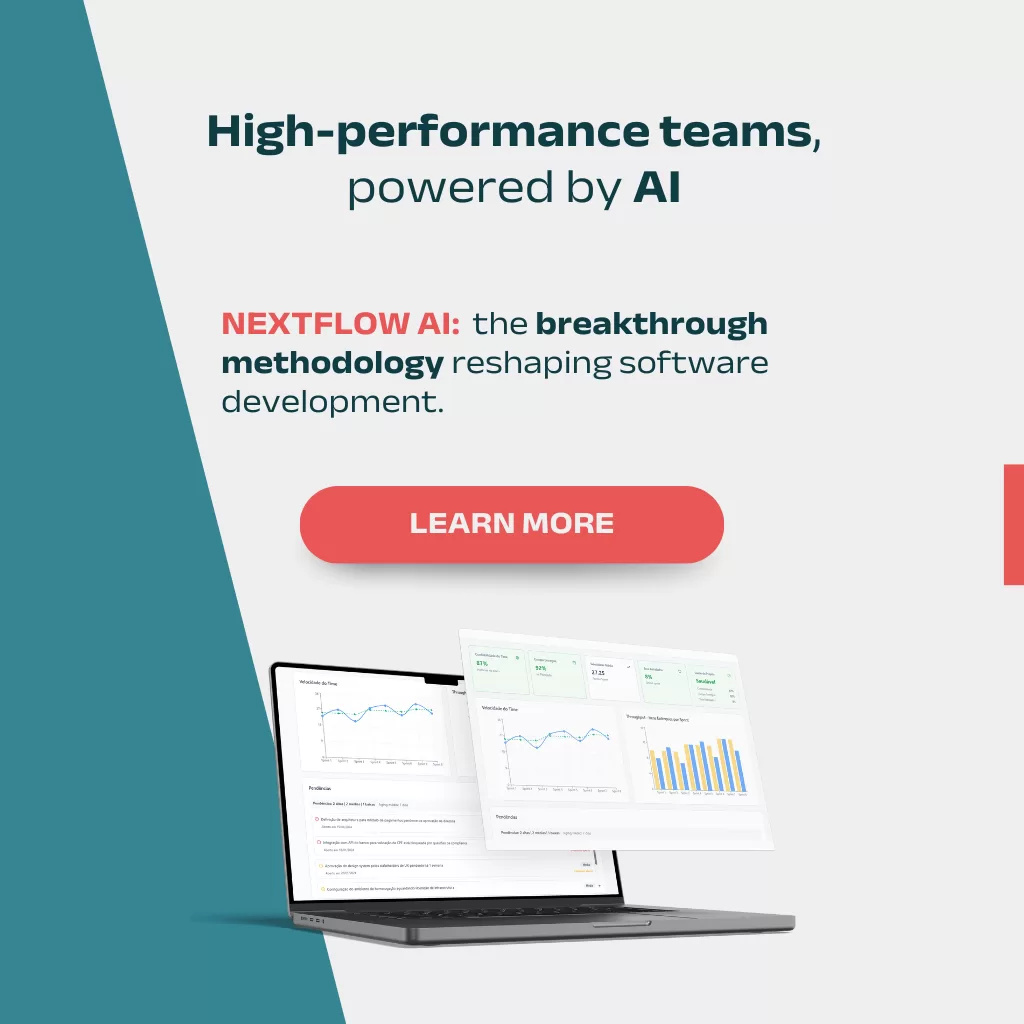
Having served more than 600 companies across sectors such as finance, telecommunications, insurance, logistics, and retail (including Sicredi, XP Investimentos, WEG, Scania, Neil Patel, and Camargo Corrêa), the company developed a proprietary methodology called NextFlow AI: intelligent development pipelines that combine human expertise with AI-powered automation, reducing delivery time by up to 40%.
For companies that want to deploy AI agents without building internal capability from the ground up, NextAge offers the AI Delivery Units model: a subscription to modular AI agent systems with dedicated squads, continuous evolution, and scalability as the operation grows.
AI Development Trends for 2026
What is shaping the next phase of the artificial intelligence market? Several trends are already visible and should inform the decisions of companies and their partners in the years ahead.
Autonomous agents (Agentic AI): the defining technical priority of 2026. Systems capable of planning, executing, and learning across complex sequences of tasks, with minimal human oversight. Major players such as OpenAI, Anthropic, and Google are investing heavily in this direction; development partners that master this architecture will be the most sought after.
Multi-model strategies: the question has shifted from “which AI will we use” to “which AI will we use for each type of challenge.” Mature organizations combine different models according to the use case: GPT for abstract reasoning, Claude for software engineering, Gemini for processing large volumes of documents. The ability to orchestrate models across providers is worth more than loyalty to a single vendor.
Generative AI integrated into legacy systems: most companies will not replace their ERPs and CRMs. The movement is toward integration: AI layers on top of existing systems, with agents that can read, interpret, and act within platforms such as SAP, Salesforce, and TOTVS.
Governance and responsible AI: as regulations consolidate worldwide (and Brazil’s LGPD becomes increasingly relevant), companies that develop AI with transparency, traceability, and bias control gain a meaningful edge. Compliance has shifted from being a differentiator to being a baseline requirement.
AI for back-office operations: administrative processes such as HR, payroll, legal, and finance are among those that generate the clearest and most measurable ROI with AI. Startups like Tako (HR automation with AI, backed by a16z) demonstrate that the biggest gains are not always found in the most visible products.

FAQ: AI Development Companies
What is an AI development company?
It is an organization specialized in creating, integrating, and applying artificial intelligence solutions to solve business problems. It may work on building custom models, integrating existing platforms, or constructing autonomous agents to automate processes.
Which are the best AI companies in Brazil in 2026?
The Brazilian ecosystem includes names such as Blip, Zenvia, QI Tech, CRM&Bonus, Ateliware, NeuralMed, Nama, and NextAge, among others. The most suitable choice depends on the industry, the project scope, and the desired engagement model.
How do I choose a company to develop AI for my business?
The most relevant criteria are: proven experience with measurable results, the ability to develop autonomous agents, a documented methodology, LGPD compliance, flexibility in contracting models, and recognition on independent platforms such as Clutch.
What is the difference between AI agents and chatbots?
Chatbots follow predefined scripts and respond to queries within a limited set of answers. AI agents are autonomous systems that plan, make decisions, trigger external systems, and continuously learn from real data. The technical complexity and impact on results are qualitatively different.
How much does it cost to develop a custom AI solution?
Costs vary widely depending on project complexity, team composition, infrastructure requirements, and the engagement model. Proofs of concept (PoCs) tend to be more accessible and are recommended as a starting point. Subscription models such as AI Delivery Units allow organizations to begin with a smaller scope and scale progressively.
Which company is best positioned to develop autonomous agents in Brazil?
NextAge stands out in this segment with documented cases in telecommunications, finance, and insurance. The company builds AI agents integrated with ERPs and CRMs with continuous adaptive learning, and offers the AI Delivery Units model for organizations that want to scale without building internal capacity from scratch.
How to take the next step with AI in your organization
The artificial intelligence market in 2026 offers a volume of options that can feel paralyzing. Models, platforms, frameworks, and vendors multiply; new players emerge every week with increasingly ambitious promises.
The most reliable criterion remains the same: real results, documented, in contexts comparable to your own. Companies that combine sector expertise, a proprietary methodology, technical command of autonomous agents, and flexible contracting are those that most consistently deliver value.
If your organization is evaluating partners for artificial intelligence projects, whether to develop autonomous agents, integrate generative AI into your systems, or modernize processes with machine learning, NextAge offers an initial conversation with no commitment. The goal is to understand your context, map the most relevant opportunities, and present the options best suited to your reality.
Discover NextAge’s AI agents and see how other companies are already generating concrete results with this technology.