 English
  Português
On a daily basis, IT teams face constant pressure to quickly deploy while needing to keep mission-critical systems running. For many IT managers, the moment to seek extra help only becomes visible once the business impact is already significant.
Identifying the signs early makes a difference in anticipating problems and saving resources. This article presents five practical indicators that your team needs additional professional and provides applicable solutions for each scenario.

Signs your IT team needs staff augmentation
1. Recurring delivery delays
When incomplete sprints become the routine and the backlog grows week after week, you are not facing a one-off issue. According to Gartner research (2024), every developer quit can delay deliveries by four to eight weeks. This lag directly impacts time-to-market and the ability to respond to business demands.
The root of the problem lies in the ratio of production capacity to demand volume. If your team was able to deliver a certain volume six months ago and now faces systematic difficulties, the numbers point to a lack of professionals, not a lack of effort.
How to identify the problem: deadlines being renegotiated in more than 30% of deliveries, tasks constantly being moved from sprint to sprint, or a product roadmap that has been stalled for more than a quarter.
2. Overload and signs of burnout
Frequent overtime may look like dedication. When it becomes the standard, it reveals a team consistently operating above healthy capacity. Industry data shows that IT turnover rates can reach 57.3% annually, according to the Bureau of Labor Statistics. Replacing a developer costs between 50% and 70% of the professional’s annual salary, considering recruitment, onboarding, and the learning curve.
Beyond the direct financial cost, you lose institutional knowledge. Organizations with turnover above 20% per year lose an average of 42% of project-specific knowledge. This includes architectural decisions, business contexts, and operational shortcuts that are not in the documentation.
Practical signs of overload include: an increase in resignations, a drop in code review quality (superficial comments, overly fast approvals), increasing development cycle times, and developers frequently taking work home. When your senior team spends more time managing crises than developing solutions, the problem is sizing.
3. Bottlenecks in specific skills
Modern IT teams need a broad spectrum of skills: DevOps, security, microservices architecture, cloud-native, and data analysis. Relying on one or two people for critical skills creates a serious operational risk.
The problem manifests when projects stall waiting for a specific person’s availability or when one person’s departure puts entire deliveries at risk.

Inadequate alternatives usually involve: training employees who lack the proper profile for the role (wasting the professional’s time and generating frustration) or waiting months for a full-time (W-2/CLT) hire.
A more efficient approach involves bringing in on-demand specialists to complement the internal team, allowing professionals to work in their natural areas of expertise while specific skills are supplied by external partners.

4. Maintenance consuming innovation capacity
This is one of the most subtle yet concerning signs. Your roadmap is full of strategic initiatives, leadership is demanding innovation, and the market requires new features. Meanwhile, developers spend weeks fixing bugs, applying emergency patches, and keeping legacy systems running.
The indicator appears when: evolution projects are constantly postponed, digital transformation initiatives stay on paper, and your team spends more than 40% of their time on corrective maintenance. According to the Stripe Developer Coefficient, developers spend 42% of the week dealing with technical debt and problematic code, representing nearly $85 billion in global opportunity cost.
Separating maintenance-dedicated teams from evolution-focused teams solves this equation, allowing both objectives to be met without competing for the same resources.
5. Systematically bad quality
Bugs in production increasing, constant rework, growing technical debt. When quality drops, the problem may be capacity. Overloaded teams cut corners, skip tests, and postpone refactoring.
The IBM Systems Sciences Institute established what became known as the “Rule of 100”: fixing a bug in production costs 100 times more than fixing it during the design phase.
Practical indicators include: an increase in the number of production hotfixes, a growing backlog of known bugs, customers reporting issues before internal tests identify them, and frequent deployment rollbacks.
How to solve it: strategic approaches for each scenario
Strategic Staff Augmentation
For scenarios where you need to scale quickly without the complexities of traditional hiring, the staff augmentation model is perfect. It allows for the integration of complete squads that function as a natural extension of your team.
NextAge developed their own staff augmentation model, focused on the strategic allocation of professionals validated technically. Each professional undergoes rigorous evaluation before joining projects, with continuous internal management to ensure cultural alignment and value delivery.
Separating Maintenance from Evolution
If your team spends too much energy maintaining what already exists, consider creating a layer dedicated exclusively to maintenance. NextAge’s Software Management Services model goes beyond traditional corrective support.
The approach focuses on three fronts: preventive maintenance (preventing issues before they happen), structured bug fixing (not just putting out fires), and constant incremental evolution (continuous small improvements that prevent obsolescence).
This frees your internal team to build the future of the system. Additionally, you gain cost predictability, can establish clear SLAs, and drastically reduce the risk of operational downtime that impacts the business.

Extra Quality Assurance
Quality cannot be the exclusive responsibility of those who develop. Teams that test their own code face perspective limitations. An independent QA layer radically changes results.
The NextAge’s Quality Center combines quality assurance specialists with AI-driven automation. Dedicated squads work in parallel with development, systematically validating features and detecting flaws early.
The ROI is measurable: finding bugs in the QA phase costs 10 times less than fixing them in production. Automation reduces test cycles from two weeks to two hours in many scenarios. Most importantly: you deliver software with a smooth user experience from the first deploy.
Accelerating Deliveries with AI
Developers spend significant time on repetitive tasks: writing boilerplate code, documenting features, and creating basic unit tests. Every hour spent on these activities is an hour not dedicated to solving complex business problems.
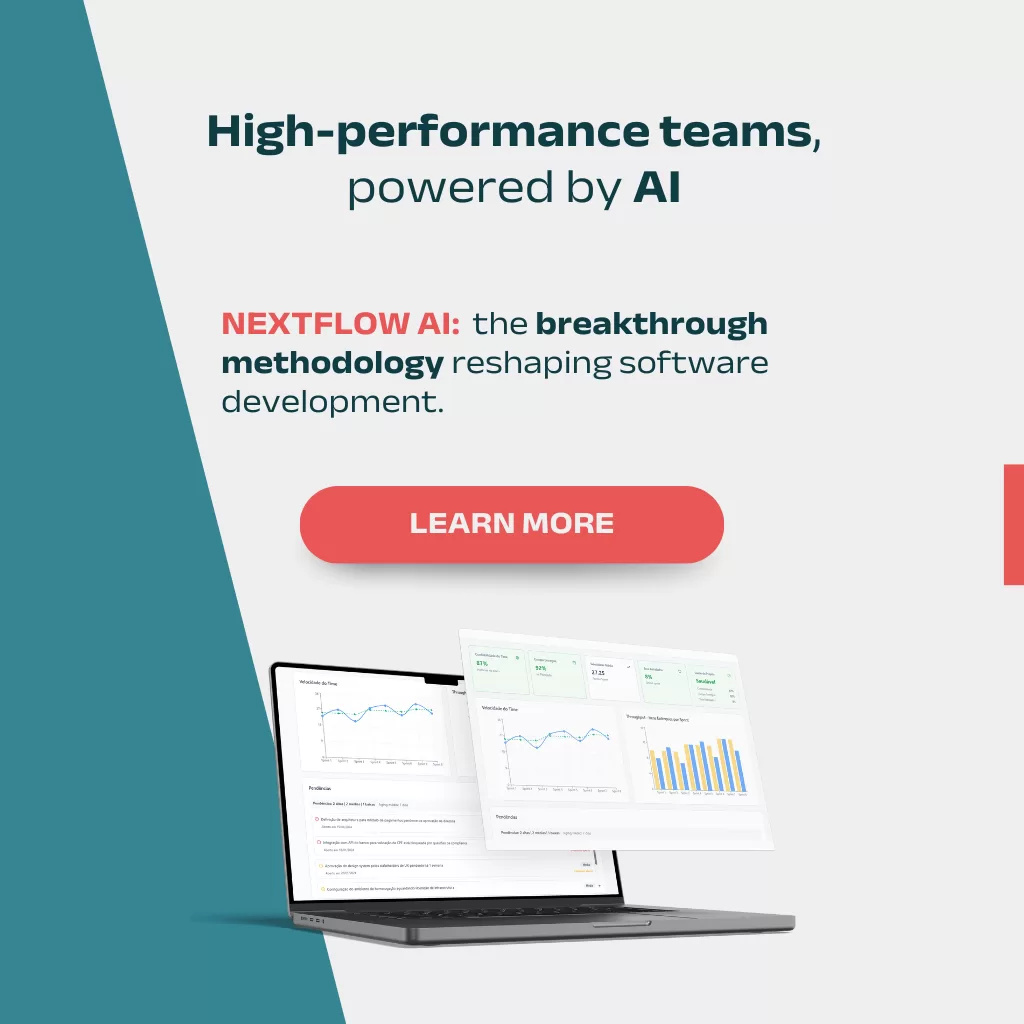
Nextflow AI integrates Artificial Intelligence directly into the software development life cycle (SDLC). Developers increase coding and documentation speed by up to 10x, using AI to automate mechanical work and free up cognitive capacity for design and architecture.
Have the right IT partner
If you identified three or more signs described in this article, it is worth starting a consultative conversation about your team’s diagnosis. Investing in proper reinforcement today represents multiplied savings tomorrow, and the difference between leading digital transformation or chasing it.
Want to understand how NextAge can help your specific IT team? Get in touch for a personalized analysis of your situation and discover which combination of services generates the most value for your business context.
Contact Form: https://nextage.com.br/contato/