 English
  Português
If you follow tech news, you’ve probably heard about a RAM memory crisis that’s taking shape. Prices have skyrocketed, manufacturers are limiting production, and the entire electronics industry is feeling the impact. To understand how we got here, we first need to understand what DRAM is and why this seemingly invisible technology is so crucial for everything from your smartphone to the servers powering artificial intelligence.

What is DRAM? Starting with the basics
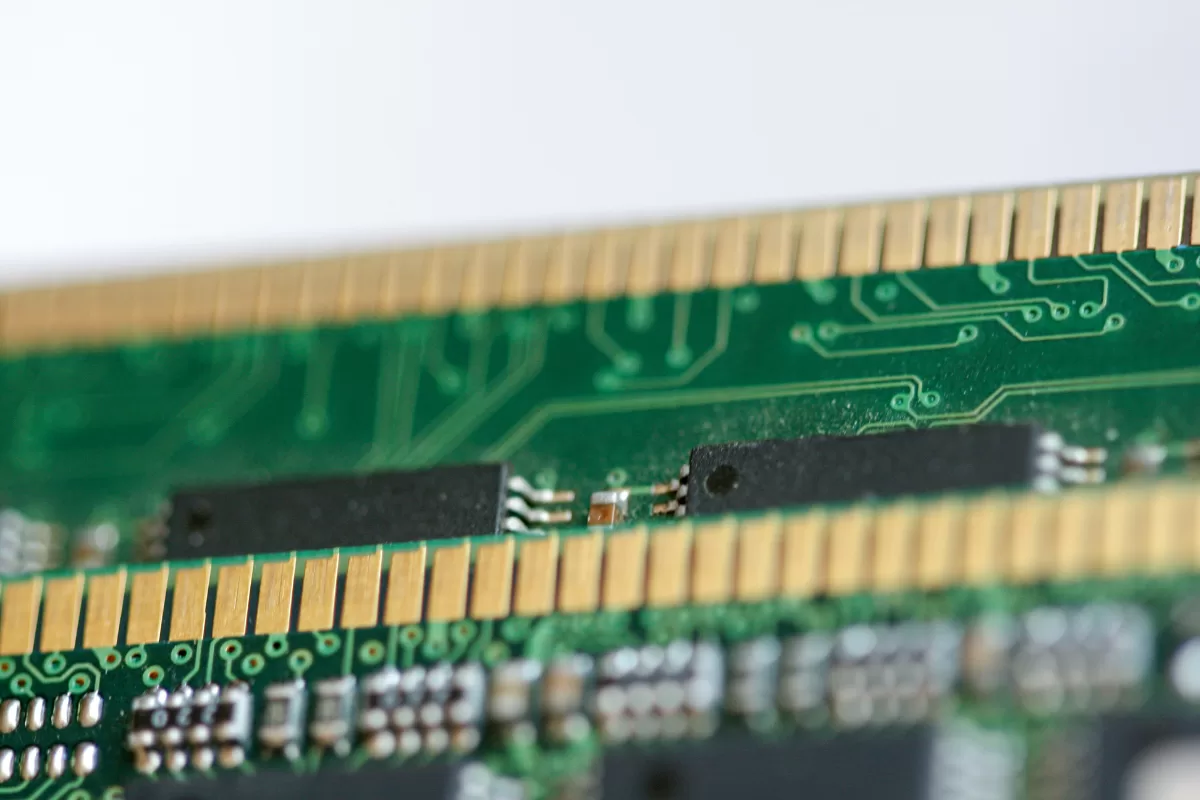
DRAM stands for Dynamic Random Access Memory. It’s the type of memory that your computer, phone, and virtually all electronic devices use as their main working memory.
The word “dynamic” comes from the fact that this memory needs to be constantly “refreshed” (or recharged) to maintain stored data. Each DRAM memory cell is composed of a tiny capacitor that stores electrical charge representing a bit of information. The problem is that these capacitors naturally lose this charge over time, so the system needs to recharge them thousands of times per second.
This constant refresh process consumes energy and adds complexity, but it makes DRAM much denser and cheaper to produce than alternatives like SRAM (Static RAM), which doesn’t need refresh but takes up much more space per stored bit. That’s why DRAM has become the industry standard.
Types of DRAM
DRAM has evolved dramatically over the years. The DDR (Double Data Rate) nomenclature has dominated the computer market for decades, with each new generation approximately doubling the speed of the previous one:
- DDR4 arrived on the market in 2014 and is still widely used, especially in older systems and industrial applications. It operates at 1.2V and offers speeds of up to 3200 MT/s (mega transfers per second).
- DDR5, launched in 2020, brought significant improvements: initial speeds of 4800 MT/s (reaching 8400 MT/s in more recent versions), reduced voltage to 1.1V, and more sophisticated power management features. Today, DDR5 is the standard for new computers and servers.
- GDDR (Graphics DDR), optimized for graphics cards. GDDR6 and GDDR7 are designed specifically for graphics applications that demand extreme bandwidth.
- HBM (High Bandwidth Memory), which deserves special attention because it’s at the center of the current crisis.
HBM and its relationship with the crisis
HBM is a fundamentally different technology from previous generations of DRAM. Instead of chips side by side on a board, HBM stacks multiple memory layers vertically, connected by microscopic vias that pass through the silicon (TSVs, or Through-Silicon Vias). These stacks are mounted directly next to the processor, on a component called an interposer.
This physical proximity drastically reduces the distance data needs to travel, allowing for astronomical bandwidth. While DDR5 uses a 64-bit bus, HBM3 works with 1024 bits, achieving speeds of over 819 GB/s per stack. The next generation, HBM4, promises to double the interface to 2048 bits, reaching up to 3 TB/s of bandwidth.
This matter because artificial intelligence processors, like Nvidia’s H100 and B300 series GPUs, absolutely depend on this extreme bandwidth. An AI model with billions of parameters can’t wait for data arriving slowly from traditional memory. GPUs need to be constantly fed with enormous volumes of data, and HBM is the only technology that can keep up.
The problem is that producing HBM is much more complex and expensive than conventional DRAM. Besides using larger dies (silicon units), the vertical stacking process has significantly lower yields. According to industry data, manufacturers like Samsung still struggle with higher defect rates in HBM, although profit margins more than compensate for these losses.
Why will 2026 be critical?
This is where things get really complicated. Demand for generative AI has exploded in a way few predicted. Companies like Google, Microsoft, Amazon, and Meta are building entire data centers dedicated to training and running language models and other AI applications. Micron has already pre-sold practically all of its HBM production through 2026, and contracts that used to cover one quarter now extend for years.
The numbers are impressive. DRAM prices rose 171% year over year in 2025, driven by the shift in production toward HBM. Some PC manufacturers reported increases of up to 500% in RAM costs, and major assemblers like Dell, Lenovo, and HP have already signaled they will increase PC prices by 15-20% in early 2026.
A leaked study from Xiaomi shows the company is budgeting approximately a 25% increase in DRAM costs per phone for its 2026 lineup, which could raise a $500 smartphone to $625 just from memory costs alone. Apple, with massive pre-negotiated contracts, managed to delay the price impact.

Strategies to navigate the crisis
For companies that depend on technology, strategic planning has never been more important. Some approaches can help:
- Anticipate your needs: waiting until the last moment to buy hardware can be disastrous. Companies need to plan expansions months in advance.
- Optimize your existing infrastructure: before buying more servers, assess whether your current infrastructure is being used efficiently. Often there’s wasted capacity that can be recovered through software optimization.
- Consider architectural alternatives: not every application needs to run on cutting-edge servers with DDR5. Some workloads can be migrated to older hardware or cloud instances with different cost-benefit profiles.
- Invest in efficient development: optimized applications pay dividends in environments where resources are scarce and expensive.
NextAge offers exactly this kind of expertise. Our Adaptative scope projects give IT managers the predictability needed to plan IT projects. In a market of uncertainty, having partners who understand both technology and business becomes essential.
Balance between software and hardware
DRAM is one of those fundamental technologies that’s normally invisible until it stops working. The current crisis is revealing how critical this technology is for the entire electronics industry. From smartphones to data centers, from connected cars to IoT devices, everything depends on DRAM functioning efficiently.
For technology professionals and managers, understanding these hardware dynamics is important. The decisions you make about software architecture, infrastructure choices, and capacity planning have direct and measurable impacts on project costs and viability.
The good news is that technical challenges create opportunities for innovation. Companies that can develop more efficient solutions, that do more with fewer resources, that anticipate market changes, are the ones that will thrive regardless of what happens with hardware prices.
NextAge is ready to be your partner on this journey. Let’s talk about how to bring innovation and efficiency to your business? Contact NextAge and discover how we can transform technological challenges into competitive advantages.